Learning Journey
Watch this topic in 60 seconds
Free preview · Lesson 1
Understanding Series (number/alphabet) (Logical Reasoning)
Decoding the Secret Patterns: An Introduction to Series (Logical Reasoning)
Have you ever tried to guess what comes next in a sequence? Maybe you saw a pattern in a line of shapes, or noticed a rhythm in a song that makes you anticipate the next note. That feeling of predicting what's coming? That's exactly what we do when we work with 'series' in logical reasoning!
What Exactly Is a Series?
Imagine a line of dominoes. When you push the first one, it knocks over the second, which knocks over the third, and so on. Each domino's fall is connected to the one before it, following a very specific, predictable chain reaction. A 'series' is very much like that domino chain: it's a sequence of numbers, letters, or sometimes a mix of both, arranged according to a specific rule or pattern. Your job is to figure out that hidden rule and use it to predict the next term in the series.
Think of it like being a detective! Each number or letter in the series is a clue. By carefully examining these clues, you can uncover the secret pattern that connects them all. Once you know the secret, solving the mystery of the missing term becomes much easier.
Why Are Series Important?
Solving series isn't just a fun puzzle; it's a fantastic way to sharpen your brain! It helps you:
- Improve Logical Thinking: You learn to connect ideas and see cause-and-effect relationships.
- Boost Problem-Solving Skills: You develop strategies to break down complex problems into smaller, manageable parts.
- Enhance Pattern Recognition: This skill is useful in everything from math and science to coding and even understanding social trends!
The Two Big Families: Number Series and Alphabet Series
Series usually fall into two main categories:
- Number Series: These involve only numbers.
- Alphabet Series: These involve only letters of the alphabet, or sometimes a mix of letters and numbers.
Let's Dive into Number Series!
Number series are all about how numbers relate to each other. Here are some common types you'll encounter:
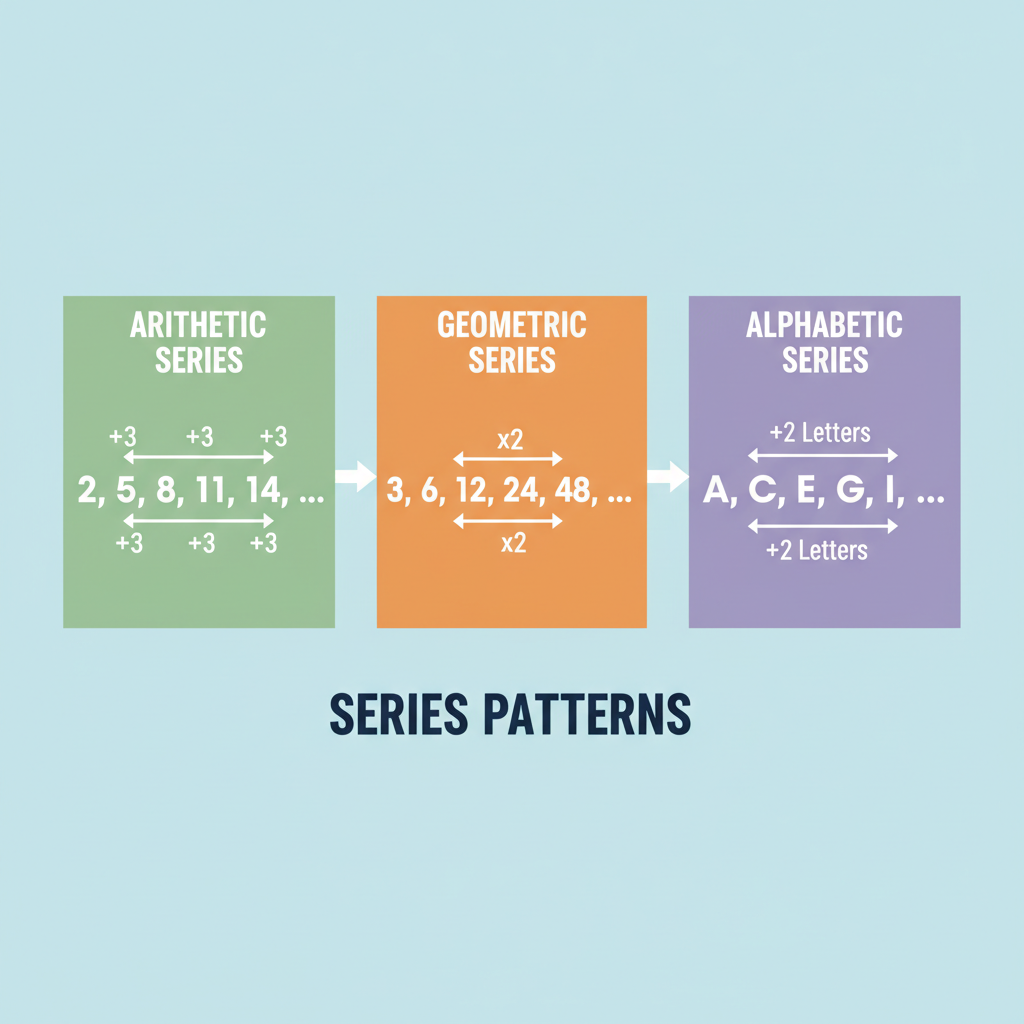
1. The 'Same Step' Series (Arithmetic Progression)
Imagine you're climbing a staircase where every step is exactly the same height. If you know the height of the first step and how much you add to reach the next, you can predict the height of any step! In this type of series, you either add or subtract the exact same number to get from one term to the next. This 'same number' is called the common difference.
- Example: 2, 5, 8, 11, ?
- Detective Work: What do we add to 2 to get 5? (+3). What do we add to 5 to get 8? (+3). What do we add to 8 to get 11? (+3).
- The Rule: Add 3 to the previous number.
- Next Term: 11 + 3 = 14. So the series is 2, 5, 8, 11, 14.
2. The 'Growing/Shrinking by a Factor' Series (Geometric Progression)
Think about a magical photocopier that doesn't just copy, but multiplies! If you put one sheet in, it makes 2 copies. Put those 2 in, it makes 4, then 8, and so on. In this series, you either multiply or divide by the exact same number to get from one term to the next. This 'same number' is called the common ratio.
- Example: 3, 6, 12, 24, ?
- Detective Work: What do we multiply 3 by to get 6? (x2). What do we multiply 6 by to get 12? (x2). What do we multiply 12 by to get 24? (x2).
- The Rule: Multiply the previous number by 2.
- Next Term: 24 x 2 = 48. So the series is 3, 6, 12, 24, 48.
3. The 'Two-Step Dance' Series (Mixed Operations or Increasing/Decreasing Differences)
Sometimes, the pattern isn't a simple add/subtract or multiply/divide. It might be a little more complex, like a dance where the steps change, but still follow a pattern! For example, the amount you add might increase by a fixed number each time, or the pattern might alternate between two different operations.
- Example: 1, 2, 4, 7, 11, ?
- Detective Work:
- From 1 to 2: +1
- From 2 to 4: +2
- From 4 to 7: +3
- From 7 to 11: +4
- The Rule: The number being added increases by 1 each time. The differences are 1, 2, 3, 4.
- Next Term: The next difference should be +5. So, 11 + 5 = 16. The series is 1, 2, 4, 7, 11, 16.
4. The 'Squaring/Cubing Up' Series
Imagine building blocks! You can arrange them into perfect squares (like 1x1=1, 2x2=4, 3x3=9) or perfect cubes (like 1x1x1=1, 2x2x2=8, 3x3x3=27). This type of series uses numbers that are perfect squares or perfect cubes.
- Example: 1, 4, 9, 16, ?
- Detective Work:
- 1 is 1 x 1 (1 squared)
- 4 is 2 x 2 (2 squared)
- 9 is 3 x 3 (3 squared)
- 16 is 4 x 4 (4 squared)
- The Rule: Each term is the square of consecutive natural numbers.
- Next Term: The next number is 5, so 5 x 5 = 25. The series is 1, 4, 9, 16, 25.
5. The 'Neighborly Sum' Series (Fibonacci-like)
Have you heard of the Fibonacci sequence? It's where each number is the sum of the two preceding ones. This series follows a similar pattern: each term (starting from the third term) is the sum of the two numbers before it.
- Example: 1, 1, 2, 3, 5, 8, ?
- Detective Work:
- 1 + 1 = 2
- 1 + 2 = 3
- 2 + 3 = 5
- 3 + 5 = 8
- The Rule: Add the two previous numbers to get the next one.
- Next Term: 5 + 8 = 13. The series is 1, 1, 2, 3, 5, 8, 13.
Now, Let's Explore Alphabet Series!
Alphabet series work similarly, but instead of numbers, you're dealing with letters. Often, thinking of letters as their numerical positions (A=1, B=2, C=3... Z=26) can be a huge help!
1. The 'Alphabetical Hop' Series
Imagine playing hopscotch on the alphabet! You might skip one letter, then two, then three. This series involves skipping a certain number of letters, or moving forward or backward in the alphabet by a consistent number of positions.
- Example: A, C, E, G, ?
- Detective Work:
- From A to C: Skip B (1 letter)
- From C to E: Skip D (1 letter)
- From E to G: Skip F (1 letter)
- The Rule: Skip one letter each time.
- Next Term: After G, skip H, so the next letter is I. The series is A, C, E, G, I.
2. The 'Position Power' Series
Each letter has a secret number code based on its position in the alphabet (A=1, B=2, C=3, and so on). In this type of series, the pattern is based on these numerical positions.
- Example: A, D, G, J, ?
- Detective Work:
- A is 1st letter
- D is 4th letter (+3 from A)
- G is 7th letter (+3 from D)
- J is 10th letter (+3 from G)
- The Rule: Each letter's position is 3 more than the previous letter's position.
- Next Term: The next position should be 10 + 3 = 13. The 13th letter is M. The series is A, D, G, J, M.
3. The 'Combo Creator' Series
Sometimes, series combine letters and numbers, or have more complex patterns like alternating patterns for consonants and vowels, or groups of letters. These are like secret codes that use both numbers and letters!
- Example: A1, B3, C5, D7, ?
- Detective Work:
- Letters: A, B, C, D... (They are just consecutive letters)
- Numbers: 1, 3, 5, 7... (These are consecutive odd numbers, increasing by 2 each time)
- The Rule: The letter advances by one position, and the number increases by 2.
- Next Term: After D comes E. After 7 comes 9. So the next term is E9. The series is A1, B3, C5, D7, E9.
 ⚠️ This picture may have spelling mistakes. Trust the words in the lesson.
Your Series-Solving Toolkit (Strategies for Success!)
Feeling overwhelmed? Don't be! With a bit of practice and these strategies, you'll become a series-solving master:
- Observe Carefully! Look at the first few terms. Are the numbers getting bigger or smaller? Are the letters moving forward or backward in the alphabet?
- Find the Difference/Ratio (for Number Series):
- If numbers are increasing/decreasing slowly: Try finding the difference between consecutive terms (subtract the first from the second, the second from the third, etc.). If the difference is constant, it's an arithmetic series.
- If numbers are increasing/decreasing rapidly: Try finding the ratio between consecutive terms (divide the second by the first, the third by the second, etc.). If the ratio is constant, it's a geometric series.
- Check for Squares/Cubes: If the numbers are 1, 4, 9, 16... or 1, 8, 27, 64..., you might have found your pattern!
- Use Alphabet Positions (for Alphabet Series): Write down the numerical position of each letter (A=1, B=2, C=3...). Sometimes, the pattern becomes obvious when you see the numbers.
- Look for Alternating Patterns: Sometimes, the pattern applies to every other term. For example, the 1st, 3rd, 5th terms follow one rule, and the 2nd, 4th, 6th terms follow another.
- Combine Clues (for Mixed Series): If it's a mix of letters and numbers, try to find a separate pattern for the letters and another for the numbers.
- Don't Give Up! Try Different Angles: If one strategy doesn't work, try another. Sometimes the pattern is tricky, but persistence pays off.
Putting It All Together: Practice Examples
Let's try a couple more with our detective toolkit:
Example 1: Number Series
Series: 100, 95, 85, 70, ?
- Step 1: Observe. Numbers are decreasing.
- Step 2: Find the difference.
- 95 - 100 = -5
- 85 - 95 = -10
- 70 - 85 = -15
- Step 3: Analyze the differences. The differences are -5, -10, -15. Aha! The amount being subtracted is increasing by 5 each time.
- Step 4: Predict the next difference. The next subtraction should be -20.
- Step 5: Find the next term. 70 - 20 = 50.
Answer: 50
Example 2: Alphabet Series
Series: Z, X, V, T, ?
- Step 1: Observe. Letters are moving backward in the alphabet.
- Step 2: Use Alphabet Positions (or just count backward).
- Z (26)
- X (24) - skipped Y (1 letter)
- V (22) - skipped W (1 letter)
- T (20) - skipped U (1 letter)
- Step 3: Analyze the pattern. Each letter is skipping one letter backward. Or, numerically, the position decreases by 2 each time.
- Step 4: Predict the next letter. After T, skip S, so the next letter is R. Or, numerically, 20 - 2 = 18, which is R.
Answer: R
Conclusion
Series problems are like engaging puzzles that challenge your logical thinking. The more you practice, the better you'll become at spotting those hidden patterns. Remember to be patient, try different strategies, and most importantly, have fun with the challenge! Happy pattern hunting!
Keep learning, free
Create a free Syllabax account to unlock practice questions and games for this topic.
Visual Learning Enhanced! 🚀
To help you master this topic, we use Advanced Syllabax AI to generate detailed diagrams and visual models.
Note on Visuals: The AI sometimes makes spelling errors in image labels. Please refer to the lesson text for the correct terminology.