Learning Journey
Watch this topic in 60 seconds
Free preview · Lesson 1
Understanding Growth, movement, eating, breathing (Living &Non Living Things)
Hello, Super Scientists! Let's Explore Living and Non-Living Things!
Have you ever looked around and wondered why some things seem to be 'alive' and others don't? Today, we're going on an exciting adventure to discover the secrets of living and non-living things! It's like being a detective, looking for clues to tell the difference.
What Makes Something ALIVE? (The Superpowers of Living Things!)
Living things are amazing! They have special 'superpowers' that non-living things don't have. Think of these superpowers as clues to help us know if something is alive. Let's learn about the most important ones:
1. Growth (Getting Bigger and Changing!)
Imagine your favorite toy car. Does it get bigger on its own? No, right? But you, a puppy, or a tiny seed planted in the ground, all get bigger and bigger! This is called growth.
- You Grow: When you were a baby, you were tiny. Now you're much bigger! You've grown taller, your shoes are bigger, and you learn new things every day.
- Animals Grow: A tiny kitten grows into a big cat. A little chick hatches from an egg and grows into a chicken.
- Plants Grow: A small seed can grow into a tall, strong tree! It pushes roots into the ground and leaves towards the sky.
Analogy: Think of growth like blowing up a balloon. But instead of just getting bigger on the outside, living things grow from the inside, adding new parts and getting stronger! A toy doesn't do this, but you do!
 ⚠️ This picture may have spelling mistakes. Trust the words in the lesson.
2. Movement (Moving Around!)
Can a rock stand up and walk away? Nope! But you can run, jump, and dance! Animals can run, fly, or swim. Even plants, though they stay in one place, can move their leaves towards the sun or open and close their flowers.
- Animals Move: Birds fly through the sky, fish swim in the ocean, and kangaroos hop across the land. They move to find food, escape danger, or find new homes.
- Humans Move: We walk to school, ride bikes, and play games. Our bodies are made for moving!
- Plants Move (Slowly!): A sunflower turns its head to follow the sun across the sky. Vines climb up walls.
Analogy: A toy car might move if you push it or if it has batteries. But living things move all by themselves, using their own energy and bodies, not just someone pushing them!
3. Eating (Getting Energy from Food!)
To have the energy to grow, move, and learn, living things need food! This is like putting fuel in a car so it can drive.
- Humans Eat: We eat fruits, vegetables, meat, and grains to get energy.
- Animals Eat: Cows eat grass, lions eat other animals, and birds eat seeds and worms. They all need food to survive.
- Plants 'Eat': Plants make their OWN food using sunlight, water, and air (a special gas called carbon dioxide). This process is called photosynthesis. It's like they have their own little food factories inside their leaves!
Analogy: Your body is like a fantastic machine that needs fuel to work! Food is that fuel. Without fuel, a car stops, and without food, living things can't grow or move.
4. Breathing (Taking in Air!)
Try holding your breath for a moment... it's hard, right? That's because all living things need to breathe! Breathing means taking in air (or something like air from water) to get a special gas called oxygen, which helps us use our food for energy.
- Humans Breathe: We use our lungs to breathe in air from the atmosphere.
- Animals Breathe: Dogs and cats use lungs too. Fish have special parts called gills to take oxygen from the water. Insects breathe through tiny holes in their bodies!
- Plants Breathe: Yes, plants breathe too! They take in and let out gases through tiny pores (like tiny mouths) on their leaves.
Analogy: Imagine a fire needing air to keep burning brightly. Our bodies are like that fire – they need a constant supply of air (oxygen) to keep all our systems working and to get energy from food.
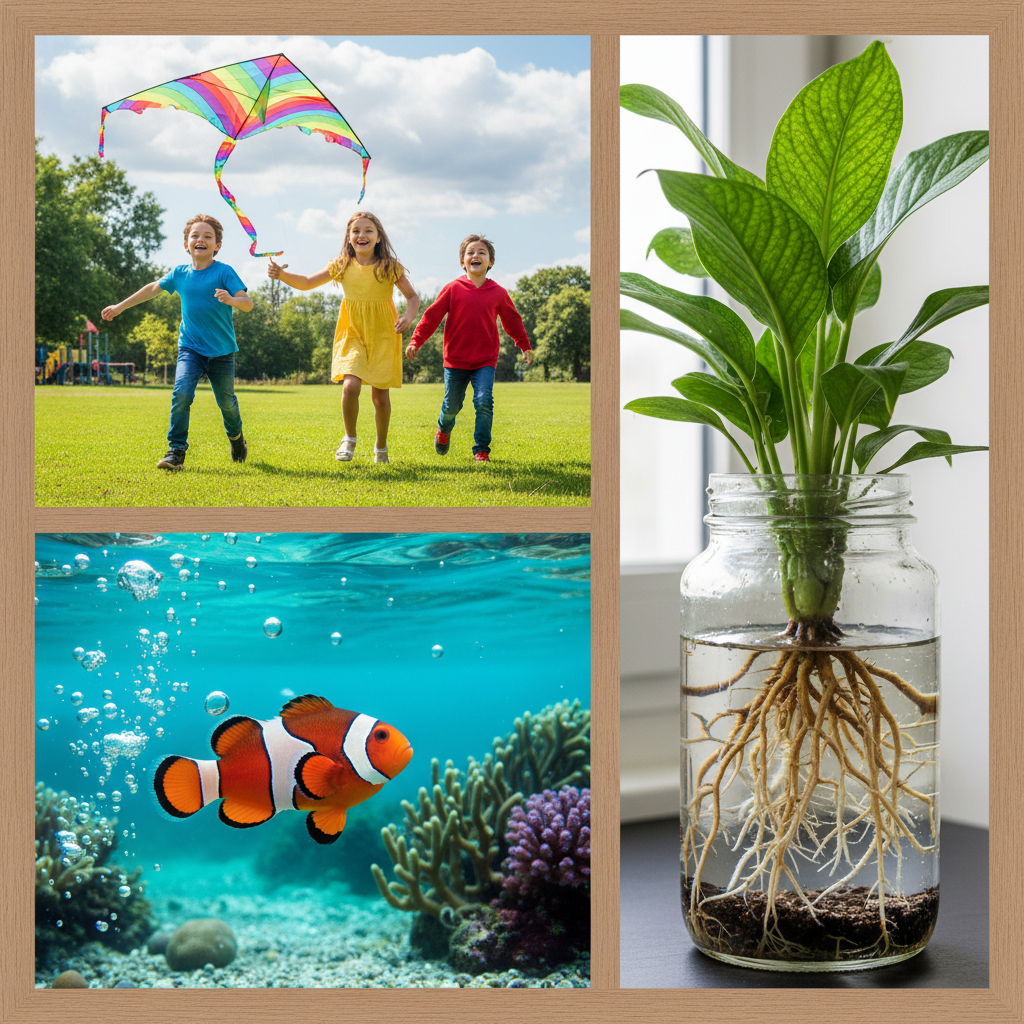
5. Reproducing (Making More of Themselves!)
Another big superpower of living things is that they can make more of themselves! This means new babies, new seedlings, or new eggs.
- Humans Reproduce: Parents have babies.
- Animals Reproduce: A hen lays eggs that hatch into chicks. A dog has puppies.
- Plants Reproduce: Seeds grow into new plants. Sometimes a part of a plant can even grow into a new plant!
This superpower ensures that there will always be more living things in the world!
What About Non-Living Things? (The Things That Don't Have Superpowers!)
Non-living things are everywhere too! They are things that do NOT grow, move on their own, eat, or breathe. They don't have the special 'superpowers' we just talked about.
- Examples: A rock, a table, your pencil, a toy car, a cloud, water, sunlight.
- Can they move? Only if something pushes them or if they are moved by nature (like wind blowing a leaf or water carrying a stone).
- Can they grow? A mountain might look like it's growing, but it's just bits of rock piling up, not growing from the inside. A sandcastle gets bigger when you add more sand, but it's not growing like a person or a plant.
- Do they eat or breathe? No! They don't need fuel or air to stay 'alive' because they aren't alive in the first place.
Important Note: Some non-living things, like a robot, can be made to move or even look like they're talking. But they don't do it all on their own. They need a person to program them or batteries to power them. They can't grow from a baby robot into an adult robot, and they can't breathe air like we do.
Let's Summarize the Superpowers!
To be a living thing, it needs to:
- Grow: Get bigger and change from the inside.
- Move: Move by itself to find food, shelter, or escape danger.
- Eat/Need energy: Take in food or make its own food to get energy.
- Breathe: Take in air (or oxygen from water) to use energy.
- Reproduce: Make more of its own kind.
If something doesn't do all or most of these things on its own, it's a non-living thing!
Your Turn, Detective!
Now you have all the clues! Next time you see a bird, a flower, a rock, or your bicycle, you'll be able to figure out if it's living or non-living. Keep exploring and learning!
Keep learning, free
Create a free Syllabax account to unlock practice questions and games for this topic.
Visual Learning Enhanced! 🚀
To help you master this topic, we use Advanced Syllabax AI to generate detailed diagrams and visual models.
Note on Visuals: The AI sometimes makes spelling errors in image labels. Please refer to the lesson text for the correct terminology.