Conservation[CHEMISTRY]
Watch this topic in 60 seconds
Free preview · Lesson 1
Understanding Conservation[CHEMISTRY]
Conservation in Chemistry: What Goes In, Must Come Out!
Welcome to the exciting world of chemistry! Today, we're going to talk about a super important idea called conservation. Think of it like a magic rule that everything in the universe follows. In chemistry, we often talk about the Law of Conservation of Mass. It sounds fancy, but it's actually quite simple and incredibly powerful.
What Does "Conservation" Mean?
Imagine you have a box filled with Lego bricks. You can build all sorts of amazing things with those bricks – a castle, a spaceship, a car. You can also take your castle apart and rebuild it into a car. No matter what you build, you always have the same number of Lego bricks. You don't suddenly get more bricks, and you don't lose any bricks. The total number of bricks stays the same. This is the idea of conservation!
In chemistry, instead of Lego bricks, we have tiny particles called atoms. Atoms are the building blocks of everything around us – the air we breathe, the water we drink, the food we eat, and even ourselves!
Atoms: The Unchanging Building Blocks
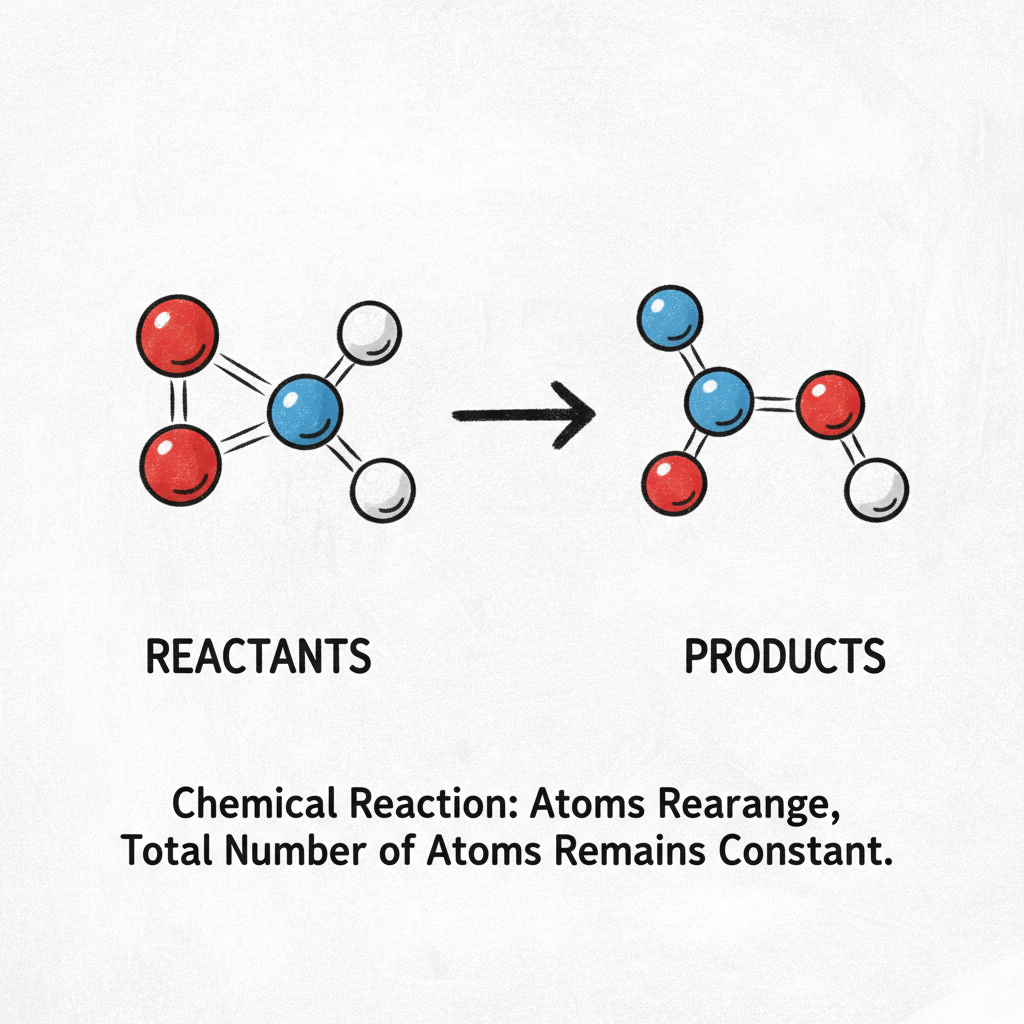
Atoms are like the ultimate, indestructible Lego bricks. They cannot be created or destroyed. When we mix different substances together, or when something like fire burns, the atoms don't disappear. Instead, they rearrange themselves to form new substances. It's like taking apart your Lego castle and using the same bricks to build a new spaceship. The bricks (atoms) themselves are still there, just in a different arrangement.
For example, when water is formed, it's made from hydrogen atoms and oxygen atoms. If you have a certain amount of hydrogen and oxygen, and they combine to make water, all of those original hydrogen and oxygen atoms are still present in the water. They haven't vanished into thin air!
Chemical Reactions: The Great Rearrangement
In chemistry, we call the process of atoms rearranging themselves a chemical reaction. Think of a chemical reaction like a dance party. The dancers (atoms) are the same people, but they might change partners or form new groups. The total number of dancers and the total number of people in the room don't change. They just interact differently.
Let's look at a simple example: When you burn wood in a fireplace, it seems like the wood disappears, right? It turns into ash, smoke, and gases. But where did the wood go? It didn't actually disappear! The atoms that made up the wood atoms have combined with oxygen atoms from the air to form new substances like carbon dioxide gas, water vapor, and ash. All the atoms that were in the wood and the oxygen are still there, just in different forms.
The Law of Conservation of Mass: Putting It All Together
So, the Law of Conservation of Mass is the scientific rule that says: In any closed system, the mass of the reactants before a chemical reaction must equal the mass of the products after the chemical reaction.
Let's break that down:
- Closed system: Imagine a perfectly sealed container, like a jar with a lid screwed on tight. Nothing can get in, and nothing can get out. This is important because if something could escape (like a gas), it would seem like mass was lost, but it really just went somewhere else.
- Mass: Mass is basically how much "stuff" an object has. It's related to weight but is a bit different. Think of it as the total number of atoms and how much they weigh.
- Reactants: These are the substances you start with before the chemical reaction happens. They are like the ingredients in a recipe.
- Products: These are the new substances that are formed after the chemical reaction is complete. They are like the cake you bake after mixing the ingredients.
So, the law means that if you weigh your ingredients before you start baking, and then you weigh your finished cake (making sure nothing spilled or evaporated), the total weight (mass) will be exactly the same!
Analogy: A Smoothie Maker
Imagine you're making a smoothie. You put in a banana, some strawberries, and a splash of milk. These are your reactants. You blend them all up. The smoothie that comes out is your product. Did the banana, strawberries, and milk disappear? No! They just got mixed together and changed form. If you could weigh the banana, strawberries, and milk before blending, and then weigh the smoothie afterward (assuming no spills!), the total weight would be the same. The atoms from the banana, strawberries, and milk are still in the smoothie!
Analogy: Building with Blocks
Think back to the Lego bricks. If you start with 100 Lego bricks (reactants) and build a house, you still have 100 Lego bricks in the form of a house (product). The total number of bricks (mass) hasn't changed.
Why is This Important?
Understanding the Law of Conservation of Mass helps chemists predict what will happen during a chemical reaction. It's like knowing that if you start with certain ingredients, you'll end up with a specific amount of final product. This is crucial for designing experiments, creating new materials, and understanding how the world around us works.
It also helps us understand environmental issues. When we talk about pollution, the idea of conservation is key. Pollutants don't just disappear; they transform into other substances, and we need to understand these transformations to manage them effectively.
Looking Ahead
As you continue your journey in chemistry, you'll see this principle of conservation applied in many different ways. It's one of the most fundamental rules of the universe, and understanding it will give you a great foundation for all the amazing things you'll learn!
Keep learning, free
Create a free Syllabax account to unlock practice questions and games for this topic.
Visual Learning Enhanced! 🚀
To help you master this topic, we use Advanced Syllabax AI to generate detailed diagrams and visual models.
Note on Visuals: The AI sometimes makes spelling errors in image labels. Please refer to the lesson text for the correct terminology.