School timetables [Real-Life Math]
Watch this topic in 60 seconds
Free preview · Lesson 1
Understanding School timetables [Real-Life Math]
Understanding Our School Timetables: A Math Adventure!
Welcome, super mathematicians! Today, we're going on an exciting adventure to understand something we see and use every single day: our school timetable! Think of your timetable as a secret map that guides you through your school day. It tells you what amazing things you'll be learning and when you'll be learning them. And guess what? Math is the secret ingredient that makes this map work!
What is a Timetable?
Imagine you're planning a fun birthday party. You need to decide when to serve cake, when to play games, and when to open presents, right? A timetable is very similar! It's a plan that shows the order of activities or subjects and the specific times they happen. Our school timetable is a special kind of plan for our entire school day. It helps everyone – students, teachers, and even the principal – know what's happening and when.
Think of it like a TV guide, but instead of shows, it lists our classes: Math, Science, English, Art, and so on. Each class has its own special time slot, just like your favorite cartoon has its time slot on TV.
Why Do We Need Timetables?
Timetables are super important because they bring order and structure to our busy school lives. They are like the conductors of an orchestra, making sure everything happens smoothly and on time.
- Helps Us Stay Organized: Just like knowing when your bus arrives helps you get to school on time, a timetable helps you know when to be ready for your next class. It's like having a personal assistant for your day!
- Makes Sure We Learn Everything: Our school has many exciting subjects to learn. The timetable makes sure that we get enough time for each subject, so we don't miss out on any important lessons. It's like making sure you get a slice of every delicious cake at the party!
- Teaches Us Time Management: Using a timetable helps us understand the concept of time. We learn how long each activity lasts and how to transition from one to another. This is a very valuable skill, like learning to share your toys – it helps everyone get along better!
- Keeps Everyone on Track: Teachers use the timetable to plan their lessons, and students use it to know where to go next. It's a team effort, and the timetable is the game plan!
Parts of a School Timetable
Let's look closely at a typical school timetable. You'll usually see columns and rows, like a grid.
- Days of the Week: Usually, timetables show the plan for each day, like Monday, Tuesday, Wednesday, Thursday, and Friday. Some might even include Saturday!
- Time Slots: These are the specific times when classes start and end. They might be listed as '9:00 AM - 9:45 AM' or 'Period 1'.
- Subjects/Activities: This is the most exciting part! It tells you which subject you'll be studying during each time slot.
- Classroom/Teacher: Sometimes, the timetable might also tell you which classroom to go to or which teacher is teaching the class.
Imagine a treasure map. The days are like the different routes, the time slots are the checkpoints, and the subjects are the treasures you find!
Reading a Timetable: Using Math Skills!
This is where our math skills come in handy! We use math to understand the times on our timetable.
- Counting Minutes and Hours: Timetables tell us how long each class is. If a Math class is from 10:00 AM to 10:45 AM, we can use subtraction to figure out that it lasts for 45 minutes. (10:45 - 10:00 = 0:45). This is like counting how long you have to wait for your favorite game to load!
- Calculating Total Time: You can also calculate the total time spent on a subject throughout the week. If you have 5 Math classes, each lasting 45 minutes, you can multiply 5 x 45 to find the total Math time. Or, you can add up the time for each individual class.
- Understanding Time Intervals: Breaks and lunchtimes are important parts of our day. The timetable shows us these intervals. If lunch is from 12:30 PM to 1:15 PM, we know we have 45 minutes to eat and relax. This is like knowing how much time you have to finish your yummy sandwich!
- Sequencing: The timetable shows the order of subjects. We learn to follow this sequence. This is like following a recipe step-by-step to bake a delicious cake.
Let's say your first class is English from 9:00 AM to 9:40 AM. Then you have a 5-minute break. After that, your next class is Math from 9:45 AM to 10:25 AM.
How long is your English class? (Answer: 40 minutes)
How long is your Math class? (Answer: 40 minutes)
What time does your Math class finish? (Answer: 10:25 AM)
Analogy Time!
Timetable as a Train Schedule: Imagine a train station. The timetable is like the train schedule. It tells you which train (subject) leaves at what time (time slot) and where it's going (classroom/teacher). You need to read it carefully to catch the right train!
Timetable as a Recipe: Think of a recipe for making a special dish. It lists the ingredients and the steps in order. The timetable is like that recipe for your school day. Each subject is an ingredient, and the time slots are the cooking steps. You follow it to create a successful and delicious learning experience!
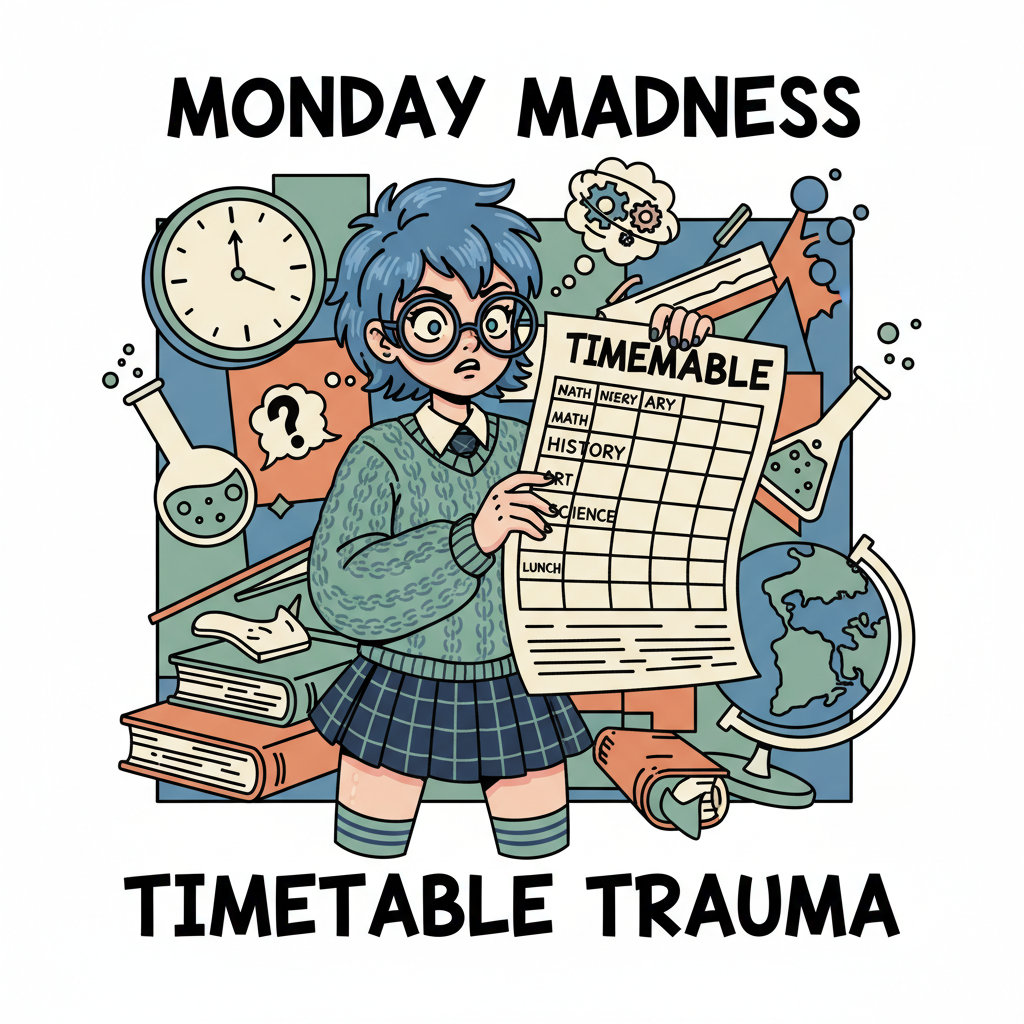 ⚠️ This picture may have spelling mistakes. Trust the words in the lesson.
Conclusion
Our school timetable is a powerful tool that uses math to organize our day. By understanding how to read and use it, we become better at managing our time, staying organized, and making sure we get the most out of our learning adventure. So next time you look at your timetable, remember the amazing math that makes it all possible!
Keep learning, free
Create a free Syllabax account to unlock practice questions and games for this topic.
Visual Learning Enhanced! 🚀
To help you master this topic, we use Advanced Syllabax AI to generate detailed diagrams and visual models.
Note on Visuals: The AI sometimes makes spelling errors in image labels. Please refer to the lesson text for the correct terminology.