Complementary Events
Watch this topic in 60 seconds
Free preview · Lesson 1
Understanding Complementary Events
Understanding Complementary Events: When Things Happen vs. When They Don't
Welcome, 10th-grade learners! Today, we're diving into a fundamental concept in probability called Complementary Events. Don't let the fancy name scare you – it's actually a very intuitive idea that helps us understand the likelihood of things happening, and just as importantly, the likelihood of them *not* happening. This concept is foundational to understanding more complex probability scenarios, so let's build a strong understanding together!
What is Probability, Anyway? A Quick Refresher
Before we jump into complementary events, let's quickly remind ourselves what probability is all about. Probability is simply a measure of how likely an event is to occur. We express it as a number between 0 and 1 (or 0% and 100%).
- A probability of 0 means an event is impossible (e.g., the sun rising in the west).
- A probability of 1 means an event is certain (e.g., gravity pulling things down).
- A probability of 0.5 (or 50%) means an event is equally likely to happen or not happen (e.g., flipping a fair coin and getting heads).
When we talk about an 'event,' we mean a specific outcome or a set of outcomes in an experiment. For example, rolling a '6' on a die is an event. Drawing a 'heart' from a deck of cards is an event. Your favorite team winning a game is an event.
Introducing Complementary Events: The 'Happening' vs. The 'Not Happening'
Imagine you're trying to figure out the probability of something specific happening. Sometimes, it's actually easier to figure out the probability of that thing *not* happening. This is where complementary events come in!
Definition: Two events are said to be complementary events if one event occurring means the other cannot occur, and together they cover all possible outcomes.
Think of it like this: for any given event, there are only two possibilities: either the event happens, or it doesn't happen. There's no in-between! The event 'happening' and the event 'not happening' are complementary.
Notation for Complementary Events
If we denote an event as 'E', then its complementary event (the event of E not happening) is denoted as E' (read as 'E prime') or sometimes Eᶜ (read as 'E complement').
The most crucial relationship between an event and its complement is:
P(E) + P(E') = 1
This simple formula means: The probability of an event happening plus the probability of that event *not* happening must always add up to 1 (or 100%). It's like saying, 'Either it rains, or it doesn't rain. Those are the only two options, and together they make up all possibilities for the weather today.'
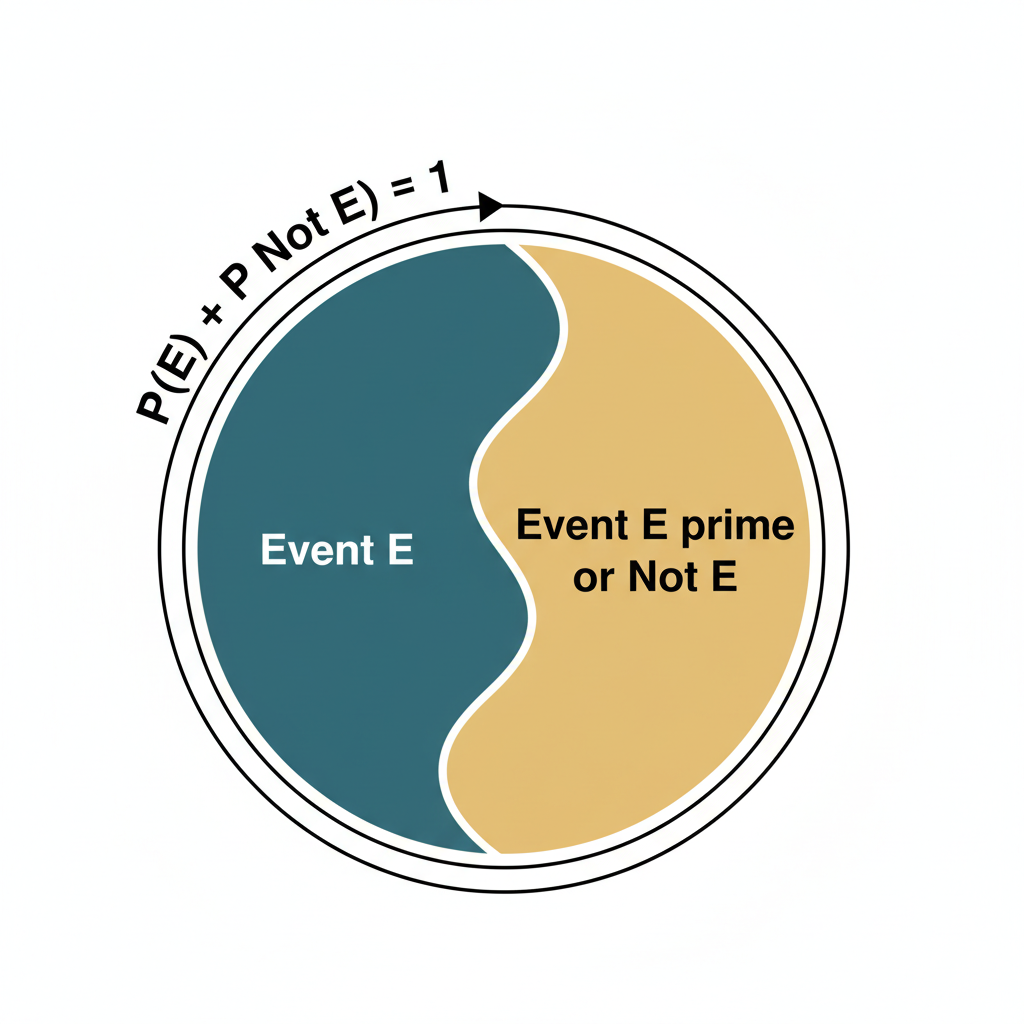 ⚠️ This picture may have spelling mistakes. Trust the words in the lesson.
Analogies to Understand Complementary Events
Let's make this super clear with some everyday examples:
- The Light Switch Analogy: Imagine a light switch. It's either ON or OFF. If 'Event E' is the light being ON, then 'Event E'' is the light being OFF. There's no 'partially on' or 'kind of off' state (in a simple switch). Together, ON and OFF cover all possibilities for the light's state.
- The Coin Flip Analogy: When you flip a fair coin, there are two possible outcomes: Heads or Tails. If 'Event E' is getting Heads, then 'Event E'' is *not* getting Heads, which means getting Tails. P(Heads) + P(Tails) = 0.5 + 0.5 = 1.
- The Weather Analogy: For any given day, it will either Rain or it will Not Rain. If 'Event E' is that it rains tomorrow, then 'Event E'' is that it does not rain tomorrow. These two are complementary.
- The Sports Game Analogy: Your favorite basketball team is playing a game. There are three outcomes: they win, they lose, or they tie. But if we simplify to only two outcomes: Your Team Wins or Your Team Does NOT Win (meaning they lose or tie). These two are complementary.
- The Sock Drawer Analogy: You have a drawer full of socks, some black and some white. If 'Event E' is picking a black sock, then 'Event E'' is *not* picking a black sock, which means picking a white sock.
Putting the Formula to Work: Examples and Calculations
The formula P(E) + P(E') = 1 is incredibly useful because it means if you know the probability of one event, you can easily find the probability of its complement!
From the formula, we can derive two other very handy forms:
- P(E') = 1 - P(E) (The probability of an event *not* happening is 1 minus the probability of it happening.)
- P(E) = 1 - P(E') (The probability of an event happening is 1 minus the probability of it *not* happening.)
Example 1: Rolling a Die
Let's say you roll a standard six-sided die. What is the probability of rolling a 6?
- Total possible outcomes: {1, 2, 3, 4, 5, 6} = 6 outcomes.
- Favorable outcome (rolling a 6): {6} = 1 outcome.
- P(rolling a 6) = 1/6.
Now, what is the probability of *not* rolling a 6?
- Let E = rolling a 6. So P(E) = 1/6.
- E' = not rolling a 6.
- Using the formula: P(E') = 1 - P(E) = 1 - 1/6 = 5/6.
Let's check this directly: The outcomes where you *don't* roll a 6 are {1, 2, 3, 4, 5}. There are 5 such outcomes. So, P(not rolling a 6) = 5/6. The formula works!
Example 2: Drawing a Card
You draw one card from a standard deck of 52 playing cards. What is the probability that you do *not* draw a King?
- Let E = drawing a King.
- There are 4 Kings in a deck of 52 cards.
- P(E) = P(drawing a King) = 4/52 = 1/13.
Now, we want P(E'), which is the probability of *not* drawing a King.
- P(E') = 1 - P(E)
- P(E') = 1 - 1/13 = 12/13.
Isn't that much faster than counting all the non-King cards (52 - 4 = 48 cards, so 48/52 = 12/13)? This demonstrates the power of complementary events!
Example 3: Probability of Rain
The local weather forecast states that there is a 30% chance of rain tomorrow. What is the probability that it will *not* rain tomorrow?
- Let E = it rains tomorrow.
- P(E) = 30% = 0.30.
We want P(E'), the probability that it does *not* rain tomorrow.
- P(E') = 1 - P(E)
- P(E') = 1 - 0.30 = 0.70.
So, there is a 70% chance it will not rain tomorrow. Simple!
Why Are Complementary Events Important?
Complementary events are more than just a neat trick; they are a powerful tool because:
- Simplification: Sometimes, directly calculating the probability of an event can be very complicated, especially if there are many ways for that event to happen. It might be much easier to calculate the probability of the event *not* happening, and then subtract that from 1.
- Completeness: They ensure that we account for all possible outcomes in a given situation, making our probability calculations robust.
- Foundation: They form the basis for understanding other important probability concepts, such as conditional probability and independent events.
Recap and Moving Forward
Remember, complementary events are like two sides of the same coin: one happens, or the other happens, and together they make up the whole picture of possibilities. The key is their sum always equals 1 (or 100%). Mastering this concept will make your journey through probability much smoother and more enjoyable!
Keep practicing these ideas, and you'll soon find yourself thinking in terms of 'what happens' and 'what doesn't happen' naturally!
Keep learning, free
Create a free Syllabax account to unlock practice questions and games for this topic.
Visual Learning Enhanced! 🚀
To help you master this topic, we use Advanced Syllabax AI to generate detailed diagrams and visual models.
Note on Visuals: The AI sometimes makes spelling errors in image labels. Please refer to the lesson text for the correct terminology.