Manure & fertilizers[BIOLOGY]
Watch this topic in 60 seconds
Free preview · Lesson 1
Understanding Manure & fertilizers[BIOLOGY]
Manure & Fertilizers: Feeding Our Plants!
Imagine your body needing food to grow strong and healthy, right? Plants are just like us! They need food too, but their food comes in a different form. Today, we're going to explore the amazing world of plant food, focusing on two main types: **manure** and **fertilizers**. Think of them as super snacks for our green friends!
Why Do Plants Need Food?
Plants are living things, and just like you need energy to run and play, plants need energy to grow tall, produce leaves, make flowers, and eventually grow fruits or seeds. This energy and the building blocks for their bodies come from nutrients they absorb from the soil through their roots. The soil is like a giant pantry for plants, and it's our job to make sure that pantry is well-stocked!
The most important nutrients plants need are **macronutrients**. These are like the main meals in a plant's diet. The top three are:
- Nitrogen (N): This nutrient is super important for leafy growth. Think of it like the protein that helps build muscles! It helps plants produce lots of green leaves.
- Phosphorus (P): This is like the energy drink for plants. It helps with root development, flowering, and fruit production. It's key for the plant to have strong foundations and to reproduce.
- Potassium (K): This is like the plant's immune system and overall health booster. It helps plants fight off diseases and stay strong, especially in tough weather.
Besides these big three, plants also need **micronutrients**, which are needed in smaller amounts. These are like vitamins and minerals for us – essential for various small but crucial jobs in the plant's life.
What Happens When the Pantry is Empty?
If the soil doesn't have enough of these nutrients, plants can't grow properly. They might look sad, with yellowing leaves, stunted growth, or poor flowering. It's like trying to build a house with not enough bricks – it just won't turn out right!
This is where manure and fertilizers come in. They are ways we can add these essential nutrients back into the soil, making sure our plants have everything they need to thrive.
Manure: Nature's Super Soil!
Manure is basically animal waste, like from cows, chickens, horses, or sheep. Now, it might not sound very glamorous, but manure is like a super-powered compost! It's packed with nutrients that plants love, and it also has a magical bonus: it improves the soil itself.
Think of soil like a sponge. Good soil can hold water and air, which plant roots need. Manure is like adding tiny little sponges into the soil, making it better at holding water. It also helps break up hard, compacted soil, making it easier for roots to grow and find food. This is called improving soil structure.
Types of Manure:
- Cow manure: Often called "gentle" manure, it's good for most plants and provides a balanced set of nutrients.
- Chicken manure: This is very "hot" and rich in nitrogen, meaning it's very powerful. It needs to be composted (rotted down) properly before being used, or it can burn plant roots! Think of it like a super spicy food – you need to prepare it carefully.
- Horse manure: Also needs to be composted, as it can contain weed seeds.
- Sheep manure: A good all-around fertilizer.
Important Note: Fresh manure can sometimes harm plants because it's too "strong" or contains things like weed seeds. That's why farmers and gardeners often let manure age or compost it first. Composting is like letting the manure sit in a pile for a while, where it breaks down and becomes a safe, nutrient-rich food for the soil.
Fertilizers: The Speedy Nutrients!
Fertilizers are different from manure. While manure is natural and also improves soil structure, fertilizers are usually manufactured products designed to provide specific nutrients to plants. They are like the fast-food meals for plants – giving them a quick boost of the nutrients they need.
Fertilizers can be made from natural sources (like bone meal or fish emulsion) or from synthetic chemicals. They are often sold in bags and can be in liquid, granular (small pellets), or powder form.
Key Features of Fertilizers:
- NPK Ratio: This is a very important number you'll see on fertilizer bags. It tells you the percentage of Nitrogen (N), Phosphorus (P), and Potassium (K) in the fertilizer. For example, a fertilizer labeled "10-10-10" means it has 10% Nitrogen, 10% Phosphorus, and 10% Potassium. This is like a recipe for plant food!
- Fast-Acting: Because they are often in a form that plants can easily absorb, fertilizers can give plants a quick pick-me-up.
- Targeted Nutrients: You can buy fertilizers that are high in one specific nutrient. For example, if your plants have yellow leaves (a sign of low nitrogen), you can buy a fertilizer that is high in nitrogen.
Analogy: If manure is like a slow-cooked, nutritious stew that also makes your whole kitchen feel warmer and cozier (improves soil), fertilizers are like energy bars – quick, packed with specific ingredients, and easy to carry around.
Manure vs. Fertilizers: What's the Difference?
It's important to understand that both manure and fertilizers help plants, but they do it in slightly different ways:
- Origin: Manure is natural (animal waste), while fertilizers can be natural or synthetic (manufactured).
- Soil Improvement: Manure is excellent for improving soil structure, making it healthier and better at holding water and air. Fertilizers primarily add nutrients.
- Nutrient Release: Manure releases nutrients slowly as it breaks down, acting as a long-term food source. Fertilizers, especially synthetic ones, often release nutrients quickly, providing an immediate boost.
- Completeness: Manure is a "complete" food source because it provides a range of nutrients and organic matter. Fertilizers are often specialized to provide specific N-P-K ratios or other micronutrients.
How Are They Used?
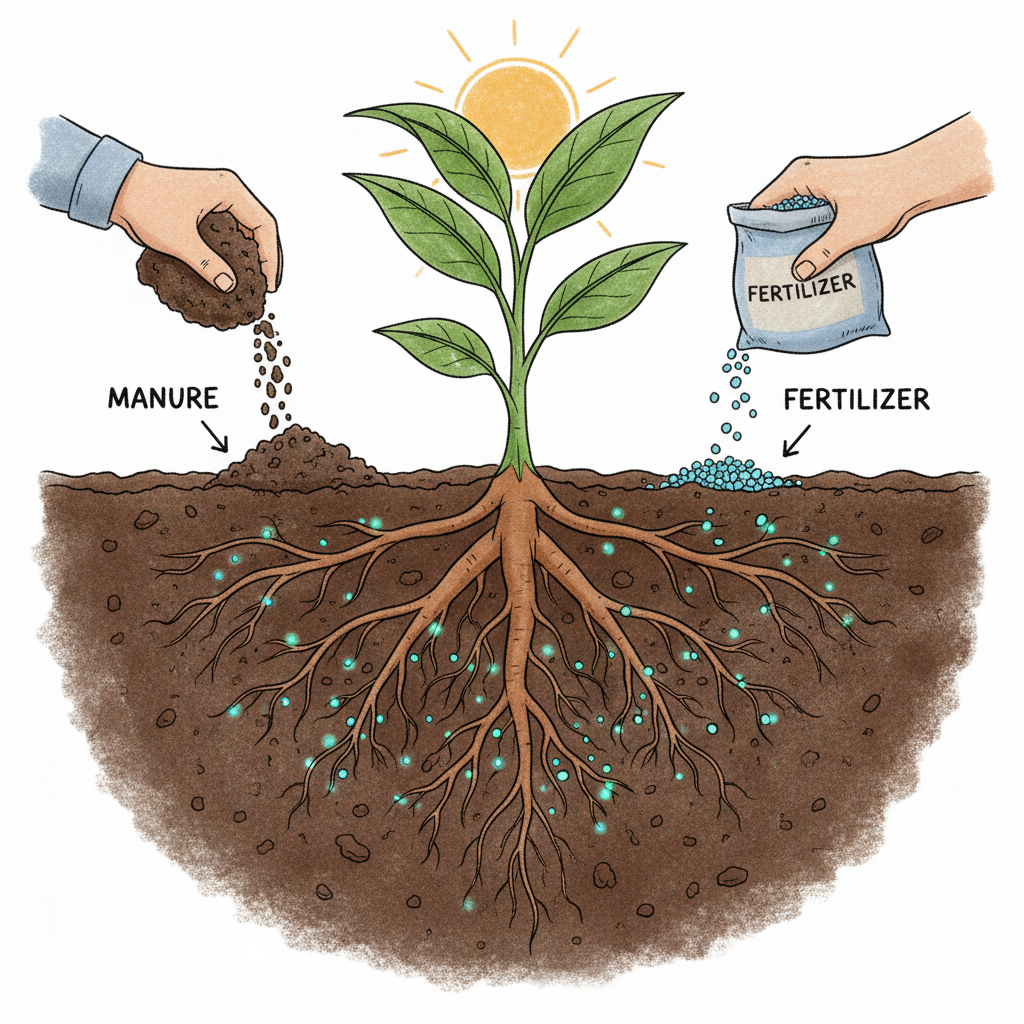
Both manure and fertilizers are added to the soil around plants. Gardeners might mix composted manure into their garden beds before planting, or spread it around existing plants. Fertilizers can be sprinkled on the soil surface, mixed into the soil, or dissolved in water and used to water the plants (liquid feeding).
Caution: It's possible to give plants *too much* food! Too much manure can burn roots, and too much fertilizer can "shock" the plant or pollute waterways if it washes away. Always follow instructions and use them wisely!
Summary: Feeding Our Plants
Plants need nutrients from the soil to grow. When the soil is lacking, we can add **manure** (natural animal waste that feeds plants AND improves soil) or **fertilizers** (products that provide specific, often fast-acting, nutrients). Both are essential tools for healthy plant growth, helping our gardens, farms, and the environment thrive!
Let's visualize this!
Keep learning, free
Create a free Syllabax account to unlock practice questions and games for this topic.
Visual Learning Enhanced! 🚀
To help you master this topic, we use Advanced Syllabax AI to generate detailed diagrams and visual models.
Note on Visuals: The AI sometimes makes spelling errors in image labels. Please refer to the lesson text for the correct terminology.