Constructing similar triangles (Constructions)
Watch this topic in 60 seconds
Free preview · Lesson 1
Understanding Constructing similar triangles (Constructions)
Constructing Similar Triangles: Building Blocks of Geometry
Welcome, future architects and geometers! Today, we're diving into the fascinating world of similar triangles. Don't worry, it's not as complex as it sounds. Think of it like making a perfect miniature version of something, or blowing up a photo without distorting it. The shape stays the same, but the size changes.
What are Similar Triangles? A Quick Refresh
Imagine you have a toy car and a real car. They look exactly alike in shape, right? The wheels are round, the body is rectangular, the windshield is a certain angle. But one is tiny, and the other is life-sized. This is the essence of similarity in geometry! Two triangles are similar if:
- All their corresponding angles are equal. (If you put one triangle on top of the other, their corners would match up perfectly in angle.)
- All their corresponding sides are in proportion. (Meaning, if one side of the larger triangle is twice as long as the corresponding side of the smaller triangle, then *all* its sides will be twice as long as their corresponding smaller sides. It's like using a zoom lens – everything gets bigger or smaller by the same factor!)
We often use the symbol '~' to denote similarity. So, if triangle ABC is similar to triangle XYZ, we write ΔABC ~ ΔXYZ.
Why Do We Construct Them?
Constructing similar triangles isn't just a fun geometric puzzle; it has many practical applications! Think about:
- Architects and Engineers: They use scaled-down models (which are similar shapes) to test designs before building massive structures.
- Cartographers (Map Makers): Maps are similar versions of real landscapes, scaled down so we can fit them on a piece of paper.
- Photography and Art: Artists use principles of perspective and scaling to create realistic representations.
In our classroom, it helps us understand the fundamental properties of shapes and develops our precision with geometric tools.
Tools of the Trade: Your Geometric Toolkit
Before we start building, let's make sure you have your trusty tools ready. For constructions, we primarily use:
- Ruler (or Straightedge): For drawing straight lines. (Think of it as your guide for perfectly straight roads.)
- Compass: For drawing circles, arcs, and measuring distances. (This is like your precision caliper for transferring lengths.)
- Pencil: For drawing!
The Main Event: Constructing a Similar Triangle Using a Given Ratio (Dilation Method)
This is one of the most common and intuitive ways to construct a similar triangle. Imagine you have a small drawing, and you want to make a bigger version of it, say, 1.5 times the original size. We'll use a technique that involves a 'center' of enlargement (or reduction) and parallel lines.
Let's Construct! Step-by-Step Guide:
Our goal: Construct ΔA'B'C' such that it is similar to a given ΔABC, with a scale factor of, for example, 3/2 (meaning the new triangle will be 1.5 times larger).
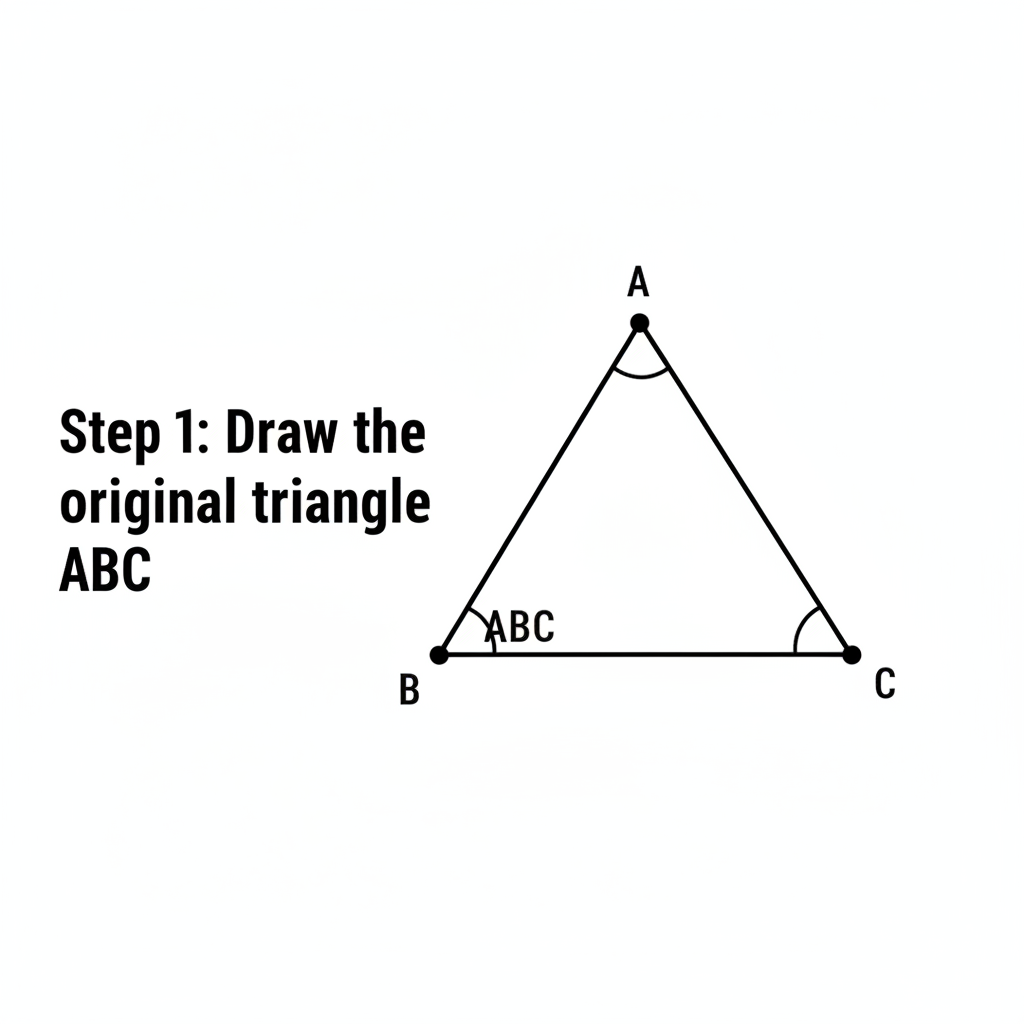
Step 1: Draw Your Original Triangle
First, draw any triangle, let's call it ΔABC. Make sure it's a decent size so you have room to work.
Step 2: Choose a Point Outside the Triangle (or a Vertex) as Your Center of Dilation
Pick a point, let's call it 'P'. This point can be one of the vertices of ΔABC (like A), or it can be a point completely outside the triangle. For simplicity and clarity in our example, let's choose point A as our center of dilation (P).
Step 3: Draw Rays from the Center of Dilation Through Each Vertex
Using your straightedge, draw rays starting from point A and passing through points B and C. So, you'll draw ray AB and ray AC. These are your 'stretching' lines.
Step 4: Mark Off the Scale Factor on One Ray
Now, here's where the scale factor comes in (our 3/2). We need to extend our sides proportionally. Since we picked A as our center of dilation, the side AB will become A'B', and AC will become A'C'. A' will be the same as A because it's our center.
On ray AB, use your compass. Open your compass to a convenient radius and mark off 3 equal segments starting from A along ray AB. Let the third mark be B'. Why three? Because our scale factor is 3/2. If the denominator was different, we'd adjust. Alternatively, if your scale factor is 3/2, you could measure the length of AB, multiply it by 3/2 (e.g., if AB is 4 cm, A'B' would be 6 cm), and mark B' on ray AB such that AB' = 1.5 * AB. For accurate construction, the 'marking segments' method is often preferred.
Step 5: Construct a Parallel Line to Create the Third Vertex
This is the crucial step that ensures similarity. From B', we need to draw a line parallel to BC. Remember that corresponding angles must be equal for similarity. By creating parallel lines, we ensure this automatically!
- Place your compass point at B and draw an arc that intersects AB and BC.
- With the same compass setting, place the point at B' and draw a similar arc intersecting the ray AB'.
- Measure the opening of the first arc (the distance between where it crossed AB and BC).
- Transfer that measurement to the second arc from the point where it crossed AB'. This will give you a point.
- Draw a line from B' through this new point. This line will be parallel to BC.
This new parallel line will intersect ray AC at a point. Let's call this point C'.
Step 6: Complete Your Similar Triangle
Now, connect B' and C'. You have successfully constructed ΔAB'C'! This triangle, ΔAB'C', is similar to your original ΔABC. All its sides are 1.5 times longer than the corresponding sides of ΔABC, and all its angles are exactly the same!
Another Method: Using Angle-Angle (AA) Similarity
If you're given two angles of a triangle, you know the third (because angles in a triangle add up to 180°). If two triangles have two pairs of corresponding angles equal, they are similar. So, you can construct a similar triangle by:
- Draw your first triangle, ΔABC.
- Choose a base for your new triangle, say D'E', which is proportional to one of the sides of ΔABC (e.g., D'E' = 2 * AB).
- At D', construct an angle equal to ∠A.
- At E', construct an angle equal to ∠B.
- The point where these two rays intersect will be F'. ΔD'E'F' will be similar to ΔABC.
This method directly applies the AA similarity criterion to build a new similar triangle.
Key Takeaways and Analogies
- Zoom Lens Analogy: Similar triangles are like photographs taken with different zoom settings. The picture is the same, just larger or smaller.
- Dollhouse Analogy: A dollhouse is a similar version of a real house – all its parts are scaled down proportionally.
- Blueprint Analogy: Blueprints are similar to the actual building; they maintain the same shapes and proportions, just at a smaller scale.
Mastering these constructions builds your understanding of proportion, angles, and geometric transformations. Keep practicing, and you'll soon be constructing complex figures with ease!
Keep learning, free
Create a free Syllabax account to unlock practice questions and games for this topic.
Visual Learning Enhanced! 🚀
To help you master this topic, we use Advanced Syllabax AI to generate detailed diagrams and visual models.
Note on Visuals: The AI sometimes makes spelling errors in image labels. Please refer to the lesson text for the correct terminology.