What are Outliers?
Watch this topic in 60 seconds
Free preview · Lesson 1
Understanding What are Outliers?
What Are Outliers? Standing Out From the Crowd!
Imagine you're in a big group of friends, and most of you are wearing blue shirts. But then, one friend shows up in a bright, neon green shirt! That friend, with their super different shirt, is a bit like an outlier in the world of data. An outlier is simply a piece of information, a number, or an observation that is very different from most of the other information in a group. It 'stands out' in a big way!
Think of it Like This: The Height Analogy
Let's say you measure the height of ten 6th graders in your class. Most of them might be around 4 feet 8 inches to 5 feet 2 inches tall. This is the 'normal' range for your class. Now, imagine one student in your class is 6 feet tall! That student's height would be an outlier because it's much, much taller than everyone else. Or, imagine another student is only 3 feet 5 inches tall. That height would also be an outlier because it's much, much shorter than everyone else. Outliers can be super big or super small compared to the rest of the group.
What Exactly IS an Outlier?
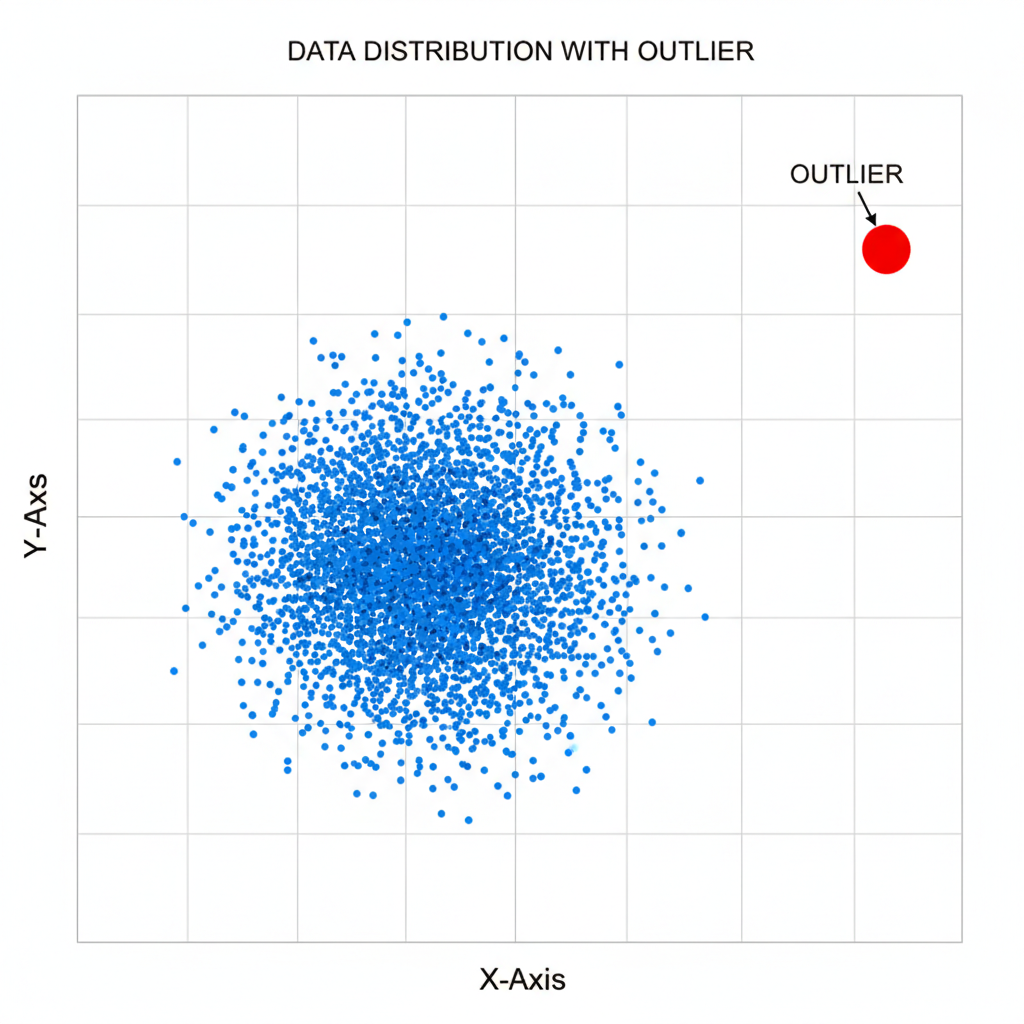
In simple terms, an outlier is a data point that lies an abnormal distance from other values in a random sample from a population. That's a fancy way of saying it's a number that doesn't quite 'fit in' with the other numbers. It's an unusual value that is far away from the main group of data points. Think of it as the 'lone wolf' or the 'black sheep' of your numbers.
Why Do We Care About Outliers? They Can Be Tricky!
Outliers are important because they can tell us some interesting things, but they can also be a bit sneaky and make us misunderstand our data. Here’s why:
- Mistakes Happen: Sometimes, an outlier is just a mistake! Maybe someone typed a number wrong. If you're measuring temperatures and accidentally write '1000 degrees' instead of '100 degrees,' that '1000' is a huge outlier and a clear error.
- Something Special is Happening: Other times, an outlier isn't a mistake at all! It could be a really important piece of information. For example, if you're measuring how long it takes students to solve a puzzle, and one student finishes it in 5 seconds while everyone else takes 5 minutes, that 5-second time is an outlier. It might mean that student is a super genius at puzzles, or they found a really clever shortcut! This outlier tells you something unique.
- They Can Change the 'Average': Outliers can mess with our idea of what's 'normal' for a group. Imagine a group of five friends, and four of them have
Another Way to See It: The Candy Price Analogy
Let's say you go to a store and look at the prices of five different candy bars:
 ⚠️ This picture may have spelling mistakes. Trust the words in the lesson.
How Do We Spot Outliers? (Just By Looking!)
For now, in 6th grade, the easiest way to spot an outlier is to simply look at your numbers and see if any of them seem really, really different from the rest. It's like finding a purple crayon in a box full of red crayons – it just pops out!
- Is it much bigger than all the other numbers?
- Is it much smaller than all the other numbers?
- Does it look like it doesn't belong with the main 'cluster' or group of numbers?
Real-World Outliers You Might See:
- Weather: If it's a really warm day in the middle of winter, that warm temperature is an outlier compared to the usual cold winter days.
- Sports: In a basketball game, if one player scores 50 points while everyone else scores between 5 and 15 points, that 50-point game is an outlier.
- Houses: If you're looking at house prices in a neighborhood where most houses cost around
Wrapping It Up: Be a Data Detective!
Outliers are those curious numbers that don't quite fit in. They can be signs of errors, or they can be signs of something truly unique and important. When you see a number that looks really different from the rest, your inner data detective should get curious! Ask yourself: Is this a mistake? Or is this telling me something really interesting? Understanding outliers helps us get a clearer picture of our data and the world around us.
Keep learning, free
Create a free Syllabax account to unlock practice questions and games for this topic.
Visual Learning Enhanced! 🚀
To help you master this topic, we use Advanced Syllabax AI to generate detailed diagrams and visual models.
Note on Visuals: The AI sometimes makes spelling errors in image labels. Please refer to the lesson text for the correct terminology.