Travel and time planning [Real-Life Math]
Watch this topic in 60 seconds
Free preview · Lesson 1
Understanding Travel and time planning [Real-Life Math]
Travel and Time Planning: Your Math Adventure!
Welcome, young adventurers, to a super exciting topic that blends math with the real world: Travel and Time Planning! Think about all the amazing places you might want to visit. Maybe it's your grandma's house across town, a fun amusement park, or even a faraway land in your dreams! To get to these places, we need to plan our journey, and that's where math comes in.
What is Travel and Time Planning?
Imagine you have a super cool toy car that can only go a certain speed. If you want to reach the other side of the room, you need to figure out how long it will take your car to get there, right? Travel and time planning is just like that, but for us humans! It's about figuring out:
- How far away something is.
- How fast we can travel.
- How much time we need to get there and back.
- When we need to leave and when we will arrive.
It's like being a detective, but instead of solving mysteries, we're solving how to get from 'here' to 'there' smoothly!
The Building Blocks: Distance, Speed, and Time
To plan our travel, we need to understand three important ideas:
1. Distance: How Far is Far?
Distance is simply how much space is between two places. Think about it like the length of a road or the number of steps it takes to walk from your bedroom to the kitchen. We usually measure distance in things like miles or kilometers.
Analogy: Imagine you have a long piece of string. The length of that string is the distance between two points. If you want to walk from your house to the park, the distance is how long the path is from your front door to the park entrance.
2. Speed: How Fast Are We Going?
Speed tells us how quickly something is moving. It's how much distance is covered in a certain amount of time. When we talk about speed, we often use units like miles per hour (mph) or kilometers per hour (km/h).
Analogy: Think about different animals running. A cheetah is super fast – it has a high speed! A snail is very slow – it has a low speed. Your school bus travels at a certain speed to get you to school on time.
3. Time: The Clock is Ticking!
Time is what we measure with clocks and calendars. It's how long an event takes or how long we have to wait. We measure time in seconds, minutes, hours, days, and even years!
Analogy: Imagine you're baking cookies. The recipe tells you how long the cookies need to bake in the oven. That baking time is crucial for yummy cookies! In travel, the time it takes to get to your destination is just as important.
Putting It All Together: The Magical Formula!
These three ideas – distance, speed, and time – are best friends! They are connected by a very important mathematical relationship. If you know two of them, you can figure out the third one!
The most common way to think about this is:
Distance = Speed × Time
This means if you know how fast you're going (speed) and for how long you're going (time), you can calculate how far you will travel (distance).
Let's break this down with an example:
Imagine you're riding your bike. You ride at a speed of 10 miles per hour (mph). You ride for 2 hours.
- Your Speed = 10 mph
- Your Time = 2 hours
- So, your Distance = 10 mph × 2 hours = 20 miles!
You traveled 20 miles!
Analogy: Think of it like building with LEGOs. If you have 5 LEGO bricks in each row (speed) and you make 3 rows (time), you end up with 15 LEGO bricks in total (distance). 5 bricks/row * 3 rows = 15 bricks.
What If We Need to Find Time or Speed?
We can rearrange our magical formula to find the other pieces!
- To find Time:
- Time = Distance ÷ Speed
Example: You need to travel 60 miles to visit a theme park. Your family car usually travels at a speed of 30 miles per hour (mph).
- Your Distance = 60 miles
- Your Speed = 30 mph
- So, your Time = 60 miles ÷ 30 mph = 2 hours!
It will take you 2 hours to get to the theme park!
Analogy: Imagine you have a big pile of 20 cookies (distance) and you want to eat 4 cookies every day (speed). How many days will it take you to eat all the cookies (time)? 20 cookies ÷ 4 cookies/day = 5 days.
Analogy for Speed: If you know you need to travel 100 miles (distance) and you have only 2 hours (time) to get there, you can figure out how fast you need to go:
- Speed = Distance ÷ Time
- Speed = 100 miles ÷ 2 hours = 50 mph.
You'll need to drive at 50 miles per hour!
Planning Your Day: From School to Fun!
Let's use this for planning a real-life day. Suppose you have a birthday party to go to on Saturday afternoon.
Here's your situation:
- The party starts at 2:00 PM.
- The party is 15 miles away from your house.
- You plan to travel by car at an average speed of 30 miles per hour (mph).
- You also want to spend 30 minutes getting ready before you leave.
Let's plan!
Step 1: How long will the travel take?
- Distance = 15 miles
- Speed = 30 mph
- Time = Distance ÷ Speed = 15 miles ÷ 30 mph = 0.5 hours.
0.5 hours is the same as 30 minutes! (Because 1 hour has 60 minutes, and half of 60 is 30).
Step 2: When do you need to leave home?
The party starts at 2:00 PM. You need 30 minutes to get there. So, you need to leave home 30 minutes *before* 2:00 PM.
- 2:00 PM - 30 minutes = 1:30 PM.
You need to leave your house at 1:30 PM.
Step 3: When do you need to start getting ready?
You need to leave at 1:30 PM. You want to spend 30 minutes getting ready. So, you need to start getting ready 30 minutes *before* 1:30 PM.
- 1:30 PM - 30 minutes = 1:00 PM.
You should start getting ready at 1:00 PM to be on time for the party!
See how math helps you plan your fun?
Here's a visual to help you imagine the journey:
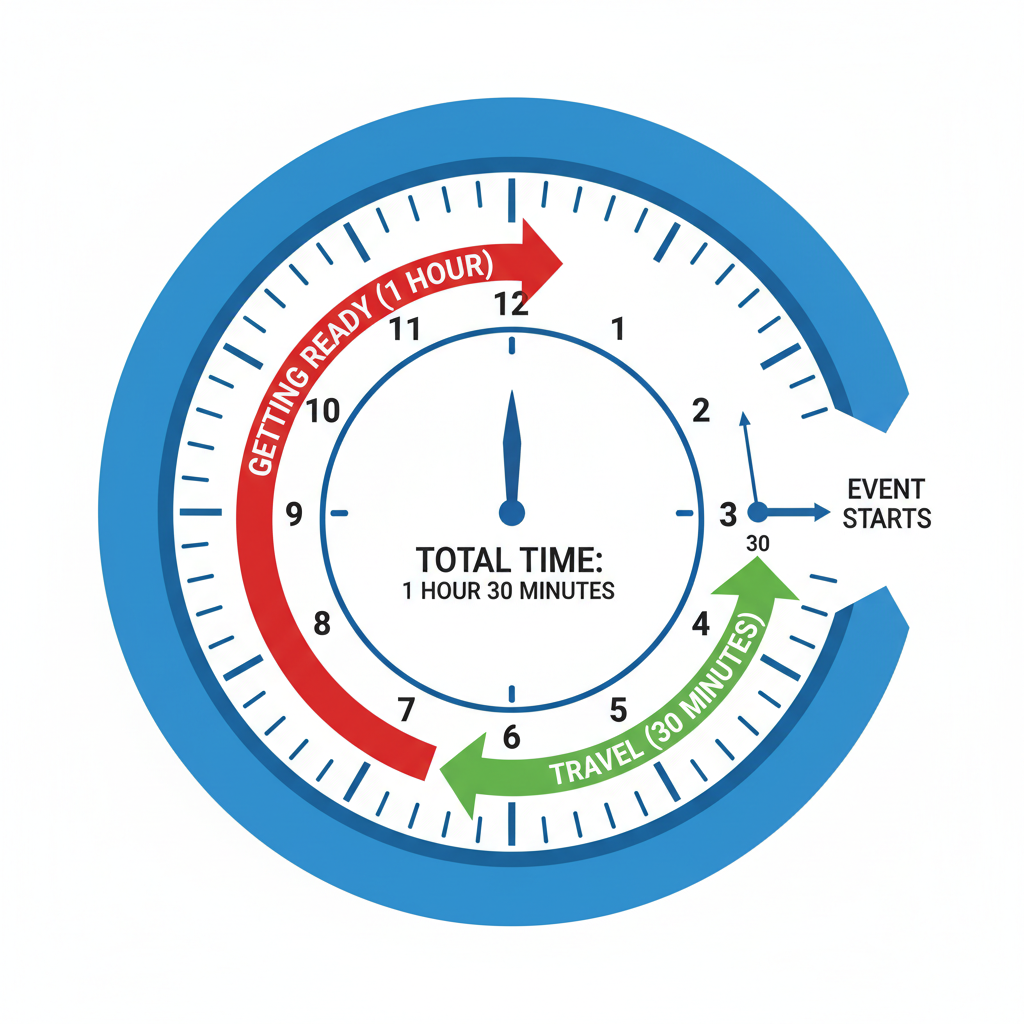 ⚠️ This picture may have spelling mistakes. Trust the words in the lesson.
Thinking About Return Trips and Delays
What about coming back home? Or what if there's traffic?
- Return Trip: If you plan to come back, you'll need to calculate the time for the return journey too, which is usually the same distance and speed.
- Traffic/Delays: Real life isn't always perfect! Sometimes roads are busy, or there are unexpected stops. It's wise to add a little extra time to your plan, just in case. Think of it as a 'waiting buffer' or 'surprise time'!
Analogy: Imagine you're packing your backpack for school. You know you need your books and lunchbox. But what if it rains? You might also want to pack an umbrella. That umbrella is like adding extra time for delays – it's being prepared for the unexpected!
Practice Makes Perfect!
The more you practice planning trips, the better you'll become at it! You can even try planning trips to the park, to a friend's house, or imagining a trip to a faraway city.
Remember:
- Distance is how far.
- Speed is how fast.
- Time is how long.
- Distance = Speed × Time is your superpower!
Let's get ready for some practice questions!
Keep learning, free
Create a free Syllabax account to unlock practice questions and games for this topic.
Visual Learning Enhanced! 🚀
To help you master this topic, we use Advanced Syllabax AI to generate detailed diagrams and visual models.
Note on Visuals: The AI sometimes makes spelling errors in image labels. Please refer to the lesson text for the correct terminology.