Puzzle-based reasoning (Logical Reasoning)
Watch this topic in 60 seconds
Free preview · Lesson 1
Understanding Puzzle-based reasoning (Logical Reasoning)
Unlocking the Secrets: A Guide to Puzzle-Based Logical Reasoning (Grade 10)
Welcome, 10th graders, to the exciting world of Puzzle-Based Logical Reasoning! Think of your brain as a super-powered detective, and logical reasoning as the magnifying glass, fingerprint kit, and clever deductions it uses to solve mysteries. Every day, you use logical reasoning without even realizing it – from figuring out the best route to school based on traffic, to deciding which chores to do first, or even predicting what your friend might say next.
What Exactly is Puzzle-Based Logical Reasoning?
At its core, puzzle-based logical reasoning is about using clues, facts, and observations to come to a sensible conclusion. It's not about guessing; it's about connecting the dots in a way that makes sense. Imagine you're trying to solve a jigsaw puzzle. You don't just randomly put pieces together. You look at the colors, the shapes, the picture on the box, and you systematically find pieces that fit. That's logical reasoning in action!
The 'Puzzle' Part: More Than Just Games
When we say 'puzzle-based,' we're not just talking about Sudoku or crosswords (though those are great for practice!). We're talking about any situation where you're given a set of information, and you need to use logic to figure out the answer. These 'puzzles' often appear in the form of word problems, riddles, or scenarios with multiple variables.
The 'Logical Reasoning' Part: Your Brain's Superpower
Logical reasoning is your brain's ability to think systematically and draw valid conclusions from given information. It's like building a strong, sturdy bridge. Each piece of information is a support beam, and your logic is the engineering that connects them all, ensuring the bridge (your conclusion) doesn't collapse. If one beam is missing or placed incorrectly, the whole structure is weak.
Core Concepts: The Tools in Your Detective Kit
1. Identifying the Clues (Premises)
Every logical puzzle starts with clues. In logical terms, these clues are called 'premises.' Premises are statements or facts that are assumed to be true for the purpose of the puzzle. Think of it like a treasure hunt: the premises are the individual clues on the map, telling you 'go three paces north,' or 'look under the big oak tree.' Without these initial clues, you wouldn't know where to start!
Analogy: If you're baking a cake, the ingredients list (flour, sugar, eggs) are your premises. You assume these ingredients are available and in good condition to start baking.
2. Finding the Connections (Inference)
Once you have your clues, the next step is to see how they relate to each other. This process of drawing a conclusion from given premises is called 'inference.' It's about making a logical jump from what you know to what you can deduce.
Example:
Premise 1: All cats like to nap.
Premise 2: My pet, Whiskers, is a cat.
Inference: Therefore, Whiskers likes to nap.
You didn't have to be told directly that Whiskers likes to nap; you inferred it from the two premises. It's like putting two pieces of a jigsaw puzzle together and suddenly seeing a larger part of the picture emerge.
3. The Big Picture (Conclusion)
The conclusion is the final answer or the logical outcome you arrive at after processing all the clues and making inferences. It's the 'Aha!' moment where everything clicks into place. A strong conclusion is directly supported by the premises and the logical steps taken.
Analogy: If the premises are ingredients and the inference is the baking process, the conclusion is the delicious, perfectly baked cake!
Strategies for Solving Logical Puzzles: Your Detective Techniques
1. Read Carefully and Understand Everything
This is the most crucial first step. Many mistakes happen because of a misunderstanding of the problem. Read the puzzle multiple times if necessary. Identify all the characters, objects, and actions involved. What are you being asked to find?
Analogy: Before starting a complex board game, you'd read the rules thoroughly, right? Missing a single rule can change the entire game.
2. Break It Down (Decomposition)
Don't try to solve the entire puzzle at once. Break it into smaller, manageable pieces. Address one clue or one relationship at a time. This makes the problem less overwhelming.
Analogy: If you're building a LEGO castle, you don't dump all the pieces on the floor and try to build the whole thing simultaneously. You follow steps, building one section at a time.
3. Organize Your Information (Tables & Diagrams)
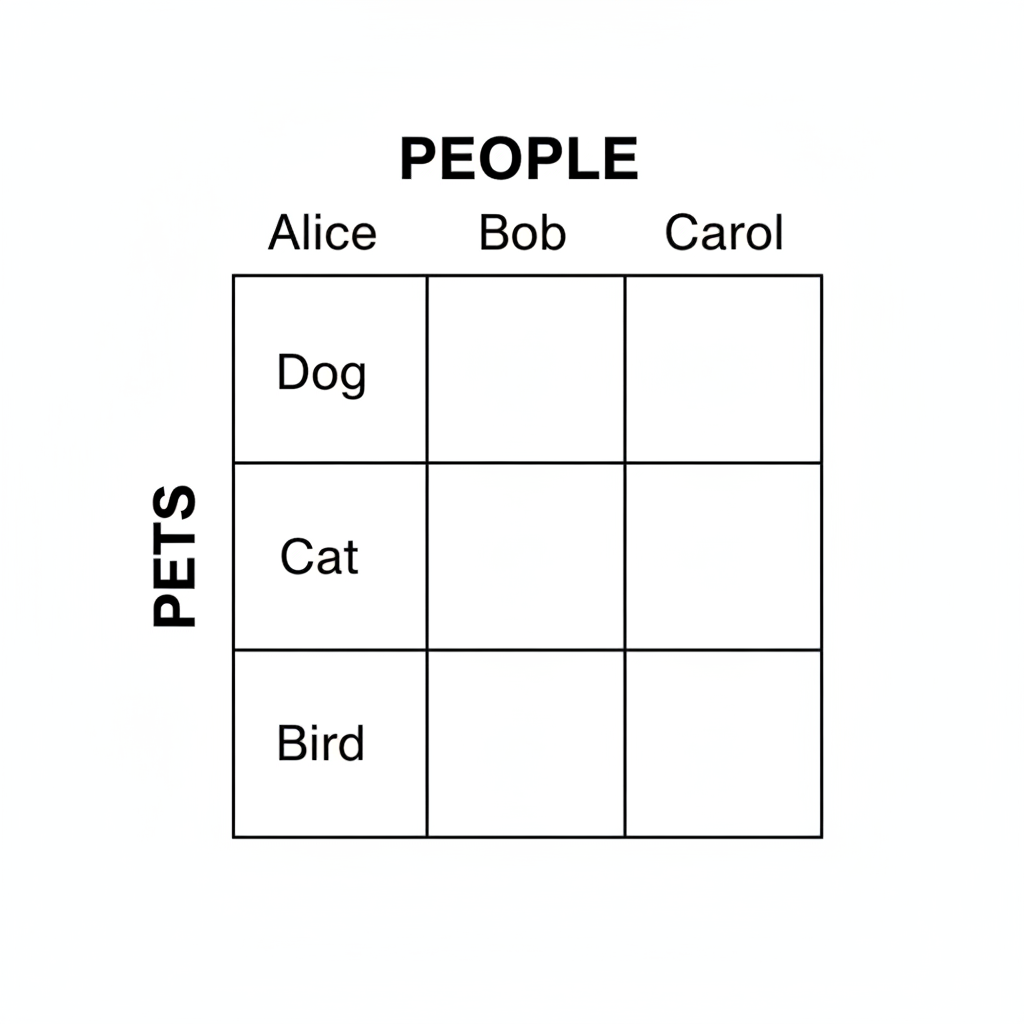
When you have many clues and variables, it's easy to get confused. Using tables, grids, or diagrams can help you organize the information visually. This is especially useful for puzzles where you need to match people to items, colors, or locations.
Imagine you have three friends (Alex, Ben, Clara) and three pets (Dog, Cat, Fish), and you have clues like 'Alex doesn't like fish' or 'The person with the cat loves to read.' A simple grid can help you mark off possibilities and pinpoint the correct matches.
4. Eliminate Possibilities (Process of Elimination)
This is a powerful technique. As you gather clues, you can often rule out certain options. If a clue says 'John is not wearing blue,' then you know John must be wearing one of the other colors available. Systematically eliminating what *can't* be true often leaves you with what *must* be true.
Analogy: If you're looking for a specific book in a library, and you know it's not in the fiction section, you've eliminated a huge number of shelves, making your search much easier.
5. Check Your Work (Verification)
Once you think you have the answer, go back and check if it fits *all* the original clues. If your conclusion contradicts even one piece of information, then your reasoning has a flaw, and you need to re-evaluate.
Analogy: If you've solved a math problem, you often plug your answer back into the original equation to ensure it holds true. It's the same principle here.
Common Types of Logical Puzzles You Might Encounter
While puzzles come in countless forms, here are a few common types that are great for practicing foundational logical reasoning:
- Matching Puzzles: These involve matching items from different categories based on a series of clues (e.g., matching people to their jobs, pets, and favorite colors).
- Ordering Puzzles: These require you to place items or people in a specific sequence based on clues (e.g., who finished a race in what order, or arranging events chronologically).
- True/False Statement Puzzles: These give you statements where some are true and some are false, and you need to deduce who is telling the truth based on contradictions or consistency.
Why is This Important?
Logical reasoning isn't just for solving fun puzzles. It's a skill you'll use constantly in school and throughout your life. It helps you:
- Solve Math Problems: Many complex math problems require logical steps.
- Understand Science: Analyzing experiments and drawing conclusions from data.
- Write Better Essays: Building strong arguments and supporting them with evidence.
- Make Good Decisions: Evaluating options and consequences in your daily life.
- Become a Critical Thinker: Not just accepting information, but questioning it and forming your own reasoned opinions.
So, get ready to sharpen your brain detective skills! The more you practice puzzle-based logical reasoning, the better you'll become at solving problems in all areas of your life.
Keep learning, free
Create a free Syllabax account to unlock practice questions and games for this topic.
Visual Learning Enhanced! 🚀
To help you master this topic, we use Advanced Syllabax AI to generate detailed diagrams and visual models.
Note on Visuals: The AI sometimes makes spelling errors in image labels. Please refer to the lesson text for the correct terminology.