How sound is produced[PHYSICS]
Watch this topic in 60 seconds
Free preview · Lesson 1
Understanding How sound is produced[PHYSICS]
How Sound is Produced: The Wonderful World of Vibrations!
Have you ever wondered what makes the sound of a bell ringing, a guitar string strumming, or your own voice speaking? It might seem like magic, but it's all thanks to a fundamental concept in physics: **vibrations**!
What is a Vibration?
Imagine a tiny, quick back-and-forth movement. That's a vibration! Think about:
- A plucked guitar string: It wiggles back and forth very rapidly.
- A drum skin: When you hit it, the surface shakes.
- Your vocal cords: These are like tiny bands in your throat that flutter open and closed incredibly fast when you talk or sing.
These rapid movements are the secret ingredient for making sound. Without vibrations, there would be no sound!
How Vibrations Create Sound: The Domino Effect
So, how does a tiny wiggle turn into something we can hear? It's like a chain reaction, or a domino effect, that travels through the air.
When an object vibrates, it bumps into the tiny particles (like little invisible balls) of the air around it. These air particles are normally spread out evenly.
Imagine this:
Analogy 1: The Dropped Pebble in a Pond
When you drop a pebble into a still pond, it creates ripples that spread outwards. The pebble disturbed the water, and those disturbances traveled across the surface. Sound travels through the air in a similar way, but instead of water, it's the air particles that get disturbed.
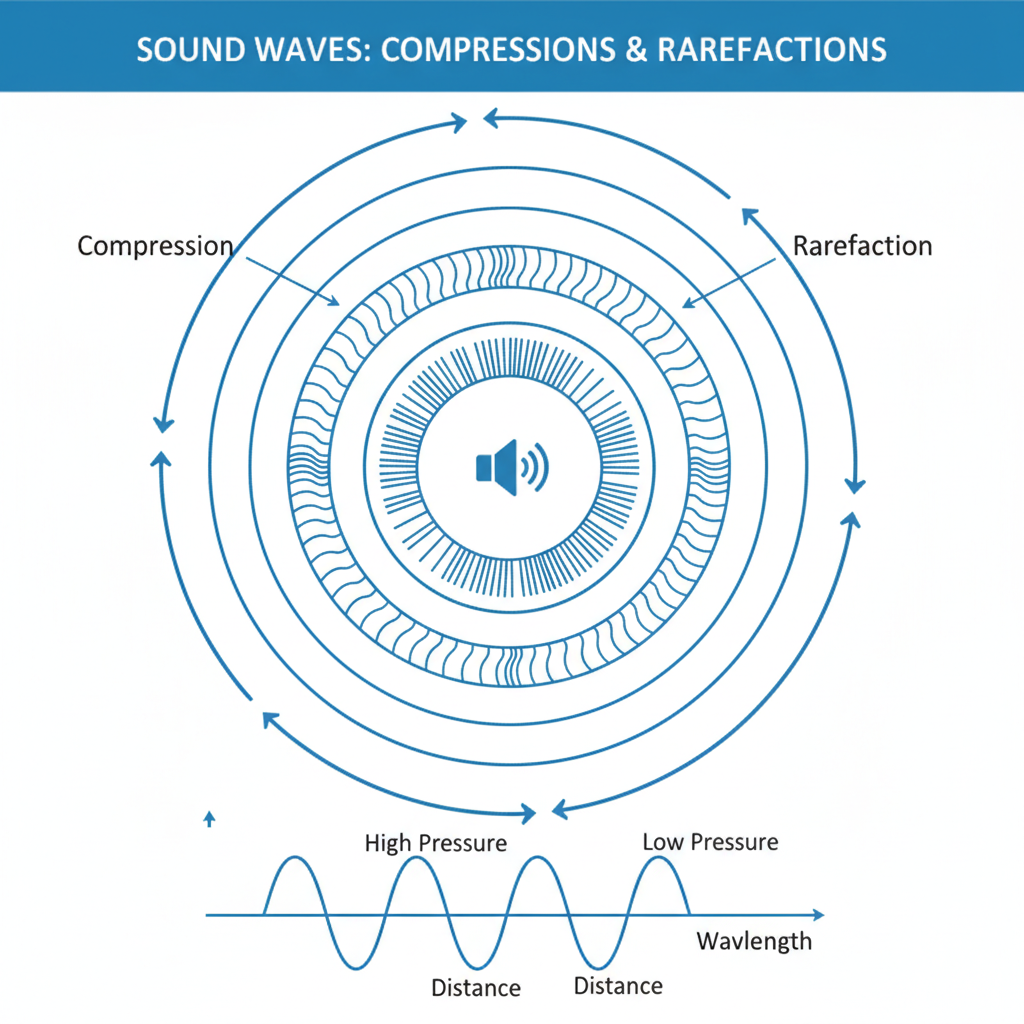
When the vibrating object pushes outwards, it squishes the air particles together. This creates an area of higher pressure, called a **compression**. Then, as the object moves back, it creates a space where the air particles are spread further apart. This is an area of lower pressure, called a **rarefaction**.
These compressions and rarefactions travel outwards from the vibrating source, like waves in the pond. This traveling disturbance is what we call a **sound wave**.
Analogy 2: The Slinky Wave
Take a slinky toy. If you push one end forward and then pull it back quickly, you'll see a wave travel down the slinky. The coils of the slinky bunch up (compression) and then spread out (rarefaction) as the wave passes. Sound waves work in a very similar way through the air particles.
So, the vibrating object shakes the air particles next to it, which then shake the particles next to them, and so on. This chain reaction continues all the way to your ears!
What Makes Different Sounds?
Not all vibrations are the same, and that's why we hear so many different sounds. Two main things affect the sound we hear:
1. How Fast Something Vibrates (Frequency)
The speed at which an object vibrates is called its **frequency**. Frequency is measured in Hertz (Hz), which means cycles (back-and-forth movements) per second.
- High frequency = High pitch: If something vibrates very quickly, it produces a high-pitched sound. Think of a tiny whistle or a chirping bird.
- Low frequency = Low pitch: If something vibrates slowly, it produces a low-pitched sound. Think of a deep drum beat or a foghorn.
Analogy 3: Running vs. Walking
Imagine two people walking towards you. One is walking slowly, and the other is running. The person running is moving their legs back and forth much faster – they have a higher frequency of steps. Similarly, a high-pitched sound comes from something vibrating quickly (high frequency).
2. How Big the Vibration Is (Amplitude)
The size or intensity of a vibration is called its **amplitude**. Amplitude is related to how much energy the vibration has.
- High amplitude = Loud sound: If an object vibrates with a large movement (large amplitude), it pushes the air particles with more force, creating stronger compressions and rarefactions. This results in a loud sound. Think of a thunderclap or a loud shout.
- Low amplitude = Soft sound: If an object vibrates with a small movement (small amplitude), it creates weaker compressions and rarefactions. This results in a soft sound. Think of a whisper or a gentle breeze rustling leaves.
Analogy 4: A Gentle Wave vs. a Big Wave
Imagine waves on the beach. A small, gentle wave barely reaches your feet (low amplitude, soft sound). A big, crashing wave can knock you over (high amplitude, loud sound).
Where Can We See Vibrations Producing Sound?
Let's look at some everyday examples:
- Musical Instruments:
- Guitar: Strumming a string makes it vibrate. The tighter and thinner the string, the faster it vibrates, producing a higher pitch.
- Drums: Hitting the drum skin makes it vibrate. A bigger hit makes the skin vibrate with more amplitude, producing a louder sound.
- Flute: When you blow across the opening, you make the air inside the flute vibrate. Changing the length of the vibrating air column by pressing keys changes the pitch.
- Your Voice:
- Your vocal cords are like two small flaps of skin in your throat. When you speak or sing, air from your lungs makes them vibrate. By changing how tight or relaxed your vocal cords are, you change the pitch of your voice.
- Bells:
- When you strike a bell, its metal surface vibrates, sending sound waves through the air.
- Speakers:
- Inside a speaker, there's a cone that moves back and forth very rapidly, driven by an electrical signal. This cone vibrates the air in front of it, creating the sounds you hear from music or a movie.
Here's a visual to help understand how sound travels:
Summary: The Core Idea
Sound is produced when an object vibrates. These vibrations create disturbances in the air (or other materials) that travel as waves to our ears. The speed of the vibration (frequency) determines the pitch, and the size of the vibration (amplitude) determines the loudness.
So next time you hear a sound, remember the amazing dance of vibrations that made it possible!
Keep learning, free
Create a free Syllabax account to unlock practice questions and games for this topic.
Visual Learning Enhanced! 🚀
To help you master this topic, we use Advanced Syllabax AI to generate detailed diagrams and visual models.
Note on Visuals: The AI sometimes makes spelling errors in image labels. Please refer to the lesson text for the correct terminology.