Kaleidoscope & periscope[PHYSICS]
Watch this topic in 60 seconds
Free preview · Lesson 1
Understanding Kaleidoscope & periscope[PHYSICS]
Kaleidoscope & Periscope: Mirrors in Action!
Have you ever looked through a kaleidoscope and seen those amazing, repeating patterns? Or maybe you've seen a submarine periscope peeking out of the water? Both of these cool gadgets use a simple but powerful scientific principle: the reflection of light using mirrors!
What is Reflection?
Imagine you're standing in front of a mirror. What do you see? You see yourself! That's because light from you bounces off the mirror and comes back to your eyes. This bouncing of light is called reflection. Think of it like a ball bouncing off a wall. When the ball hits the wall, it doesn't go through it; it bounces back. Light does the same thing when it hits a smooth, shiny surface like a mirror.
There are two important things to remember about reflection:
- The Angle of Incidence equals the Angle of Reflection: Imagine a ray of light hitting a mirror. The angle at which the light hits the mirror (called the angle of incidence) is exactly the same as the angle at which it bounces off (called the angle of reflection). It's like throwing a bouncy ball at a wall – if you throw it straight at the wall, it bounces straight back. If you throw it at an angle, it bounces off at the same angle.
- The image is reversed: When you look in a mirror, your right hand appears to be your left hand in the reflection. This is called lateral inversion.
The Kaleidoscope: A World of Patterns!
A kaleidoscope is like a magic tube that creates beautiful, symmetrical patterns. How does it work?
Inside a kaleidoscope, there are usually three mirrors placed at angles to each other. These mirrors are arranged to form a triangular prism. When you look through one end of the tube, and shine light into the other end where there are colorful pieces of glass or beads, something amazing happens.
The light enters the tube and hits the colorful pieces, scattering light. This scattered light then bounces off the mirrors multiple times. Because of the angles of the mirrors, the light reflects over and over, creating many images of the colorful pieces. These reflected images overlap and combine to form a complex, symmetrical pattern. When you rotate the tube, the colorful pieces move, and the mirrors create a whole new pattern!
Analogy: Think of standing between two parallel mirrors in a funhouse. You see yourself reflected many, many times, stretching into the distance. A kaleidoscope does something similar, but with mirrors angled together, which creates a more contained and colorful repeating pattern.
Key components of a kaleidoscope:
- Mirrors: Usually three mirrors placed at specific angles (often 60 degrees to each other) to create the repeating patterns.
- Object Chamber: A section at one end containing colorful beads, glass fragments, or other small, translucent objects.
- Eyepiece: The end you look through.
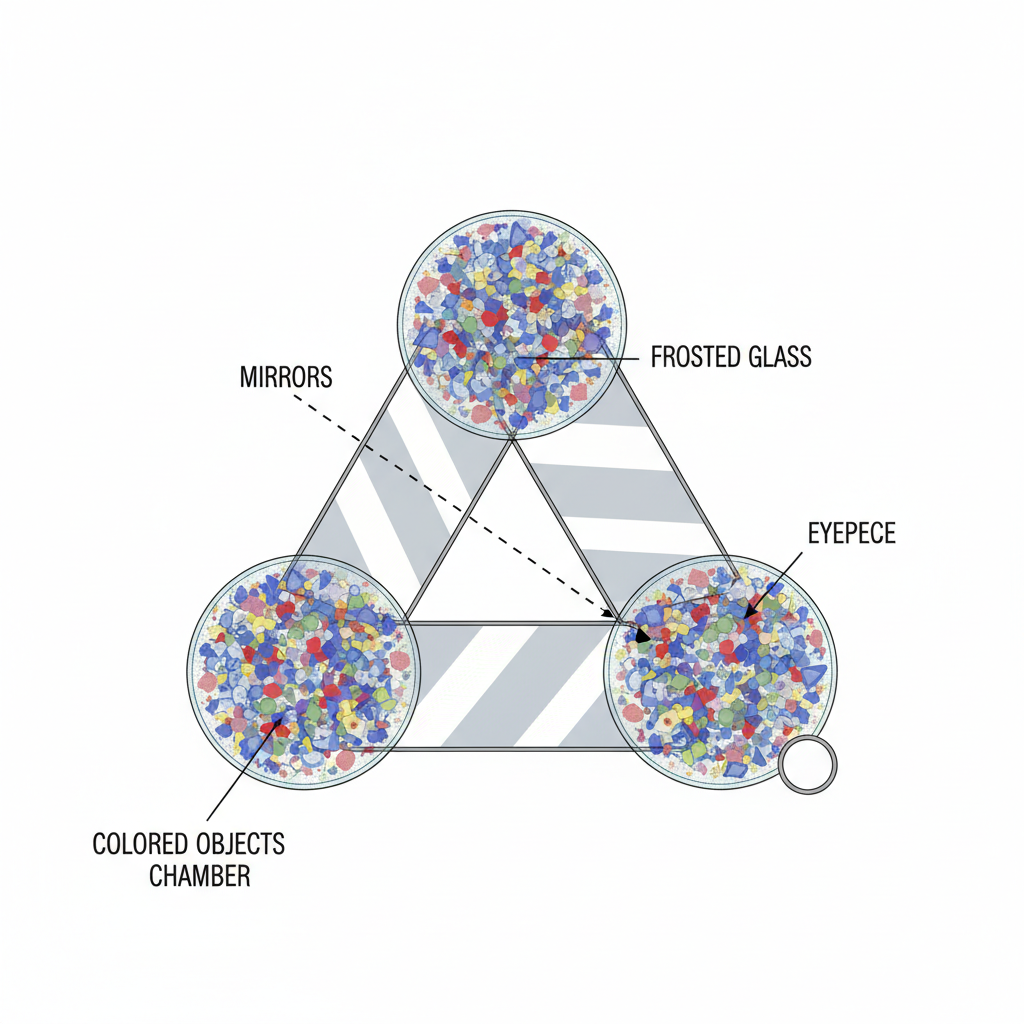 ⚠️ This picture may have spelling mistakes. Trust the words in the lesson.
The Periscope: Seeing Around Corners!
A periscope is a device that allows you to see things that are out of your direct line of sight. It's like having a secret window that lets you peek over or around obstacles.
How does it work? A simple periscope uses two mirrors placed parallel to each other, but angled at 45 degrees inside a tube. Here's the journey of light:
- Light from the object you want to see travels to the top mirror.
- This top mirror reflects the light downwards into the tube.
- The light travels down the tube.
- At the bottom of the tube, another mirror, also angled at 45 degrees, reflects the light horizontally towards your eyes.
This way, you can see something that is above you or around a corner, even if you can't see it directly.
Analogy: Imagine you're trying to see a cat hiding behind a bush. If you hold a mirror at a 45-degree angle on top of the bush, you can see the cat's reflection in the mirror. Then, if you hold another mirror at a 45-degree angle at your eye level, you can see the reflection of the first mirror (which shows the cat), allowing you to see the cat without moving from your spot!
Periscopes are famously used in submarines so sailors can see what's happening on the surface of the water without having to surface themselves. They are also used in tanks and by soldiers to see over fortifications.
Key components of a periscope:
- Two Mirrors: Placed parallel to each other, each angled at 45 degrees to the vertical tube.
- Tube: A long body that holds the mirrors and allows light to travel from the top to the bottom.
- Eyepiece: The opening at the bottom where the observer looks.
- Objective Lens: The opening at the top to capture light from the scene.
Why Mirrors?
Mirrors are used because they are very good at reflecting light. Unlike a regular surface, which might absorb or scatter light, mirrors are coated with a special material (like silver or aluminum) that reflects most of the light that hits it. This strong reflection is what makes both kaleidoscopes and periscopes work so well!
So, the next time you play with a kaleidoscope or see a periscope, remember the magic of reflection and how simple mirrors can create amazing visual experiences and allow us to see the world in new ways!
Keep learning, free
Create a free Syllabax account to unlock practice questions and games for this topic.
Visual Learning Enhanced! 🚀
To help you master this topic, we use Advanced Syllabax AI to generate detailed diagrams and visual models.
Note on Visuals: The AI sometimes makes spelling errors in image labels. Please refer to the lesson text for the correct terminology.