Mole concept (basic introduction) [CHEMISTRY]
Watch this topic in 60 seconds
Free preview · Lesson 1
Understanding Mole concept (basic introduction) [CHEMISTRY]
Mastering the "Mole": Your Chemical Counting Unit
Welcome, future chemists! Today, we're going to unlock one of the most fundamental and powerful concepts in all of chemistry: the mole. Don't let the name scare you – it's not a furry animal burrowing in your garden! In chemistry, the 'mole' is simply a very special way of counting things, especially the incredibly tiny particles that make up everything around us.
Why Do We Even Need a "Mole"?
Imagine trying to count all the grains of sand on a beach, one by one. Impossible, right? Or perhaps counting every single drop of water in an ocean. Again, not going to happen! Now, imagine trying to count something even smaller – atoms and molecules. These particles are so incredibly tiny that a single drop of water contains trillions upon trillions of them. They are far too small to see, let alone count individually with our eyes or even the most powerful microscopes.
This is where the mole comes comes in. Chemists deal with reactions where billions of billions of atoms and molecules are interacting. We need a way to talk about large groups of these particles in a manageable way. Just like we have specific units for large quantities in everyday life, chemists have the mole.
Analogy Time! Counting in Groups
Analogy 1: The Dozen
Think about buying eggs at the grocery store. You don't usually ask for 12 individual eggs, do you? You ask for a dozen eggs. A 'dozen' is a convenient word that immediately tells you you're getting 12 items. It's a standard grouping that makes counting and packaging much easier.
- 1 dozen eggs = 12 eggs
- 1 dozen donuts = 12 donuts
- 1 dozen roses = 12 roses
The number is always 12, regardless of what you're counting. The 'dozen' is a counting unit.
Analogy 2: The Ream of Paper
If you've ever bought paper for a printer, you might have noticed it comes in packs called 'reams'. A ream of paper always contains 500 sheets of paper. It's another counting unit for a specific, larger quantity.
- 1 ream of paper = 500 sheets of paper
Chemists needed a 'dozen' or a 'ream' for atoms and molecules. But because atoms are so incredibly small, their 'dozen' had to be a mind-bogglingly huge number!
Introducing The Mole: Our Chemical Dozen
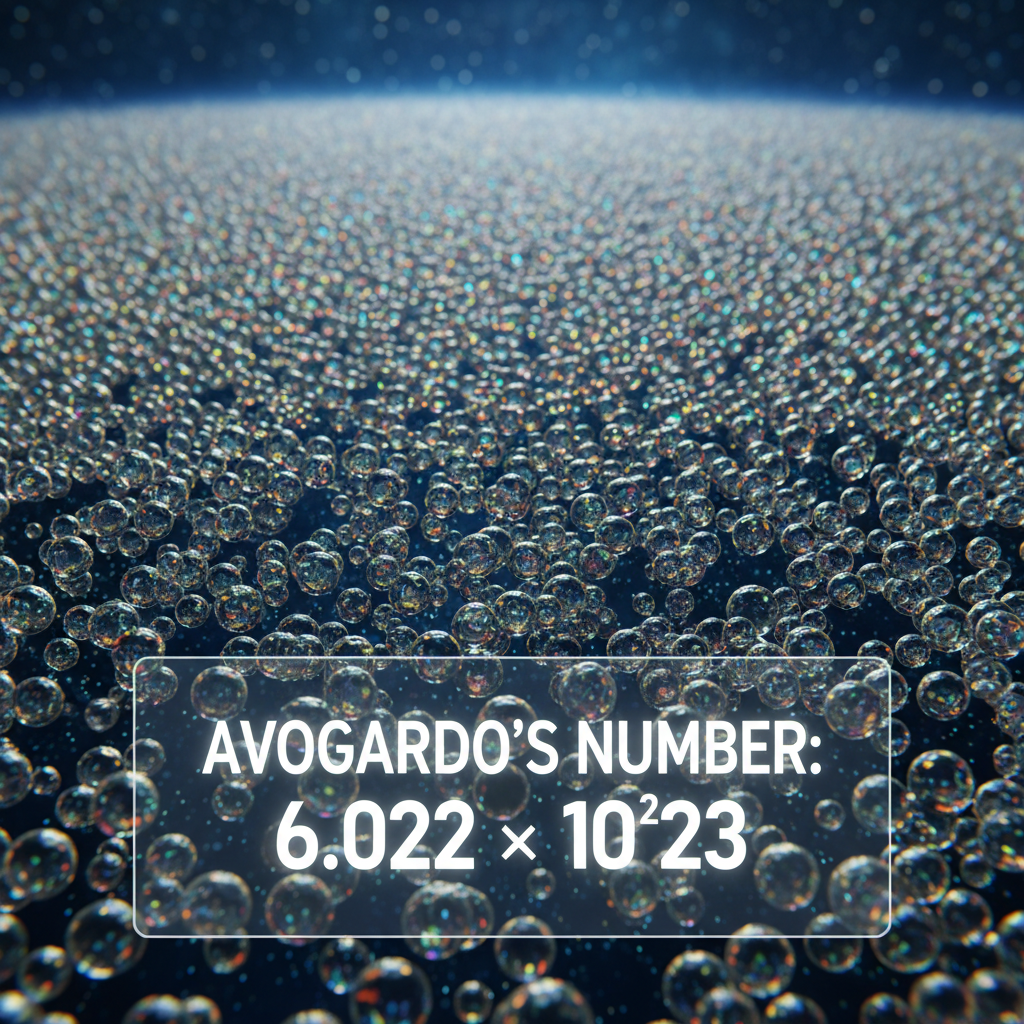
In chemistry, our special counting unit for atoms, molecules, ions, or any other microscopic particles is called the mole. And just like a dozen always means 12, a mole always means a very specific, very large number of particles. This number is known as Avogadro's Number.
Avogadro's Number: The Magic Number
One mole of anything contains approximately 6.022 x 10²³ particles. Yes, that's 602,200,000,000,000,000,000,000 particles! It's a number so vast it's hard to even imagine.
So, when a chemist says they have:
- 1 mole of oxygen atoms, they mean they have 6.022 x 10²³ oxygen atoms.
- 1 mole of water molecules, they mean they have 6.022 x 10²³ water molecules.
- 1 mole of protons, they mean they have 6.022 x 10²³ protons.
It's always the same number, just like a dozen is always 12.
How Big is Avogadro's Number, Really?
Let's try some analogies to grasp the sheer scale of 6.022 x 10²³:
- If you had a mole of pennies, and you distributed them equally among everyone on Earth (about 8 billion people), each person would get enough money to spend over a billion dollars every single hour, for their entire life!
- If you could count atoms at a rate of 10 million per second, it would still take you about 2 billion years to count just one mole of atoms!
- A mole of grains of sand would cover the entire state of Texas to a depth of several feet!
These analogies highlight that the mole is designed to count things that are unbelievably small and present in truly astronomical quantities.
The Link Between Moles and Mass: Molar Mass
So, we know the mole is a counting unit. But how do we actually use it in the lab? We can't count atoms, but we *can* measure mass using a balance. This is where the beauty of the mole concept shines: it connects the number of particles (moles) to their measurable mass (grams).
Atomic Mass (amu) vs. Molar Mass (grams/mol)
You've probably seen atomic masses on the periodic table. For example, carbon has an atomic mass of approximately 12.011 atomic mass units (amu). An 'amu' is a tiny unit used for measuring the mass of individual atoms.
The amazing thing about the mole is this:
The numerical value of an element's atomic mass in amu is the same as the mass in grams of one mole of that element.
This mass is called the molar mass, and its units are grams per mole (g/mol).
Let's look at some examples:
- Carbon (C): Atomic mass = 12.011 amu. Therefore, 1 mole of Carbon atoms has a mass of 12.011 grams. (Molar mass of C = 12.011 g/mol)
- Oxygen (O): Atomic mass = 15.999 amu. Therefore, 1 mole of Oxygen atoms has a mass of 15.999 grams. (Molar mass of O = 15.999 g/mol)
- Hydrogen (H): Atomic mass = 1.008 amu. Therefore, 1 mole of Hydrogen atoms has a mass of 1.008 grams. (Molar mass of H = 1.008 g/mol)
Calculating Molar Mass for Compounds
What about compounds like water (H2O)? To find the molar mass of a compound, you just add up the molar masses of all the atoms in its chemical formula:
Example: Water (H2O)
- Water has 2 Hydrogen atoms and 1 Oxygen atom.
- Molar mass of H = 1.008 g/mol
- Molar mass of O = 15.999 g/mol
Calculation:
(2 × Molar mass of H) + (1 × Molar mass of O)
(2 × 1.008 g/mol) + (1 × 15.999 g/mol)
2.016 g/mol + 15.999 g/mol = 18.015 g/mol
So, 1 mole of water molecules (which is 6.022 x 10²³ water molecules) has a mass of 18.015 grams.
This connection is incredibly useful! It means we can weigh out a certain mass of a substance in grams and know exactly how many moles (and thus, how many particles) we have.
The Mole: Your Bridge Between Worlds
In summary, the mole concept is the chemist's way of dealing with the enormous number of tiny particles (atoms, molecules, ions) involved in chemical reactions. It provides a crucial bridge between the microscopic world of individual atoms and molecules (which we can't see) and the macroscopic world of grams and liters (which we can measure in the lab).
By understanding the mole, you can predict how much product you'll get from a reaction, determine how much reactant you need, and truly understand the quantitative side of chemistry. Keep practicing, and the mole will become one of your best friends in the chemistry lab!
Keep learning, free
Create a free Syllabax account to unlock practice questions and games for this topic.
Visual Learning Enhanced! 🚀
To help you master this topic, we use Advanced Syllabax AI to generate detailed diagrams and visual models.
Note on Visuals: The AI sometimes makes spelling errors in image labels. Please refer to the lesson text for the correct terminology.