Introduction to Robotics
Watch this topic in 60 seconds
Free preview · Lesson 1
Understanding Introduction to Robotics
Welcome to the World of Robotics!
Imagine a world where machines can help you with your chores, explore distant planets, or even perform complex surgeries. This isn't science fiction anymore – it's the exciting world of robotics! In this lesson, we're going to embark on an adventure to understand what robots are, how they work, and why they are becoming such an important part of our lives. Get ready to meet your future robot friends!
What Exactly is a Robot?
Have you ever seen a self-driving car, a robot vacuum cleaner zooming around your house, or a giant arm building cars in a factory? These are all examples of robots! Simply put, a robot is a machine designed to carry out a complex series of actions automatically. Think of a robot as a super-smart tool that can follow instructions and do tasks without needing a human to control every single step.
Let's use an analogy: Imagine you have a recipe for baking cookies. A regular machine (like a mixer) can help you with one part of the recipe (mixing). But a robot is like a super chef who can read the entire recipe, gather the ingredients, mix them, put them in the oven, and even take the cookies out when they're done – all by itself, following the steps you gave it!
The "Body Parts" of a Robot: What Makes Them Tick?
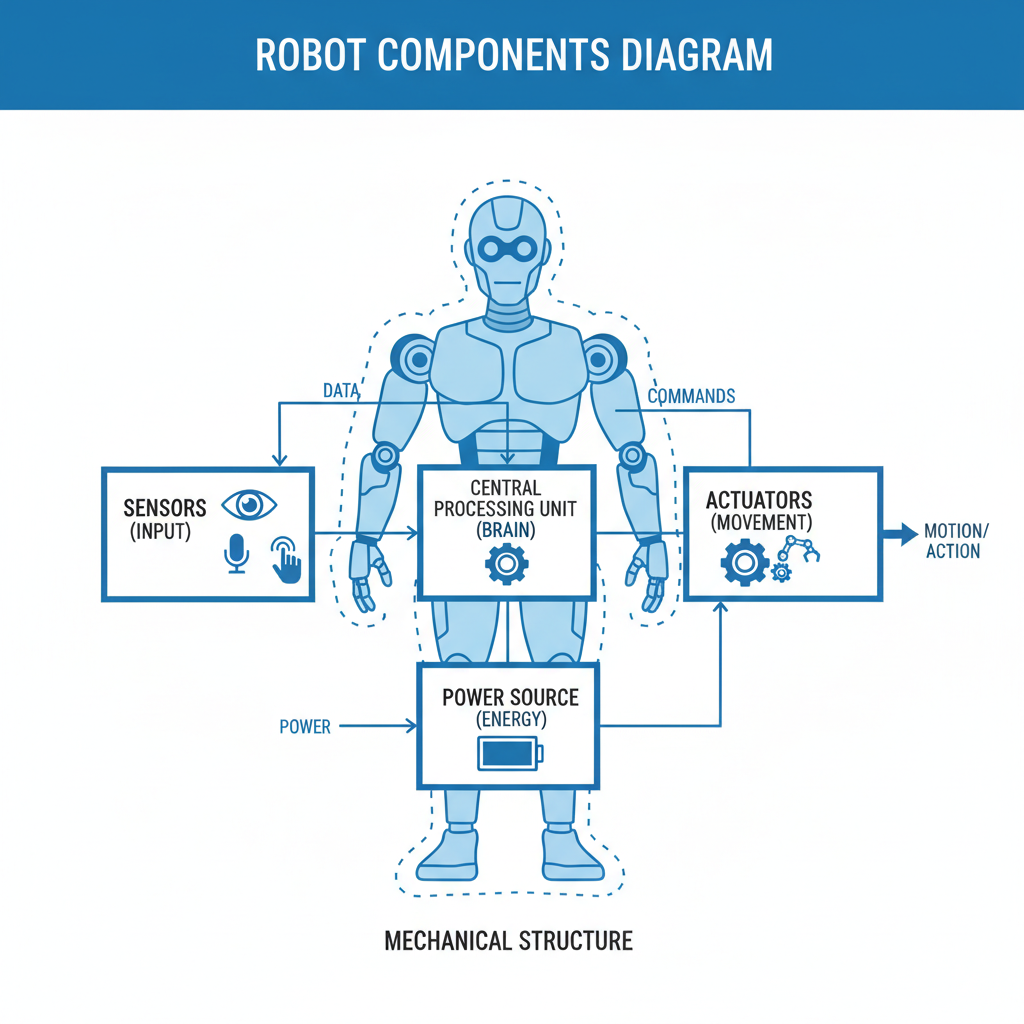
Just like humans have different body parts that work together, robots also have several key components that allow them to function. Let's break them down:
1. The Body (Mechanical Structure)
This is the physical frame and parts of the robot. It’s what gives the robot its shape and allows it to hold other components. Think of it as the robot's skeleton and muscles! Some robots have arms, wheels, legs, or tracks, depending on what they are designed to do. A robot designed to lift heavy objects in a factory will have a very strong, rigid body, while a robot designed to explore uneven terrain might have flexible legs or robust wheels.
Analogy: Just like your skeleton gives you shape and support, a robot's mechanical structure provides its framework. And just as your muscles help you move, a robot's mechanical parts (like joints and linkages) allow for movement.
2. The Brain (Controller/Processor)
Every robot needs a "brain" to tell it what to do. This is usually a computer or a microchip. The brain receives information, processes it, and sends commands to other parts of the robot. It stores all the instructions (the "program" or "code") that the robot needs to follow.
Analogy: Your brain tells your hands to pick up a pencil or your legs to walk. Similarly, a robot's controller is the central processing unit that interprets commands and coordinates all the robot's actions. It's like the conductor of an orchestra, making sure all the instruments play at the right time.
3. The Senses (Sensors)
How does a robot know what's happening around it? It uses sensors! Sensors are like the robot's eyes, ears, and sense of touch. They collect information from the environment and send it to the robot's brain.
- Light Sensors: Detect light and darkness (like our eyes). Some robots can follow lines on the floor or avoid obstacles by detecting shadows.
- Touch/Pressure Sensors: Detect when something is physically touching the robot (like our skin). These are useful for grasping objects gently or knowing when it has bumped into something.
- Distance Sensors: Measure how far away objects are (like a bat using sonar). This helps robots avoid crashing into walls or other robots.
- Temperature Sensors: Measure how hot or cold something is.
- Sound Sensors (Microphones): Allow robots to "hear" sounds, or even recognize spoken commands.
Analogy: If you close your eyes, you can't see where you're going. Robots rely on their sensors just like we rely on our senses to understand the world around us.
4. The Movement (Actuators/Motors)
Once the robot's brain has decided what to do, it needs a way to move or act. This is where actuators come in. Actuators are devices that convert energy (usually electrical) into physical motion. Motors are the most common type of actuator.
- Motors: Make wheels turn, arms swing, or grippers close.
- Gears: Help motors transfer power and change speed or force, much like a bicycle uses gears to make pedaling easier or faster.
- Hydraulic/Pneumatic Systems: Use liquids (hydraulic) or air (pneumatic) pressure to create powerful movements, often seen in large industrial robots or heavy machinery.
Analogy: Actuators are like the robot's muscles, making it move, lift, push, or pull. When your brain decides to pick up a book, your muscles contract to move your arm and hand. A robot's brain sends a signal to its motors, which then make the arm move.
 ⚠️ This picture may have spelling mistakes. Trust the words in the lesson.
5. The Power Source
Robots need energy to operate, just like you need food to play and learn! This energy usually comes from batteries, electrical outlets, or sometimes even solar power or fuel cells, depending on the robot's design and purpose.
Analogy: A robot's power source is like the food you eat or the gasoline in a car. Without energy, nothing works!
How Do Robots Work? The "Sense-Think-Act" Cycle
Most robots follow a simple, repeating pattern to do their jobs. We call this the Sense-Think-Act cycle:
- Sense: The robot uses its sensors to gather information from its environment. (e.g., A light sensor "sees" a dark line on the floor, or a distance sensor detects an obstacle).
- Think: The robot's brain (controller) processes this information using its programmed instructions. It decides what to do next based on what its sensors detected. (e.g., "If I see a dark line, I need to follow it. If I detect an obstacle, I need to stop or turn.").
- Act: The robot uses its actuators (motors) to perform an action based on its decision. (e.g., Its wheels turn to follow the line, or it stops moving).
This cycle repeats continuously, allowing the robot to interact with its surroundings and complete its tasks.
Analogy: Imagine you're walking and see a puddle (Sense). Your brain quickly thinks, "I should step around that puddle to avoid getting wet" (Think). Then, your legs move to step around the puddle (Act). Robots do something very similar, but with programmed instructions!
Where Do We Find Robots? A World Full of Automation!
Robots are not just found in sci-fi movies; they are all around us! Here are a few places:
- Factories: Industrial robots are common in car factories, assembling parts, welding, and painting. They do repetitive, precise, and sometimes dangerous tasks quickly and accurately.
- Homes: Robot vacuum cleaners (like Roomba), robotic lawnmowers, and even smart home assistants that respond to your voice are becoming more common.
- Hospitals: Surgical robots assist doctors with incredibly precise operations. Pharmacy robots can sort and dispense medications.
- Exploration: Robots like NASA's Mars rovers explore other planets, sending back amazing images and data. Underwater robots explore the deep oceans, where it's too dangerous for humans.
- Logistics: In warehouses, robots move packages, sort items, and help manage inventory, making sure your online orders arrive quickly.
Why Are Robots So Helpful? The Benefits!
Robots offer many advantages:
- Safety: They can perform dangerous jobs, like diffusing bombs, working in contaminated areas, or exploring volcanoes, keeping humans out of harm's way.
- Precision and Accuracy: Robots can do tasks with incredible accuracy and consistency, like performing delicate surgeries or assembling tiny electronic parts.
- Speed and Efficiency: They can work much faster than humans on repetitive tasks, without getting tired or needing breaks.
- Repetitive Tasks: Robots excel at doing the same thing over and over again without getting bored, which frees up humans to do more creative or complex work.
- Accessibility: Robots can assist people with disabilities, provide companionship, or help with daily tasks.
The Future of Robotics: What's Next?
The field of robotics is constantly evolving. Robots are becoming smarter, more adaptable, and even better at interacting with humans. Imagine robots that can learn new skills by watching you, or robots that can understand and respond to complex emotions. While true human-like intelligence is still a dream, the future holds incredible possibilities for how robots will continue to improve our lives and explore new frontiers.
This journey into robotics is just beginning, and with the foundational knowledge you've gained today, you're ready to explore even more exciting robotic discoveries!
Keep learning, free
Create a free Syllabax account to unlock practice questions and games for this topic.
Visual Learning Enhanced! 🚀
To help you master this topic, we use Advanced Syllabax AI to generate detailed diagrams and visual models.
Note on Visuals: The AI sometimes makes spelling errors in image labels. Please refer to the lesson text for the correct terminology.