Learning Journey
Watch this topic in 60 seconds
Free preview · Lesson 1
Understanding Calendars & clocks (Logical Reasoning)
Calendars & Clocks: Your Everyday Time Travel Guides!
Imagine trying to plan a birthday party without knowing what day of the week it will be, or meeting a friend without knowing if it’s 9 AM or 9 PM! That would be chaos, right? Calendars and clocks are like your personal GPS systems for time. They help us organize our lives, understand the past, plan for the future, and know exactly when to show up for school or dinner!
Part 1: Calendars - Mapping Our Year
A calendar is essentially a system for organizing days into larger units like weeks, months, and years. It helps us keep track of seasons, holidays, and important events.
The Building Blocks of Time: Days, Weeks, Months, and Years
1. The Day: Earth's Own Spin Cycle!
- What it is: A day is the time it takes for the Earth to complete one full rotation on its axis. Think of it like a fidget spinner making one complete turn. When your part of the Earth faces the sun, it's daytime; when it faces away, it's nighttime.
- Duration: Approximately 24 hours.
2. The Week: A Convenient Group of Seven!
- What it is: A week is a period of seven days. This seven-day cycle has ancient origins, possibly from the Babylonians, and is super convenient for planning work and rest cycles.
- Analogy: Imagine a sports team always having 7 players. Every 7 days, a new 'game' starts, with the same sequence of events.
- Days of the Week: Monday, Tuesday, Wednesday, Thursday, Friday, Saturday, Sunday.
3. The Month: From Moon Cycles to Fixed Lengths!
- What it is: Originally, months were based on the cycles of the moon (about 29.5 days). However, our modern calendar uses months with fixed lengths to fit neatly into a year.
- Different Lengths: Most months have 30 or 31 days. February is special, with 28 days (and 29 in a leap year!).
- Handy Trick: The Knuckle Method! Make a fist. Starting with your index finger knuckle as January, count across your knuckles and the spaces between them. Knuckles are 'long' months (31 days), spaces are 'short' months (30 days, except February).
- Knuckle: January (31)
- Space: February (28/29)
- Knuckle: March (31)
- Space: April (30)
- Knuckle: May (31)
- Space: June (30)
- Knuckle: July (31)
- (Then switch back to the beginning of your hand)
- Knuckle: August (31)
- Space: September (30)
- Knuckle: October (31)
- Space: November (30)
- Knuckle: December (31)
4. The Year: Earth's Grand Orbit!
- What it is: A year is the time it takes for the Earth to complete one full orbit around the sun.
- Analogy: Think of it as Earth running one complete lap around a giant race track with the Sun in the middle.
- Duration: Approximately 365 days.
The Mystery of Leap Years: Keeping Time Balanced!
You might be wondering, if a year is "approximately 365 days," what about the "approximately" part? It's actually closer to 365 and a quarter days (365.25 days to be more precise!). If we just used 365 days every year, those extra quarter days would add up. After four years, we'd be off by a whole day! Our calendar would slowly drift out of sync with the seasons.
To fix this, we have a leap year!
- What it is: Every four years, we add an extra day to the calendar – February 29th – to catch up on those accumulated quarter days.
- Analogy: Imagine you're baking a cake, and the recipe calls for exactly 365 scoops of flour, but you always spill a tiny bit – a quarter of a scoop – each time. To keep the total amount of flour correct over four cakes, every fourth cake you'd add one extra full scoop to make up for all the tiny spills. That extra scoop is your leap day!
- How to Know if it's a Leap Year (The Rules):
- A year is a leap year if it is perfectly divisible by 4. (e.g., 2020, 2024, 2028).
- EXCEPTION: Century years (years ending in 00, like 1900, 2000) are NOT leap years UNLESS they are also perfectly divisible by 400. So, 1900 was NOT a leap year (it's divisible by 4 but not by 400), but 2000 WAS a leap year (it's divisible by both 4 and 400).
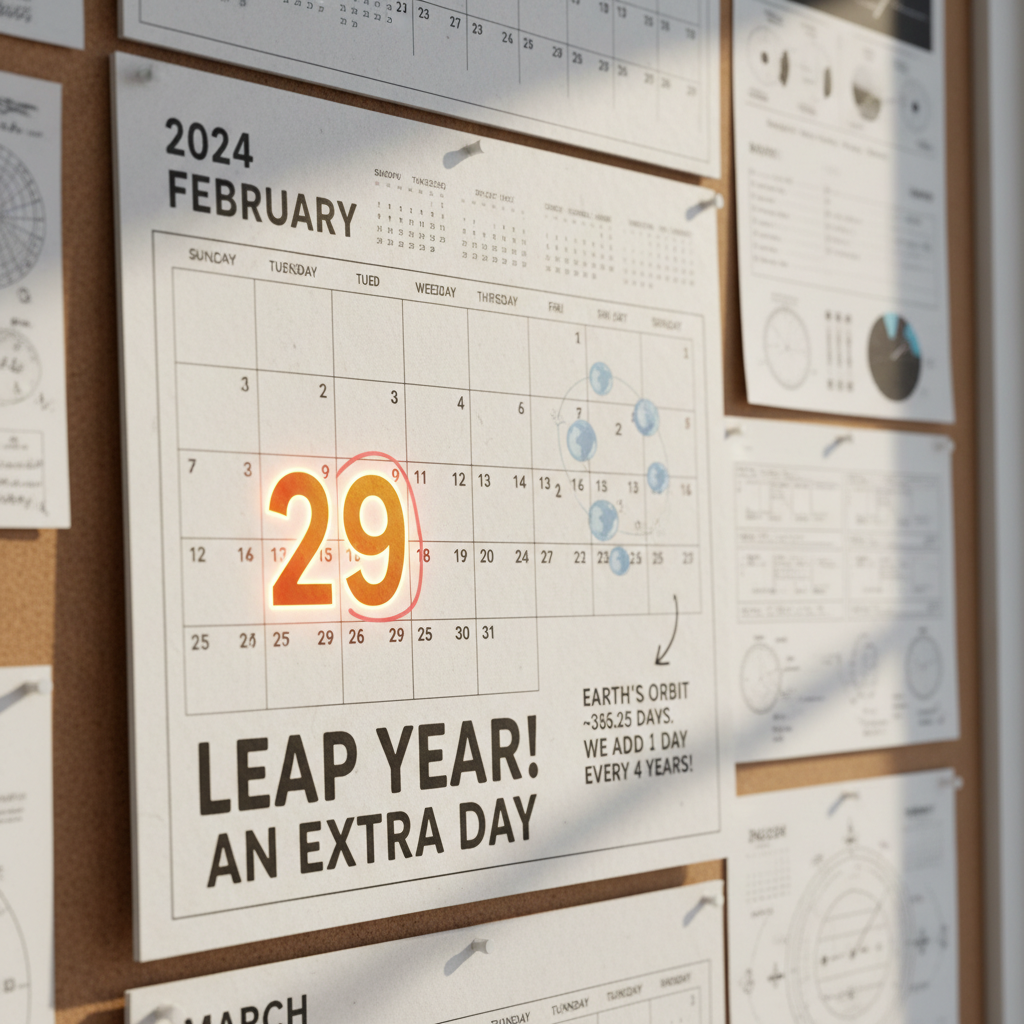 ⚠️ This picture may have spelling mistakes. Trust the words in the lesson.
Calendar Logic: Finding Days of the Week
Understanding the 7-day cycle is key. If today is Monday, what day will it be in 7 days? Still Monday! In 14 days? Still Monday! This is because 7, 14, 21, etc., are all multiples of 7. If you add or subtract a number of days that is a multiple of 7, the day of the week remains the same.
- Example: If today is Thursday, what day will it be in 10 days?
- 10 days = 7 days + 3 days.
- After 7 days, it will still be Thursday.
- Then count 3 more days from Thursday: Friday, Saturday, Sunday.
- So, in 10 days, it will be Sunday.
Part 2: Clocks - Tracking Our Day
Clocks help us divide each day into smaller, manageable units: hours, minutes, and seconds. They tell us "when" things happen within a single day.
The Smallest Units: Seconds, Minutes, Hours
- Second: The basic unit of time. Imagine a quick 'tick' sound.
- Minute: 60 seconds make 1 minute.
- Hour: 60 minutes make 1 hour.
- Analogy: Think of it like measuring distance. Seconds are like millimeters, minutes are like centimeters, and hours are like meters. They're all related, just different scales!
12-hour vs. 24-hour Format: Two Ways to Say the Same Time!
Just like some countries speak different languages, we have two common ways to tell time:
- 12-hour format: This is what you see on most analog clocks (the ones with hands) and many digital clocks. It uses AM (Ante Meridiem - "before midday") for times from midnight to noon, and PM (Post Meridiem - "after midday") for times from noon to midnight.
- 1:00 AM (one hour after midnight)
- 11:00 AM (one hour before noon)
- 12:00 PM (noon)
- 1:00 PM (one hour after noon)
- 11:00 PM (one hour before midnight)
- 12:00 AM (midnight)
- 24-hour format (Military Time): This system counts hours from 00 to 23. It avoids the confusion of AM/PM, which is why it's used in places like the military, hospitals, and transportation.
- Midnight is 00:00.
- 1 AM is 01:00, 5 AM is 05:00, etc.
- Noon (12 PM) is 12:00.
- 1 PM is 13:00 (12 + 1).
- 5 PM is 17:00 (12 + 5).
- 11 PM is 23:00 (12 + 11).
- Converting: For PM times, just add 12 to the hour (e.g., 3 PM + 12 = 15:00). For AM times, it's usually the same (except 12 AM is 00:00).
Time Zones: Why the World Doesn't Eat Lunch at the Same Time!
If it's noon where you are, it's bright and sunny. But what about on the other side of the world? It's the middle of the night! Because the Earth is constantly spinning, different parts of the world experience sunrise, noon, and sunset at different times.
- What they are: Time zones are regions that observe a uniform standard time. The Earth is divided into 24 main time zones, roughly 15 degrees of longitude apart (because 360 degrees / 24 hours = 15 degrees per hour).
- Analogy: Imagine the world is a giant pie, cut into 24 slices. Each slice gets its own "mealtime." When it's breakfast in one slice, it might be dinner in another!
- Prime Meridian & UTC: The starting point for time zones is the Prime Meridian, which runs through Greenwich, London. Its time is called Greenwich Mean Time (GMT) or Coordinated Universal Time (UTC). Other time zones are described as UTC+X (ahead of UTC) or UTC-X (behind UTC).
- Calculating Time Differences:
- If you move eastward, you generally add hours.
- If you move westward, you generally subtract hours.
Example: If it's 3 PM in New York (UTC-5) and you want to know the time in London (UTC+0), London is 5 hours ahead of New York. So, 3 PM + 5 hours = 8 PM in London.
Logical Reasoning with Calendars and Clocks
Now, let's put it all together. Logical reasoning with calendars and clocks often involves calculating dates, times, durations, and understanding how different factors (like leap years or time zones) affect these calculations.
- Problem Type 1: Counting Days/Weeks: "If a project starts on a Tuesday and lasts for 25 days, what day of the week will it end?" (Divide 25 by 7, find the remainder, count that many days from Tuesday).
- Problem Type 2: Time Duration: "A train departs at 7:30 AM and arrives at 4:15 PM the same day. How long was the journey?" (Convert to 24-hour if needed, then subtract arrival time from departure time).
- Problem Type 3: Time Zones: "A flight leaves Tokyo (UTC+9) at 10:00 AM on Monday and takes 10 hours to reach Los Angeles (UTC-8). What will be the arrival time and day in Los Angeles?" (This requires careful step-by-step calculation of flight duration, time zone difference, and crossing the International Date Line implicitly).
Mastering calendars and clocks isn't just about memorizing facts; it's about understanding the systems and applying logical thinking to navigate our world's time-based operations. Keep practicing, and you'll become a time-telling expert!
Keep learning, free
Create a free Syllabax account to unlock practice questions and games for this topic.
Visual Learning Enhanced! 🚀
To help you master this topic, we use Advanced Syllabax AI to generate detailed diagrams and visual models.
Note on Visuals: The AI sometimes makes spelling errors in image labels. Please refer to the lesson text for the correct terminology.