Balanced & unbalanced forces[PHYSICS]
Watch this topic in 60 seconds
Free preview · Lesson 1
Understanding Balanced & unbalanced forces[PHYSICS]
Forces in Motion: Understanding Balanced and Unbalanced Forces (Grade 9 Physics)
Welcome to the fascinating world of forces! In physics, a force is simply a push or a pull. It's an interaction that, when unopposed, will change the motion of an object. Think about it: when you push a shopping cart, you're applying a force. When a magnet pulls a paper clip, that's also a force. Forces are all around us, constantly influencing how things move (or don't move!).
What is a Force? The Basics
Imagine you have a toy car. If you want it to move, you either push it or pull it, right? That push or pull is a force. Forces have two main characteristics: magnitude (how strong the push or pull is) and direction (which way it's pushing or pulling). The standard unit for measuring force is the Newton (N), named after the famous scientist Isaac Newton.
An easy way to think about a Newton: it's roughly the force you'd use to hold up a small apple! So, if you push a heavy box, you're likely applying many Newtons of force.
Understanding Net Force: The Overall Push or Pull
Often, more than one force acts on an object at the same time. For example, when you're standing, gravity is pulling you down, but the floor is pushing you up. The net force is the total, overall force acting on an object. It's like adding up all the pushes and pulls to see what the final result is.
Let's use an analogy: Imagine two friends are trying to push a box. If they both push in the same direction, their forces add up, making the box move faster. If they push in opposite directions, their forces might cancel each other out, or one might be stronger than the other, determining which way the box moves.
Balanced Forces: When Everything Stays Still (or Moves Steadily)
Think about a classic game of tug-of-war. If the team on the left pulls with the same strength (magnitude) as the team on the right, and they're pulling in opposite directions, what happens to the rope? It doesn't move! This is a perfect example of balanced forces.
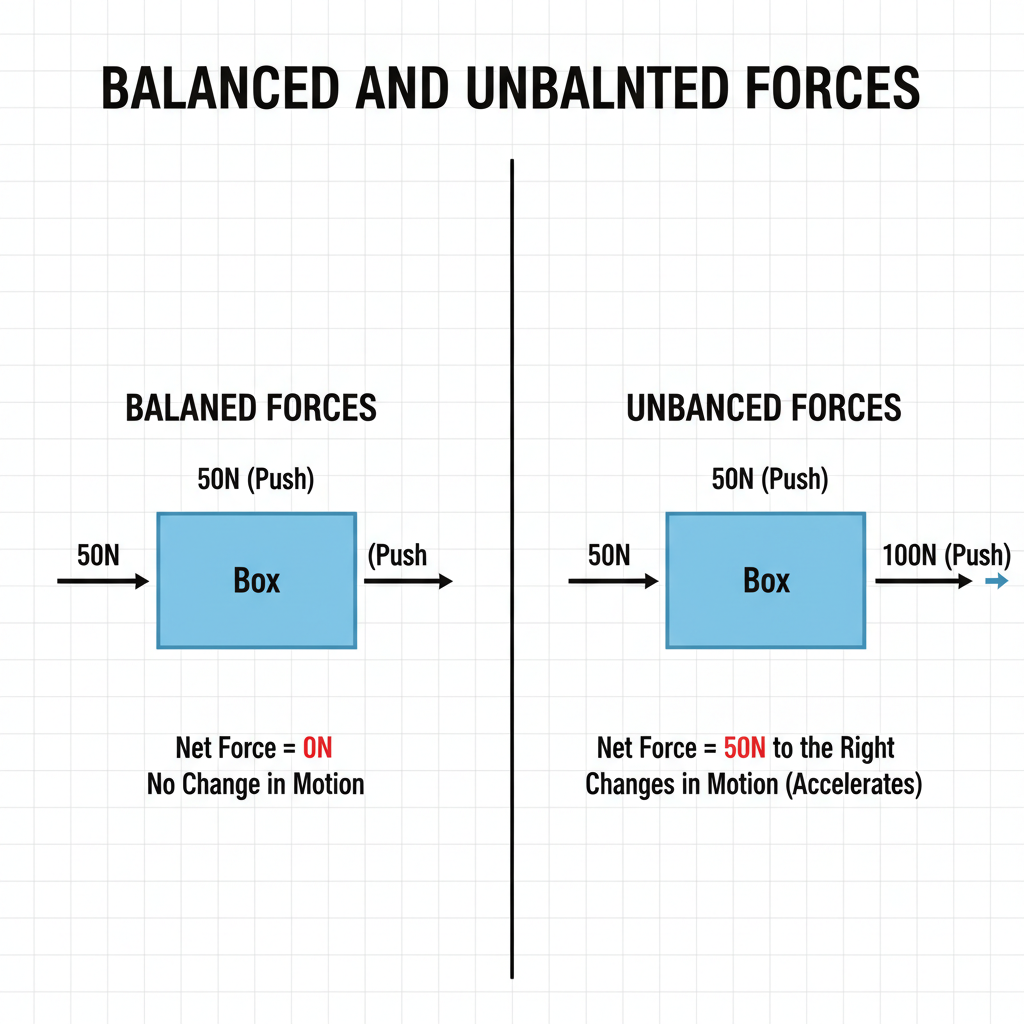
Definition: Balanced forces are two or more forces acting on an object that are equal in magnitude and opposite in direction. When forces are balanced, the net force on the object is zero.
What happens when forces are balanced?
- If the object is at rest (not moving), it will stay at rest.
- If the object is already in motion, it will continue to move at a constant speed in a straight line (constant velocity).
Analogies for Balanced Forces:
- A book resting on a table: Gravity pulls the book down, but the table pushes the book up with an equal and opposite force. The book stays still. Net force = 0.
- A car cruising at a steady speed on a flat highway: The engine's forward push is exactly balanced by the forces of air resistance and friction. The car isn't speeding up or slowing down; it's moving at a constant velocity. Net force = 0.
- A person standing still: Gravity pulls you down, and the ground pushes you up. You're not falling through the floor or floating into space. Net force = 0.
The key idea with balanced forces is that there is no change in the object's motion. No acceleration (speeding up, slowing down, or changing direction) occurs.
Unbalanced Forces: When Things Move or Change Direction
Now, let's go back to our tug-of-war. What if one team pulls much harder than the other? The rope (and the weaker team!) will start to move in the direction of the stronger pull. This is an example of unbalanced forces.
Definition: Unbalanced forces are two or more forces acting on an object that are not equal in magnitude or are not opposite in direction. When forces are unbalanced, the net force on the object is not zero.
What happens when forces are unbalanced?
When there are unbalanced forces, the object's motion will change. This change in motion is called acceleration. Acceleration can mean:
- Speeding up: Like when you push a swing from rest.
- Slowing down: Like when you apply the brakes on a bicycle.
- Changing direction: Like when you kick a soccer ball at an angle, making it curve.
Analogies for Unbalanced Forces:
- Kicking a soccer ball: Your foot applies a strong, brief force to the ball. This force is unbalanced, causing the ball to accelerate from rest and fly through the air. Net force is not zero.
- A rocket launching into space: The powerful thrust from the engines is much greater than the downward pull of gravity and air resistance. The net force is upwards, causing the rocket to accelerate upwards. Net force is not zero.
- A car braking: The friction from the brakes creates a force opposite to the car's motion, causing it to slow down (negative acceleration). Net force is not zero.
- Turning a bicycle: When you lean and steer, you're applying unbalanced forces that cause the bike to change its direction of motion. Net force is not zero.
The crucial point about unbalanced forces is that they always cause a change in an object's velocity (meaning its speed, direction, or both).
Connecting to Newton's First Law of Motion (The Law of Inertia)
What we've learned about balanced and unbalanced forces directly relates to one of the most fundamental laws in physics: Newton's First Law of Motion, also known as the Law of Inertia.
An object at rest stays at rest, and an object in motion stays in motion with the same speed and in the same direction unless acted upon by an unbalanced force.
See how this connects? If the forces are balanced (net force is zero), an object keeps doing what it's already doing – either staying still or moving steadily. It's only when an unbalanced force comes along that its motion changes.
Summary and Real-World Impact
Understanding balanced and unbalanced forces helps us explain why things move the way they do, from the simplest act of walking to the complex flight of an airplane. Every change in motion you observe, whether a soccer ball curving into a goal or a roller coaster speeding up, is a direct result of unbalanced forces at play. When things are perfectly still or moving smoothly without a hitch, you know the forces are beautifully balanced.
Keep your eyes open for forces in your daily life – you'll start to see them everywhere!
Keep learning, free
Create a free Syllabax account to unlock practice questions and games for this topic.
Visual Learning Enhanced! 🚀
To help you master this topic, we use Advanced Syllabax AI to generate detailed diagrams and visual models.
Note on Visuals: The AI sometimes makes spelling errors in image labels. Please refer to the lesson text for the correct terminology.