Word problems (Direct & Inverse Proportion)
Watch this topic in 60 seconds
Free preview · Lesson 1
Understanding Word problems (Direct & Inverse Proportion)
Understanding Word Problems: Direct and Inverse Proportion (Grade 8 Foundational)
Welcome, 8th graders! Have you ever wondered how people figure out how much paint they need for a wall, or how long it will take a group of friends to finish a big project? The secret often lies in understanding something called proportion. It's a fancy word for how two things change together. In this lesson, we're going to break down word problems involving two main types of proportion: Direct and Inverse.
What is Proportion? The Basic Idea
Imagine you're baking cookies. If you want to make more cookies, you'll need more flour, more sugar, and more eggs, right? That's the basic idea of proportion – when changing one amount causes another amount to change in a predictable way. It’s like a mathematical dance where two partners move in relation to each other.
Part 1: Direct Proportion – Moving Together!
Definition: Two quantities are in direct proportion if they increase or decrease together at the same rate. This means if one quantity doubles, the other quantity also doubles. If one quantity becomes half, the other also becomes half.
Analogy Time!
- The Snack Shop Analogy: Think about buying snacks. If one bag of chips costs
- The Driving Analogy (Constant Speed): If you drive at a steady speed, the longer you drive, the more distance you cover. More time spent driving means more distance traveled. Both go up together.
- The Pencil Case Analogy: If each pencil case holds 5 pencils, then 2 pencil cases hold 10 pencils, and 3 hold 15. The number of pencil cases and the total number of pencils are directly proportional.
Key Features of Direct Proportion:
- If one quantity gets bigger, the other gets bigger.
- If one quantity gets smaller, the other gets smaller.
- The ratio between the two quantities always stays the same (it's constant). For example, in the snack shop, Cost/Bags =
How to Spot Direct Proportion in Word Problems:
Look for phrases like:
- "...for every..."
- "...costs per..."
- "...rate of..."
- "If more of X, then more of Y."
Solving Direct Proportion Problems:
The easiest way is often to find the 'unit rate' or use ratios.
Example: If 3 apples cost $1.50, how much do 5 apples cost?
- Find the unit rate (cost per apple):
- Multiply by the new quantity:
You can also set up a proportion as a fraction:
Cost1 / Quantity1 = Cost2 / Quantity2
$1.50 / 3 = x / 5
Then cross-multiply: 3 * x = 1.50 * 5 => 3x = 7.50 => x = 7.50 / 3 => x = $2.50.
Part 2: Inverse Proportion – Opposites Attract (or Repel)!
Definition: Two quantities are in inverse proportion (sometimes called indirect proportion) if an increase in one quantity causes a decrease in the other, and vice versa. They move in opposite directions.
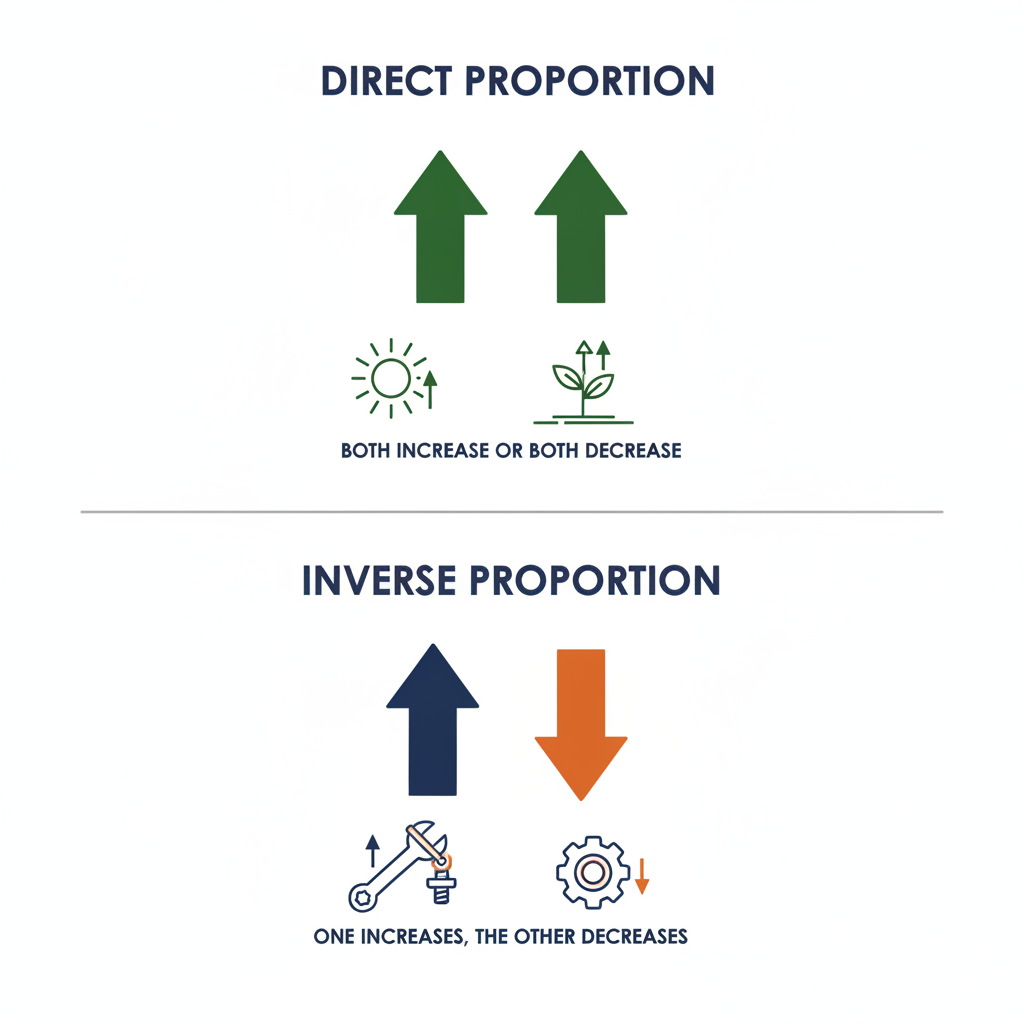
Analogy Time!
- The Work Crew Analogy: Imagine you have a big wall to paint. If you hire 1 painter, it takes 10 hours. If you hire 2 painters, they will likely finish the wall in 5 hours (half the time!). If you hire 5 painters, it might take only 2 hours. As the number of painters increases, the time to paint the wall decreases. They move in opposite directions!
- The Road Trip Analogy (Fixed Distance): You have a 100-mile road trip. If you drive really fast (high speed), it will take you less time to get there. If you drive slowly (low speed), it will take you more time. Speed and time are inversely proportional when the distance is fixed.
- The Pizza Slicing Analogy: If you slice a pizza into more pieces, each piece becomes smaller. More pieces means smaller pieces.
Key Features of Inverse Proportion:
- If one quantity gets bigger, the other gets smaller.
- If one quantity gets smaller, the other gets bigger.
- The product of the two quantities always stays the same (it's constant). For example, in the work crew analogy: Painters * Time = 1 * 10 = 2 * 5 = 5 * 2 = 10.
How to Spot Inverse Proportion in Word Problems:
Look for phrases like:
- "...workers to complete a job..."
- "...speed and time taken..." (for a fixed distance)
- "If more of X, then less of Y."
Solving Inverse Proportion Problems:
The easiest way is often to use the 'product method'.
Quantity1 * Quantity2 = Constant Value
So, Quantity1a * Quantity2a = Quantity1b * Quantity2b
Example: If 4 workers can build a fence in 6 days, how long will it take 8 workers?
- Identify knowns: Workers1 = 4, Days1 = 6, Workers2 = 8, Days2 = ?
- Set up the product equation: Workers1 * Days1 = Workers2 * Days2
- Plug in values: 4 * 6 = 8 * Days2
- Solve: 24 = 8 * Days2 => Days2 = 24 / 8 => Days2 = 3 days.
Putting It All Together: A Strategy for Word Problems
Solving word problems can feel tricky, but with a clear strategy, you can tackle them!
- Read Carefully: Understand what the problem is asking. What information is given? What do you need to find?
- Identify the Quantities: What two things are changing? (e.g., apples and cost, workers and time).
- Determine the Relationship (Direct or Inverse?): Ask yourself: "If one quantity increases, does the other quantity increase (Direct) or decrease (Inverse)?" This is the most crucial step!
- Set Up the Equation:
- Direct: Use ratios (Quantity1a / Quantity2a = Quantity1b / Quantity2b) or find the unit rate.
- Inverse: Use products (Quantity1a * Quantity2a = Quantity1b * Quantity2b).
- Solve: Do the math!
- Check Your Answer: Does your answer make sense in the context of the problem? If you have more workers, should it take less time? If you buy more apples, should it cost more money?
Practice is key! The more you work with these problems, the better you'll become at recognizing direct and inverse proportion. Good luck!
Keep learning, free
Create a free Syllabax account to unlock practice questions and games for this topic.
Visual Learning Enhanced! 🚀
To help you master this topic, we use Advanced Syllabax AI to generate detailed diagrams and visual models.
Note on Visuals: The AI sometimes makes spelling errors in image labels. Please refer to the lesson text for the correct terminology.