Probability of simple events (Data Handling)
Watch this topic in 60 seconds
Free preview · Lesson 1
Understanding Probability of simple events (Data Handling)
Exploring the World of Chance: Probability of Simple Events (Grade 8)
Have you ever tried to guess if it will rain tomorrow? Or wondered what your chances are of winning a game? All these questions are about predicting what might happen, and that's exactly what probability helps us understand! In simple terms, probability is a way to measure how likely something is to occur. It's like having a special tool that tells us the "odds" of an event happening.
Why Do We Study Probability?
- Daily Life: From weather forecasts to predicting sports outcomes, probability is all around us.
- Games: Card games, board games, and even video games often involve an element of chance, guided by probability.
- Decision Making: Businesses use probability to decide on new products, and doctors use it to understand the likelihood of treatments working.
Core Concepts: Building Blocks of Probability
Before we dive into calculating probabilities, let's learn some important words. Think of them as the special vocabulary we need to speak the language of chance!
1. Experiment
An experiment is any activity that involves chance and leads to different results. It's something you do that has an uncertain outcome.
- Analogy: Imagine you're about to flip a coin. The act of flipping the coin is the experiment.
- Another Analogy: Rolling a six-sided dice is an experiment.
- Another Analogy: Picking a marble from a bag without looking is an experiment.
2. Outcome
An outcome is one of the possible results of an experiment.
- Analogy (Coin Flip): If you flip a coin, the possible outcomes are "Heads" or "Tails."
- Analogy (Dice Roll): If you roll a standard six-sided dice, the possible outcomes are 1, 2, 3, 4, 5, or 6.
3. Sample Space
The sample space is the list of ALL possible outcomes of an experiment. It's like making a complete list of everything that could happen.
- Analogy (Coin Flip): The sample space is {Heads, Tails}.
- Analogy (Dice Roll): The sample space is {1, 2, 3, 4, 5, 6}.
- Analogy (Spinner): If you have a spinner with Red, Blue, Green, Yellow sections, the sample space is {Red, Blue, Green, Yellow}.
4. Event
An event is a specific outcome or a group of specific outcomes that we are interested in. It's what you are hoping or looking for.
- Analogy (Coin Flip): An event could be "getting Heads."
- Analogy (Dice Roll): An event could be "rolling an even number" (outcomes: 2, 4, 6) or "rolling a 3."
- Analogy (Marbles): If you have a bag with red, blue, and green marbles, an event could be "picking a red marble."
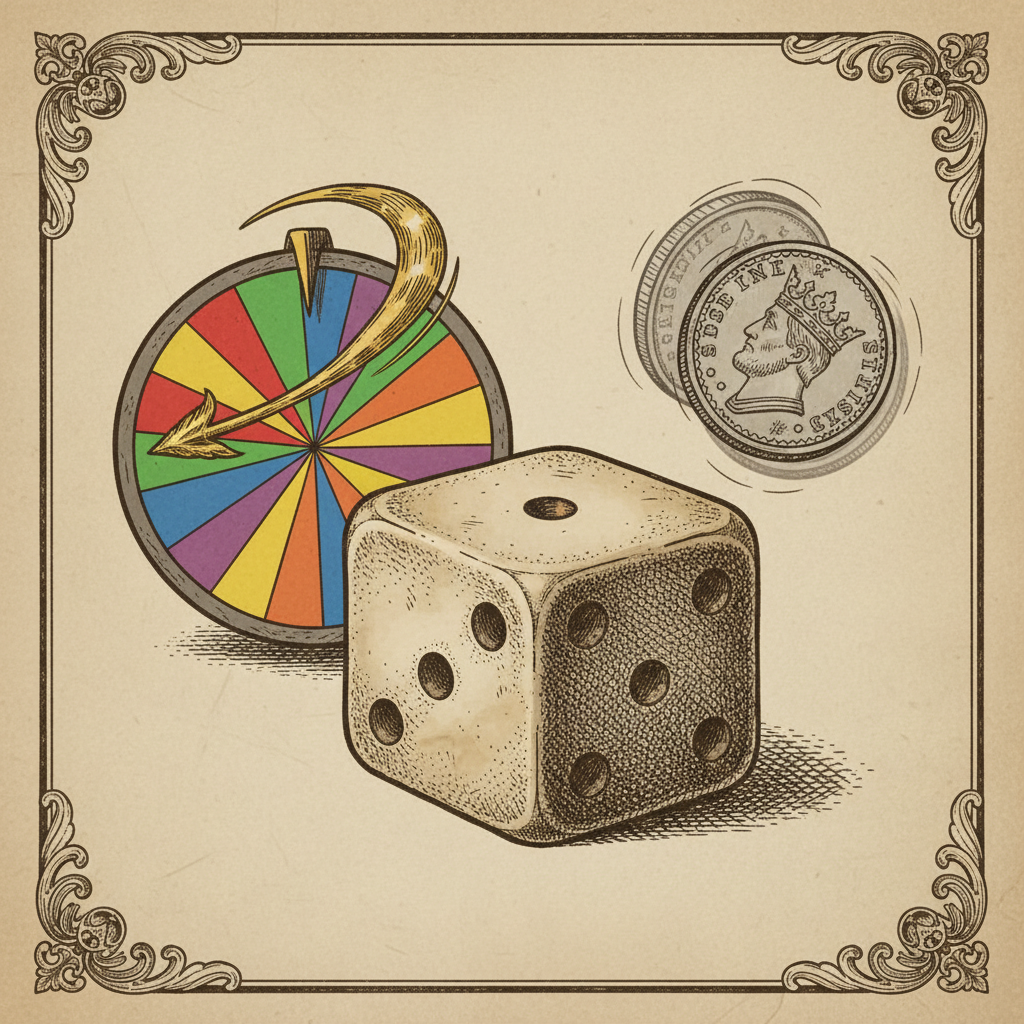
Calculating the Probability of a Simple Event
Now that we know the basic terms, let's learn how to calculate the probability of a simple event. A simple event is an event that consists of only one outcome. For example, rolling a '4' on a dice is a simple event. Rolling an 'even number' (which includes 2, 4, 6) is a compound event, but we'll focus on simple ones first.
The formula for the probability of a simple event is:
P(Event) = (Number of Favorable Outcomes) / (Total Number of Possible Outcomes)
Let's break this down:
- P(Event): This is the shorthand way to write "The Probability of the Event."
- Number of Favorable Outcomes: This is how many ways your specific event can happen. It's the count of the outcomes you're interested in.
- Total Number of Possible Outcomes: This is the total number of items in your sample space. It's everything that could possibly happen.
Example 1: Flipping a Coin
What is the probability of getting Heads when you flip a fair coin?
- Experiment: Flipping a coin.
- Sample Space: {Heads, Tails} (Total Possible Outcomes = 2)
- Event: Getting Heads (Favorable Outcomes = 1, because "Heads" is only one of the possibilities)
- Calculation: P(Heads) = 1 / 2
So, the probability of getting Heads is 1/2, or 0.5, or 50%.
Example 2: Rolling a Dice
What is the probability of rolling a '4' on a standard six-sided dice?
- Experiment: Rolling a dice.
- Sample Space: {1, 2, 3, 4, 5, 6} (Total Possible Outcomes = 6)
- Event: Rolling a '4' (Favorable Outcomes = 1, because '4' is just one number)
- Calculation: P(Rolling a 4) = 1 / 6
The probability of rolling a '4' is 1/6.
Example 3: Marbles in a Bag
Imagine a bag contains 3 red marbles, 2 blue marbles, and 5 green marbles. What is the probability of picking a blue marble?
- Experiment: Picking a marble from the bag.
- Total Number of Marbles (Sample Space): 3 (red) + 2 (blue) + 5 (green) = 10 marbles. (Total Possible Outcomes = 10)
- Event: Picking a blue marble (Favorable Outcomes = 2, because there are 2 blue marbles)
- Calculation: P(Picking a Blue Marble) = 2 / 10 = 1 / 5
The probability of picking a blue marble is 1/5, or 0.2, or 20%.
The Probability Scale: From Impossible to Certain
Probabilities are always numbers between 0 and 1 (inclusive). You can also express them as percentages between 0% and 100%.
- Probability = 0 (or 0%): Impossible Event
- This event will absolutely not happen. There are zero favorable outcomes.
- Analogy: The probability of the sun rising in the west tomorrow is 0.
- Analogy: The probability of rolling a 7 on a standard six-sided dice is 0.
- Probability = 0.5 (or 50%): Equally Likely
- This event has an equal chance of happening or not happening.
- Analogy: The probability of getting Heads when flipping a coin is 0.5.
- Probability = 1 (or 100%): Certain Event
- This event will definitely happen. All possible outcomes are favorable outcomes.
- Analogy: The probability of the sun rising in the east tomorrow is 1.
- Analogy: The probability of rolling a number less than 7 on a standard six-sided dice is 1. (Because 1, 2, 3, 4, 5, 6 are all less than 7).
Other values fall in between:
- Between 0 and 0.5: Unlikely (e.g., rolling a 1 on a dice, P = 1/6 which is about 0.167)
- Between 0.5 and 1: Likely (e.g., rolling a number greater than 1 on a dice, P = 5/6 which is about 0.833)
Putting It All Together
Remember, probability helps us understand and quantify uncertainty. By using the simple formula and understanding the key terms, you can calculate the likelihood of many everyday events. Practice makes perfect, so keep thinking about the chances of things happening around you!
Keep learning, free
Create a free Syllabax account to unlock practice questions and games for this topic.
Visual Learning Enhanced! 🚀
To help you master this topic, we use Advanced Syllabax AI to generate detailed diagrams and visual models.
Note on Visuals: The AI sometimes makes spelling errors in image labels. Please refer to the lesson text for the correct terminology.