Introduction to Permutations
Watch this topic in 60 seconds
Free preview · Lesson 1
Understanding Introduction to Permutations
Introduction to Permutations: The Art of Arranging Things in Order (Grade 9)
Welcome to the exciting world of permutations! Have you ever wondered how many different ways you can arrange your favorite books on a shelf? Or how many unique passwords you can create with a set of characters? These are the kinds of questions permutations help us answer. At its heart, permutations are all about arranging items where the order of arrangement matters.
What Exactly is a Permutation? Simple Terms, Big Ideas!
Imagine you have three distinct toys: a car, a doll, and a ball. If you want to line them up on a table, how many different ways can you do it? Let's list them out:
- Car, Doll, Ball
- Car, Ball, Doll
- Doll, Car, Ball
- Doll, Ball, Car
- Ball, Car, Doll
- Ball, Doll, Car
There are 6 different ways! Each of these unique arrangements is called a permutation. Notice that "Car, Doll, Ball" is different from "Doll, Car, Ball" because the order of the toys has changed. This is the golden rule of permutations: ORDER MATTERS!
Analogy 1: The Locker Combination Conundrum
Think about your school locker. If your combination is 10-20-30, will 20-30-10 open it? Absolutely not! The sequence, or order, of the numbers is crucial. This is a perfect real-world example of a permutation. Each correct combination is a specific ordered arrangement of numbers.
The Fundamental Counting Principle: The Building Block
Before we dive deeper into permutations, let's understand a fundamental concept called the Fundamental Counting Principle, also known as the Multiplication Principle. It's super simple but incredibly powerful.
Definition: If there are 'm' ways to do one thing and 'n' ways to do another thing, then there are 'm x n' ways to do both things in sequence.
Analogy 2: Your Morning Outfit Choices
Suppose you have 3 different shirts (red, blue, green) and 2 different pairs of pants (jeans, khakis). How many different outfits can you create?
- Shirt 1 (Red) with Pants 1 (Jeans)
- Shirt 1 (Red) with Pants 2 (Khakis)
- Shirt 2 (Blue) with Pants 1 (Jeans)
- Shirt 2 (Blue) with Pants 2 (Khakis)
- Shirt 3 (Green) with Pants 1 (Jeans)
- Shirt 3 (Green) with Pants 2 (Khakis)
You can make 3 x 2 = 6 different outfits! See how easy that was? You just multiply the number of choices for each decision.
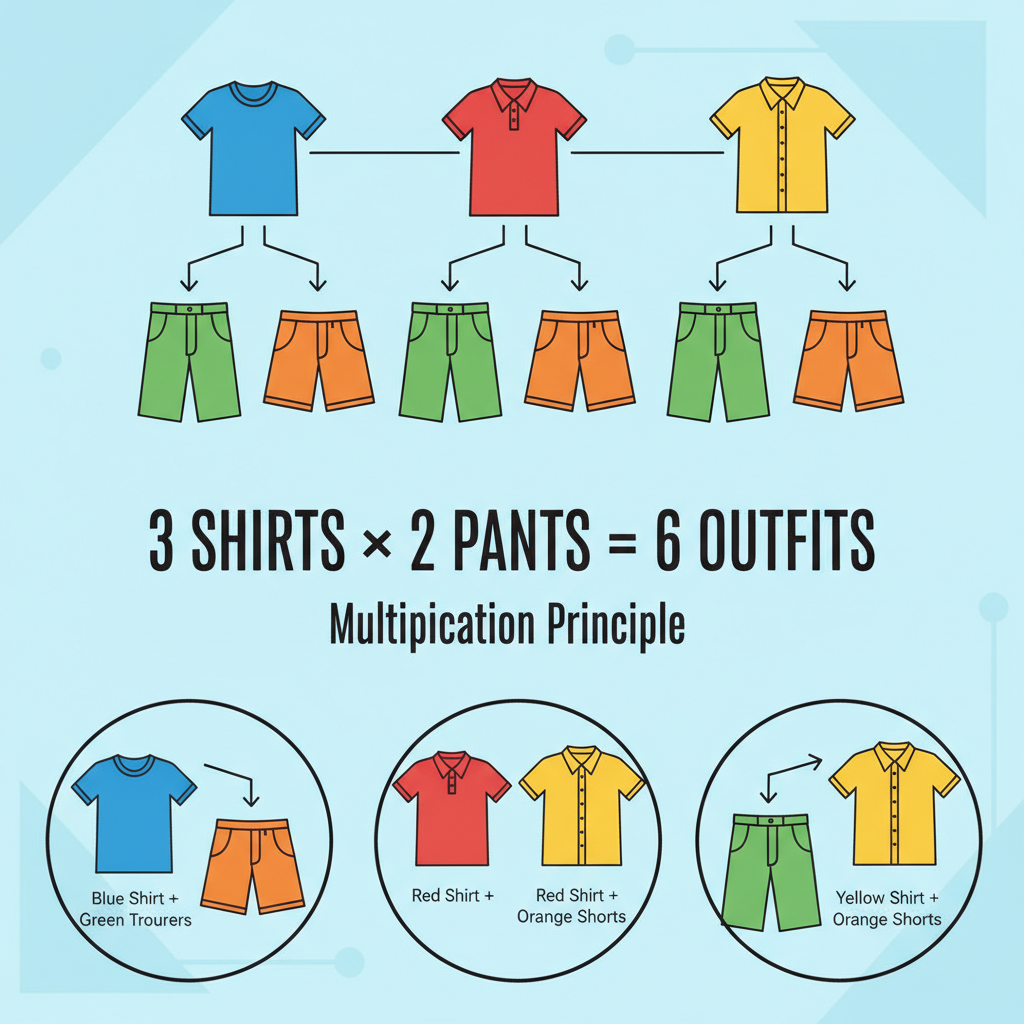 ⚠️ This picture may have spelling mistakes. Trust the words in the lesson.
Applying the Principle to Permutations (When All Items are Arranged)
Let's revisit our three toys: Car, Doll, Ball. How many ways can we arrange them?
- For the first spot, you have 3 choices (Car, Doll, or Ball).
- Once you've placed one toy, you only have 2 choices left for the second spot.
- And for the last spot, you only have 1 choice remaining.
Using the Fundamental Counting Principle: 3 x 2 x 1 = 6 ways. This matches what we found by listing them out!
Factorials (!): A Shortcut for Arranging All Items
When you multiply a sequence of descending natural numbers down to 1 (like 3 x 2 x 1), there's a special mathematical notation for it called a factorial, denoted by an exclamation mark (!).
- 4! (read as "four factorial") = 4 x 3 x 2 x 1 = 24
- 5! (read as "five factorial") = 5 x 4 x 3 x 2 x 1 = 120
- 1! = 1
- 0! = 1 (This is a special definition that's important in higher math, just accept it for now!)
So, the number of ways to arrange 'n' distinct items is simply 'n!'.
Example: How many ways can you arrange 5 different books on a shelf?
Answer: 5! = 5 x 4 x 3 x 2 x 1 = 120 ways.
Permutations When You Don't Arrange All Items (P(n, r))
What if you have a group of items, but you only want to arrange *some* of them? This is where the permutation formula becomes very handy.
Analogy 3: The Race for Medals
Imagine 10 athletes are competing in a race. Only the first, second, and third place finishers receive gold, silver, and bronze medals, respectively. How many different ways can the medals be awarded?
Here, 'n' is the total number of items (10 athletes) and 'r' is the number of items we are arranging (3 medal winners). Order definitely matters here – coming in 1st is different from 2nd!
Using the Fundamental Counting Principle:
- For 1st place, there are 10 choices.
- For 2nd place, there are 9 choices remaining.
- For 3rd place, there are 8 choices remaining.
So, 10 x 9 x 8 = 720 ways.
The formal notation for this is P(n, r), which stands for "the number of permutations of 'n' items taken 'r' at a time."
The formula is: P(n, r) = n! / (n - r)!
Let's use it for our race example (n=10, r=3):
P(10, 3) = 10! / (10 - 3)!
P(10, 3) = 10! / 7!
P(10, 3) = (10 x 9 x 8 x 7 x 6 x 5 x 4 x 3 x 2 x 1) / (7 x 6 x 5 x 4 x 3 x 2 x 1)
Notice that the (7!) in the numerator and denominator cancel out:
P(10, 3) = 10 x 9 x 8 = 720
The formula essentially tells us to take 'n' choices for the first spot, 'n-1' for the second, and so on, for 'r' spots. The division by (n-r)! effectively 'removes' the arrangements of the items we *didn't* choose, since their order doesn't matter to our problem.
Key Takeaway for P(n,r):
This formula is used when you are selecting a subset of items from a larger group AND the order in which you select/arrange them matters.
Summary: The Heart of Permutations
Permutations are a fundamental concept in counting and probability. Remember these core ideas:
- Order is King: If changing the order creates a new outcome, it's a permutation.
- Fundamental Counting Principle: Multiply the number of choices for each step.
- Factorials: A shorthand (n!) for arranging all 'n' distinct items.
- P(n, r): Use this formula when arranging 'r' items selected from a larger group of 'n' distinct items, and order matters.
With these tools, you're now ready to tackle a variety of problems involving ordered arrangements!
Keep learning, free
Create a free Syllabax account to unlock practice questions and games for this topic.
Visual Learning Enhanced! 🚀
To help you master this topic, we use Advanced Syllabax AI to generate detailed diagrams and visual models.
Note on Visuals: The AI sometimes makes spelling errors in image labels. Please refer to the lesson text for the correct terminology.