Trains, boats & stream (intro) (Time, Speed & Distance)
Watch this topic in 60 seconds
Free preview · Lesson 1
Understanding Trains, boats & stream (intro) (Time, Speed & Distance)
Time, Speed, and Distance: An Introduction to Trains, Boats, and Streams (Grade 9)
Welcome, future problem-solvers! Have you ever wondered how fast a train needs to go to cross a bridge, or why a boat takes longer to travel upstream than downstream? These aren't just tricky questions; they're everyday applications of a fundamental concept in mathematics and physics: Time, Speed, and Distance (TSD). This lesson will introduce you to the core ideas of TSD and then gently guide you into the fascinating world of trains, boats, and streams.
The Holy Trinity: Time, Speed, and Distance
Let's start with the basics. Imagine you're on a journey. Three key elements define that journey:
1. Time (T)
What it is: Time is simply the duration of an event or journey. How long did it take you to get from point A to point B? That's time. Think of it as the ticks of a clock or the numbers on a stopwatch.
- Units: Commonly measured in seconds (s), minutes (min), or hours (h).
- Analogy: If you run a race, the time is how long it takes you to cross the finish line.
2. Distance (D)
What it is: Distance is the total path covered by an object in motion. It's how far you've traveled from your starting point to your ending point.
- Units: Commonly measured in meters (m), kilometers (km), or miles (mi).
- Analogy: If you walk from your home to school, the distance is the length of the path you took.
3. Speed (S)
What it is: Speed tells us how fast an object is moving. More formally, it's the rate at which distance is covered over a period of time.
- Units: Commonly measured in meters per second (m/s) or kilometers per hour (km/h).
- Analogy: The speedometer in a car shows you its speed. If a car is moving at 60 km/h, it means it covers 60 kilometers in one hour.
The Golden Formula of TSD
These three concepts are linked by one fundamental formula:
Distance = Speed × Time (D = S × T)
This formula is your best friend! You can also rearrange it to find any of the three variables if you know the other two:
- Speed = Distance / Time (S = D / T)
- Time = Distance / Speed (T = D / S)
Example: If a cyclist travels at a speed of 20 km/h for 2 hours, what distance does she cover?
D = S × T = 20 km/h × 2 h = 40 km. Simple, right?
Unit Conversions: Changing Gears!
Sometimes, the units of speed, time, and distance don't match. For instance, speed might be in km/h, but time is in seconds. We need to convert them to be consistent!
The two most common conversions are between km/h and m/s:
- To convert km/h to m/s: Multiply by (1000 meters / 3600 seconds) which simplifies to 5/18.
- To convert m/s to km/h: Multiply by (3600 seconds / 1000 meters) which simplifies to 18/5.
Why 5/18 and 18/5?
1 km = 1000 m
1 hour = 60 minutes = 60 × 60 = 3600 seconds
So, 1 km/h = 1000 m / 3600 s = 10/36 m/s = 5/18 m/s.
Example: Convert 72 km/h to m/s.
72 km/h × (5/18) = 4 × 5 = 20 m/s.
Introducing Relative Speed: When Things Move Together (or Apart)!
Imagine you're standing still. A car passes you at 50 km/h. That's its speed relative to you. But what if you're also moving? That's where relative speed comes in.
Relative speed is the speed of one object with respect to another moving object.
Analogy 1: The Escalator Ride
- If you walk up a moving escalator (both you and the escalator are going in the same direction), your walking speed adds to the escalator's speed. You feel like you're going super fast!
- If you walk down a moving escalator (you're going one way, escalator the other), your walking speed subtracts from the escalator's speed (or vice versa). It feels like you're barely moving, or even going backward if the escalator is faster!
This idea of speeds adding or subtracting is crucial for understanding boats in streams and trains.
Boats and Streams: Navigating the Waters
When a boat travels in a river, its actual speed isn't just the speed its engine can produce. The river's current also plays a big role!
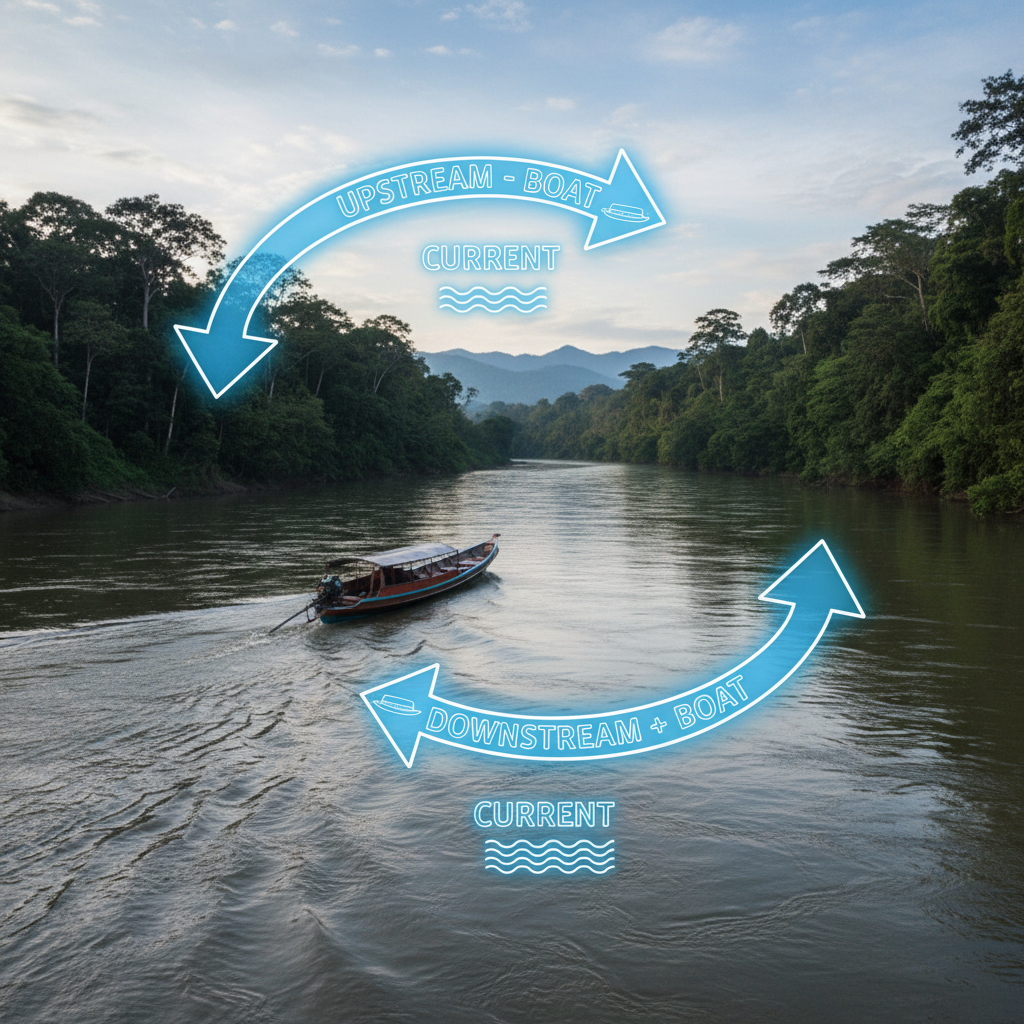
The Players:
- Speed of Boat in Still Water (B): This is the boat's own speed, as if it were in a calm lake with no current. Think of it as the power of its engine.
- Speed of Stream/Current (S): This is the speed of the water itself. It's the speed at which a floating log would drift without any engine power.
1. Downstream (Going with the flow!)
When a boat travels downstream, it means it's moving in the same direction as the river current. The current helps push the boat along, making it go faster.
- Effect: The current *adds* to the boat's speed.
- Downstream Speed (D) = Speed of Boat (B) + Speed of Stream (S)
- Analogy: Rolling a ball down a gentle hill. Gravity (like the current) assists the ball, making it go faster.
2. Upstream (Fighting the current!)
When a boat travels upstream, it means it's moving in the opposite direction to the river current. The current resists the boat's movement, slowing it down.
- Effect: The current *subtracts* from the boat's speed.
- Upstream Speed (U) = Speed of Boat (B) - Speed of Stream (S)
- Analogy: Trying to push a heavy shopping cart up a steep hill. The hill (like the current) works against you, making it harder and slower.
- Important Note: For upstream travel to be possible, the speed of the boat in still water (B) must always be greater than the speed of the stream (S). Otherwise, the boat would be pushed backward!
Finding Boat and Stream Speeds (Derivations)
If you know the downstream and upstream speeds, you can find the individual speeds:
- Speed of Boat (B) = (Downstream Speed + Upstream Speed) / 2
- Speed of Stream (S) = (Downstream Speed - Upstream Speed) / 2
Trains: Length Matters!
Unlike a car or a person, a train is a very long object. When we talk about a train 'crossing' something, its length becomes a crucial part of the distance covered.
Key Idea: What Distance Does a Train Cover?
- Case 1: Crossing a Point Object (like a pole, a standing person, or a signal post)
Imagine a very long snake passing a tiny pebble. For the 'snake' to completely pass the 'pebble', its entire length must move past the pebble.
Distance Covered = Length of the Train - Case 2: Crossing an Extended Object (like a platform, a bridge, or another train)
Now imagine our long snake passing another long snake (or a very long log). For the first snake to completely pass the second, its front must reach the beginning of the second object, AND its tail must pass the end of the second object.
Distance Covered = Length of Train + Length of the Object (Platform/Bridge/Other Train)
Relative Speed for Trains (Revisited for Tracks)
Just like with the escalator, when two trains are moving, their relative speed determines how quickly they approach or pass each other.
- When Trains Move in Opposite Directions (Towards each other or away from each other):
Their speeds add up quickly! This is like two cars crashing head-on (a very high relative speed of approach!).
Relative Speed = Speed of Train 1 + Speed of Train 2 - When Trains Move in the Same Direction (One overtaking the other):
Their speeds subtract. The faster train's speed minus the slower train's speed.
Relative Speed = |Speed of Faster Train - Speed of Slower Train|
This is like one car slowly overtaking another on a highway. The relative speed is the difference in their speeds.
The Universal Train Crossing Formula
Regardless of what a train is crossing, the general Time, Speed, Distance formula still applies, but with 'Distance' and 'Speed' adapted for the scenario:
Time taken to cross = (Total Distance Covered) / (Relative Speed)
Remember to always be consistent with units!
Putting It All Together
The concepts of Time, Speed, and Distance are the building blocks. When you introduce a river current, it either boosts or hinders a boat, creating downstream and upstream scenarios. When you deal with trains, their physical length and their movement relative to other objects become key considerations. Master these foundational ideas, and you'll be well-equipped to tackle more complex TSD problems!
Keep learning, free
Create a free Syllabax account to unlock practice questions and games for this topic.
Visual Learning Enhanced! 🚀
To help you master this topic, we use Advanced Syllabax AI to generate detailed diagrams and visual models.
Note on Visuals: The AI sometimes makes spelling errors in image labels. Please refer to the lesson text for the correct terminology.