Real-life math situations [HOTS (High Order Thinking Skills)]
Watch this topic in 60 seconds
Free preview · Lesson 1
Understanding Real-life math situations [HOTS (High Order Thinking Skills)]
Real-Life Math: Thinking Smarter with HOTS!
Welcome, super math explorers! Have you ever wondered if the math you learn in school actually pops up in the world around you? The answer is a giant YES! Math isn't just about numbers and equations; it's a powerful tool that helps us understand and solve problems in our everyday lives. Today, we're going to become math detectives, using our Higher-Order Thinking Skills (HOTS) to tackle real-life math situations.
What are HOTS? Thinking Beyond the Basics!
Imagine you have a box of crayons. The basic skill is knowing the colors. HOTS are like using those crayons to draw a masterpiece! They help us:
- Analyze: Break down a problem into smaller pieces, like taking apart a toy to see how it works.
- Evaluate: Judge whether a solution makes sense, like deciding if a recipe has the right amount of sugar.
- Create: Come up with new ideas or solutions, like planning a surprise party.
- Problem-Solve: Figure out how to get from where we are to where we want to be, like finding the best route to a friend's house.
In short, HOTS help us think critically and creatively about math!
Math in the Kitchen: Following Recipes
Let's start in the kitchen! Following a recipe is a fantastic real-life math situation. Think about baking cookies:
Scenario: The recipe calls for 2 cups of flour, but you only want to make half the batch. How much flour do you need?
HOTS in Action:
- Analyze: You need to figure out half of 2 cups.
- Problem-Solve: You know that half of 2 is 1.
- Evaluate: Does 1 cup of flour make sense for half a batch? Yes, it's less than the original amount, which is what you expect.
Core Concept: Fractions and Division. You're using your understanding of fractions (half) and division (dividing the ingredients) to solve this.
Analogy: It's like sharing a pizza. If you want half the pizza, you cut it into two equal pieces and take one. Here, you're 'cutting' the ingredients in half.
Math at the Store: Budgeting and Comparing Prices
Shopping is another place where math shines! When you go to the grocery store with your family, you're often dealing with money.
Scenario: You have
HOTS in Action:
- Analyze: List the items and their prices. List your budget.
- Create/Problem-Solve: Try different combinations. What if you buy 3 apples (
- Evaluate: Did you spend too much? No,
Core Concept: Addition, Subtraction, and Decision Making. You're adding up costs, subtracting from your budget, and making smart choices.
Analogy: It's like packing your backpack for school. You have a limited amount of space (your budget) and need to decide which books and supplies (snacks) will fit and be most useful.
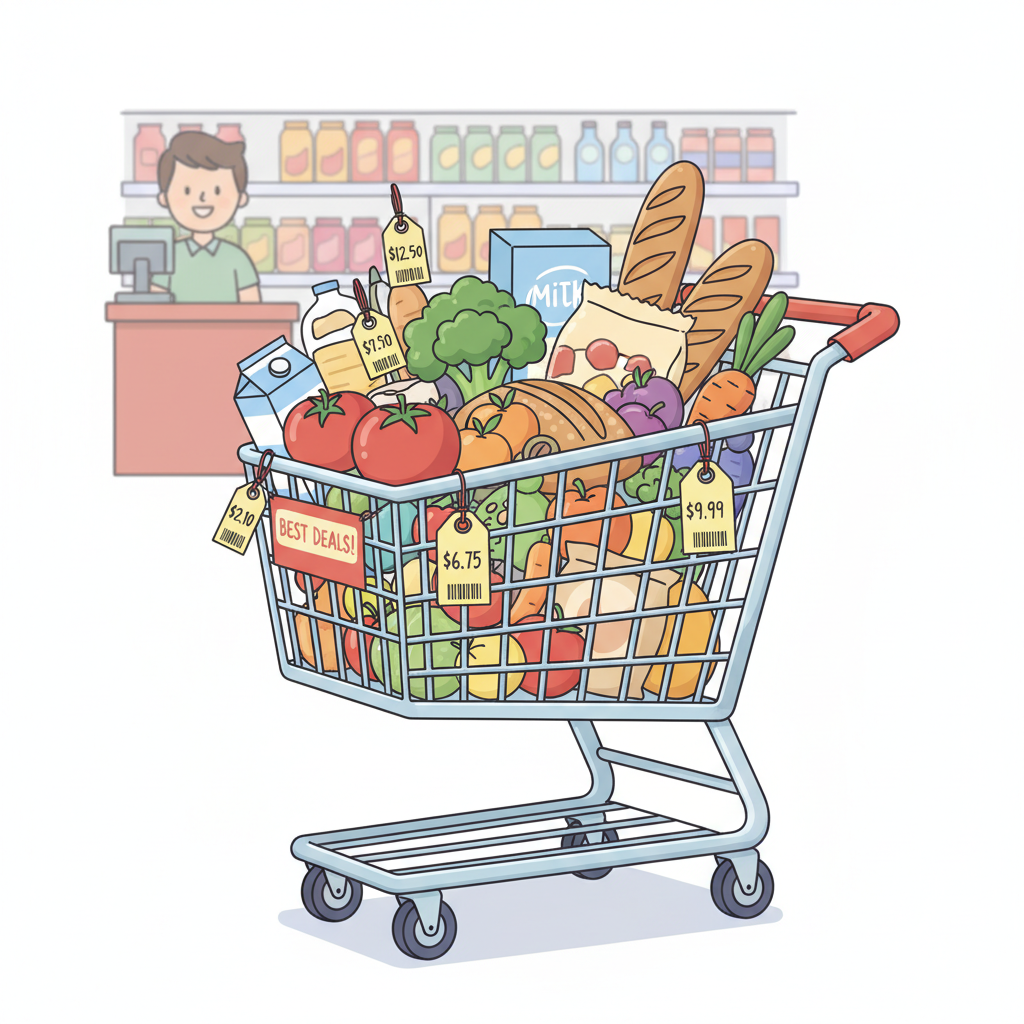 ⚠️ This picture may have spelling mistakes. Trust the words in the lesson.
Math on the Go: Planning a Trip
Planning a trip, even a short one, involves math!
Scenario: You're going on a road trip that is 120 miles long. Your car can travel 30 miles per gallon of gas, and gas costs $4 per gallon. How much will the gas for the trip cost?
HOTS in Action:
- Analyze: You need to find out how many gallons of gas you'll need first, then calculate the total cost.
- Problem-Solve:
- Step 1: How many gallons? Divide the total distance by miles per gallon: 120 miles / 30 miles/gallon = 4 gallons.
- Step 2: How much will it cost? Multiply the number of gallons by the price per gallon: 4 gallons *
- Evaluate: Does $16 seem reasonable for a 120-mile trip? Yes, it's not an extremely large or small amount.
Core Concept: Division and Multiplication. You used division to find out how many 'units' (gallons) you needed, and multiplication to find the total cost.
Analogy: It's like figuring out how many steps you need to take to walk across a field. If the field is 100 steps long and you take 2 steps at a time, you'll need 50 sets of steps (100 / 2 = 50). Then, if each 'set' of steps costs something, you'd multiply.
Math in Your Free Time: Planning a Party
Planning a party is a fun way to use math!
Scenario: You're inviting 10 friends to your birthday party. You want to give each friend a party favor bag. Each bag needs 3 stickers, 2 pieces of candy, and 1 small toy. You also need 1 extra set of everything for yourself. How many stickers, candies, and toys do you need in total?
HOTS in Action:
- Analyze: You need to count the total number of people (friends + you) and then multiply the items per bag by that total.
- Create/Problem-Solve:
- Total people: 10 friends + 1 (you) = 11 people.
- Stickers: 11 people * 3 stickers/person = 33 stickers.
- Candies: 11 people * 2 candies/person = 22 candies.
- Toys: 11 people * 1 toy/person = 11 toys.
- Evaluate: Do these numbers seem right? Yes, you have more items than just for your friends because you included yourself.
Core Concept: Multiplication and Addition. You're using multiplication to scale up the items needed and addition to figure out the total number of people.
Analogy: Imagine you're building with LEGOs. You know each LEGO house needs 5 red bricks. If you want to build 4 houses, you'll need 4 * 5 = 20 red bricks. You're scaling up!
Why Does This Matter?
Understanding these real-life math situations helps you:
- Make better decisions: Like choosing the best deal at the store or figuring out if you have enough time to get somewhere.
- Become more independent: You can manage your own money, follow instructions, and solve everyday problems.
- See the world differently: You'll start noticing math everywhere and appreciate its usefulness!
Keep practicing your HOTS, and you'll become a math whiz in no time!
Keep learning, free
Create a free Syllabax account to unlock practice questions and games for this topic.
Visual Learning Enhanced! 🚀
To help you master this topic, we use Advanced Syllabax AI to generate detailed diagrams and visual models.
Note on Visuals: The AI sometimes makes spelling errors in image labels. Please refer to the lesson text for the correct terminology.