Learning Journey
Watch this topic in 60 seconds
Free preview · Lesson 1
Understanding How sound is produced (PHYSICS)
How Sound is Produced: A Journey into Vibrations!
Hello future scientists! Have you ever wondered what makes the music in your favorite song, the bark of a dog, or even your own voice? It's all thanks to something called **sound**! But how does sound actually get made? Let's dive in and find out!
What is Sound?
Sound is basically a form of energy that travels in waves. We hear these waves when they reach our ears. Think of sound like a secret message traveling from one place to another. But what sends that message? It's something called **vibration**!
Vibrations: The Secret Ingredient of Sound
Imagine you pluck a guitar string. What happens? It wiggles back and forth very, very quickly! This wiggling is called a **vibration**. Every sound you hear, from a tiny whisper to a loud roar, starts with something vibrating.
Analogy Alert!
Think about a tiny bell. When you tap it, it rings, right? But if you look closely, you might see it shaking or trembling. That shaking is the vibration that creates the sound of the bell.
Another great example is a drum. When you hit a drum with a stick, the surface of the drum shakes. This shaking is what makes the loud 'boom!' sound.
How Vibrations Create Sound Waves
So, how does this wiggling (vibration) turn into something we can hear across a room? Vibrations push and pull the tiny particles (like air molecules) all around them. Imagine dropping a pebble into a calm pond. Ripples spread out, right? Sound waves are a bit like those ripples, but they travel through the air (or water, or solids!).
When something vibrates, it pushes the air particles next to it closer together, creating a crowded area (called a **compression**). Then, as it moves back, it pulls those particles apart, creating a spread-out area (called a **rarefaction**). This pushing and pulling creates a chain reaction, sending these compressions and rarefactions outwards as a sound wave.
Analogy Alert!
Imagine a line of dominoes. If you push the first domino, it falls and hits the next one, and so on. The vibration of the first domino is like the vibrating object, and the falling dominoes are like the air particles being pushed and pulled, creating a wave of motion.
Or, think of a Slinky toy. If you push one end, a wave travels all the way down the Slinky. The push is like the vibration, and the wave moving along the Slinky is like the sound wave traveling through the air.
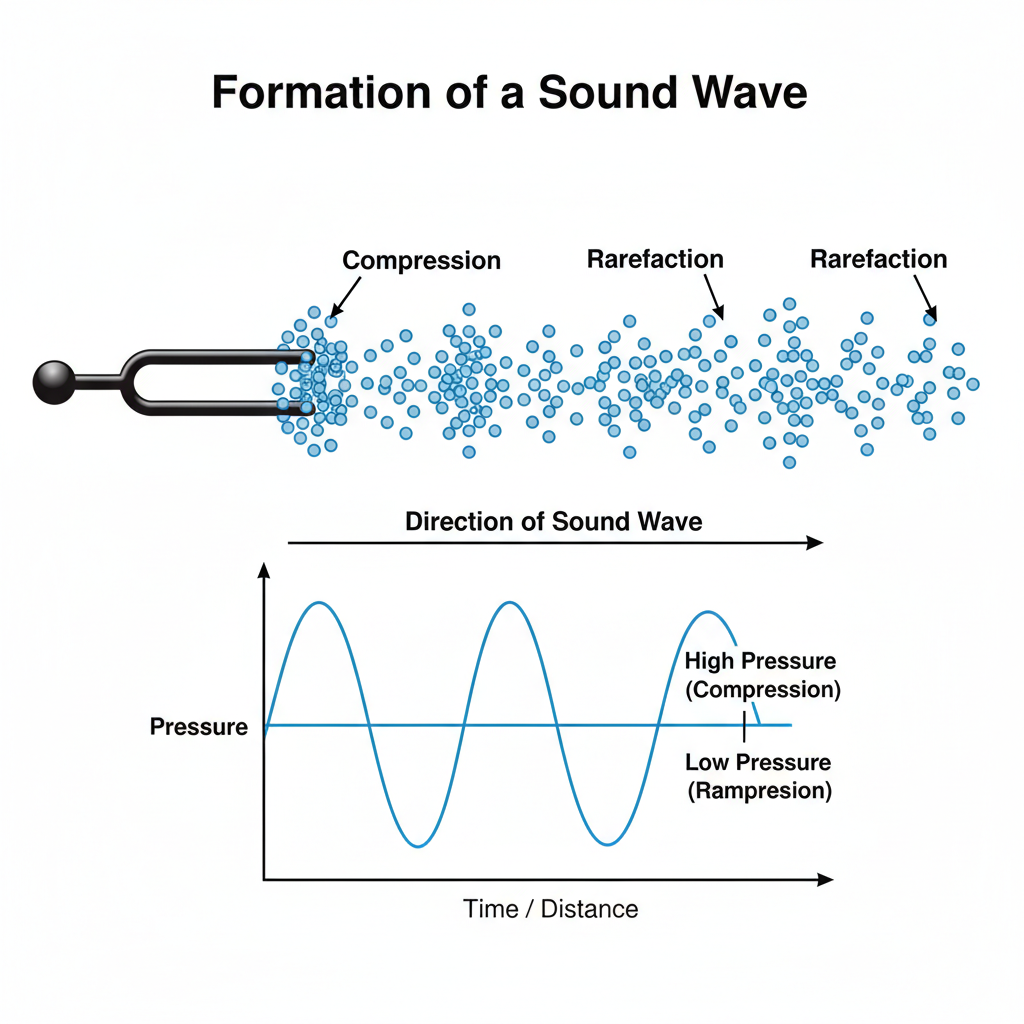 ⚠️ This picture may have spelling mistakes. Trust the words in the lesson.
Where Do Vibrations Come From?
Vibrations can be produced in many ways:
- Striking an object: Like hitting a drum, a cymbal, or a tuning fork. A tuning fork is a great example! When you strike it, it vibrates and produces a clear, pure tone.
- Plucking an object: Like guitar strings or rubber bands. When you pluck them, they vibrate back and forth.
- Blowing over an object: Like blowing across the top of a bottle to make a sound, or air passing through your vocal cords to speak or sing. Your vocal cords are like two tiny strings in your throat that vibrate when you talk!
- Rubbing an object: Like rubbing your fingers on the rim of a wet glass.
Analogy Alert!
Think about how a flute makes music. You blow air across an opening, and the air inside the flute starts to vibrate, creating the sound.
Sound Needs a Medium to Travel
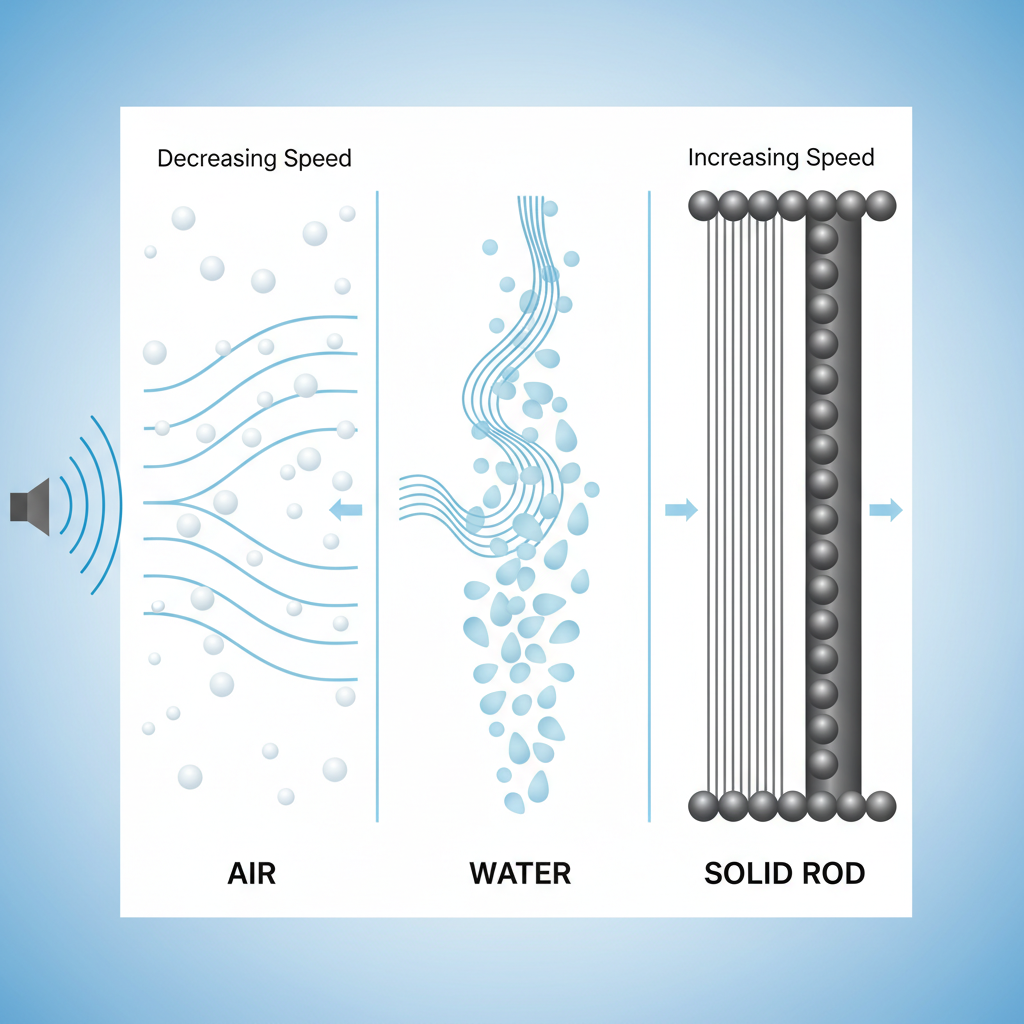
Sound waves need something to travel through. This 'something' is called a **medium**. The most common medium is air, but sound can also travel through liquids (like water) and solids (like wood or metal).
When a sound is made, the vibrations are passed from particle to particle of the medium. Imagine a playground full of children holding hands in a circle. If one child pushes the child next to them, that push travels around the circle. The children are like the particles in the medium, and the push is like the sound wave.
Can sound travel in space?
Space is mostly a vacuum, which means there are very few particles. Since there's nothing for the vibrations to push and pull, sound cannot travel in space! That's why astronauts in movies can't hear explosions in space – it's silent!
Summary: How Sound is Made
To sum it all up, sound is produced when:
- Something vibrates.
- These vibrations cause the particles in a medium (like air) to push and pull, creating waves.
- These sound waves travel to our ears, and our brains interpret them as sound.
So next time you hear a sound, remember the amazing journey those vibrations took to reach you!
Keep learning, free
Create a free Syllabax account to unlock practice questions and games for this topic.
Visual Learning Enhanced! 🚀
To help you master this topic, we use Advanced Syllabax AI to generate detailed diagrams and visual models.
Note on Visuals: The AI sometimes makes spelling errors in image labels. Please refer to the lesson text for the correct terminology.