Applications in daily life[PHYSICS]
Watch this topic in 60 seconds
Free preview · Lesson 1
Understanding Applications in daily life[PHYSICS]
Physics in Your Everyday World: Unveiling the Magic Behind the Mundane
Have you ever stopped to wonder how a simple action like kicking a ball, turning on a light, or even just seeing your reflection in a mirror works? It might seem like magic, but behind all these everyday occurrences is a fascinating science called Physics. Physics is essentially the study of how the universe works, from the tiniest particles to the vastest galaxies. It helps us understand energy, force, motion, light, heat, sound, and electricity. And the best part? It's not just for scientists in labs; it's happening all around you, all the time!
Think of physics as the 'rulebook' of the universe. Just like a game has rules, the universe has rules, and physics helps us discover what those rules are. Understanding these rules makes the world less mysterious and more incredible. Let's dive into some core concepts and see how they play out in your daily life, using lots of simple analogies to make things super clear.
1. The World of Motion and Forces: Why Things Move (or Don't!)
Imagine you're pushing a shopping cart, riding a bicycle, or even just sitting still reading this. All these involve fundamental physics principles related to motion and forces.
a. Motion: Everything That Moves
Motion is simply a change in position over time. When you walk from your bedroom to the kitchen, you are in motion. When a car drives down the street, it's in motion. When a bird flies, it's in motion. Even the Earth itself is constantly in motion, orbiting the sun!
- Analogy: Think of motion like a traveler's journey. You start at one point, and you end up at another. The path you take and how quickly you get there are all part of your motion.
b. Force: The Push or Pull
What makes things move or stop moving? That would be force. A force is a push or a pull. When you kick a soccer ball, you apply a force to it. When you pull a wagon, you're exerting a force. Even when you're just sitting, the Earth's gravity is pulling you down – that's a force too!
- Analogy: Imagine force as an invisible hand. Sometimes it pushes, sometimes it pulls, and it's what makes things change their speed or direction.
c. Gravity: Earth's Invisible Magnet
One of the most common forces we experience daily is gravity. It's the force that pulls everything towards the center of the Earth. It's why an apple falls from a tree, why you stay on the ground instead of floating away, and why rivers flow downhill.
- Analogy: Think of Earth like a giant, super-powerful magnet, and everything on or near it is made of magnetic material, constantly being pulled towards it. That's gravity at work!
d. Friction: The Brakes of Motion
Have you ever noticed why a rolling ball eventually stops? That's due to friction. Friction is a force that opposes motion when two surfaces rub against each other. It's what allows you to walk without slipping, makes a car's tires grip the road, and helps you hold a pen.
- Analogy: Imagine friction as a tiny, invisible army of speed bumps or rough patches on every surface. When something tries to slide, these bumps resist, slowing it down. Without friction, the world would be an extremely slippery place!
e. Pressure: Force in a Small Space
Pressure is related to force, but it also considers the area over which the force is applied. It's defined as force per unit area. This is why a sharp knife cuts easily (the force is concentrated on a very small area, creating high pressure), but a blunt knife struggles. It's also why you can walk on snow with snowshoes (spreading your weight over a larger area, reducing pressure) but would sink without them.
- Analogy: Think of pressure like standing on one foot versus standing on two feet. If you stand on one foot, all your weight (force) is concentrated on a small area, creating more pressure on the ground. Standing on two feet spreads that same weight over a larger area, reducing the pressure.
2. Light: The Messenger of Vision
How do you see the words on this page, the colors of a rainbow, or your own face in a mirror? It's all thanks to light! Light is a form of energy that travels in waves and allows us to see things. Without light, our world would be completely dark.
a. Reflection: Bouncing Back
When light hits a smooth, shiny surface and bounces back, that's called reflection. Mirrors are excellent reflectors, which is why you can see your image. Calm water also reflects, showing you the sky or trees upside down.
- Analogy: Imagine light as a bouncy ball. When you throw it against a wall, it bounces back to you. A mirror is like a perfectly smooth wall for light.
b. Refraction: Bending Light
Have you ever looked at a spoon in a glass of water and noticed it looks bent or broken? That's because of refraction. Refraction is the bending of light as it passes from one transparent material (like air) into another (like water or glass). This principle is used in eyeglasses, cameras, and telescopes to help us see better or further.
- Analogy: Picture light as a car driving from a smooth road (air) onto a muddy field (water) at an angle. The wheels on one side hit the mud first and slow down, causing the car to swerve or 'bend' its path.
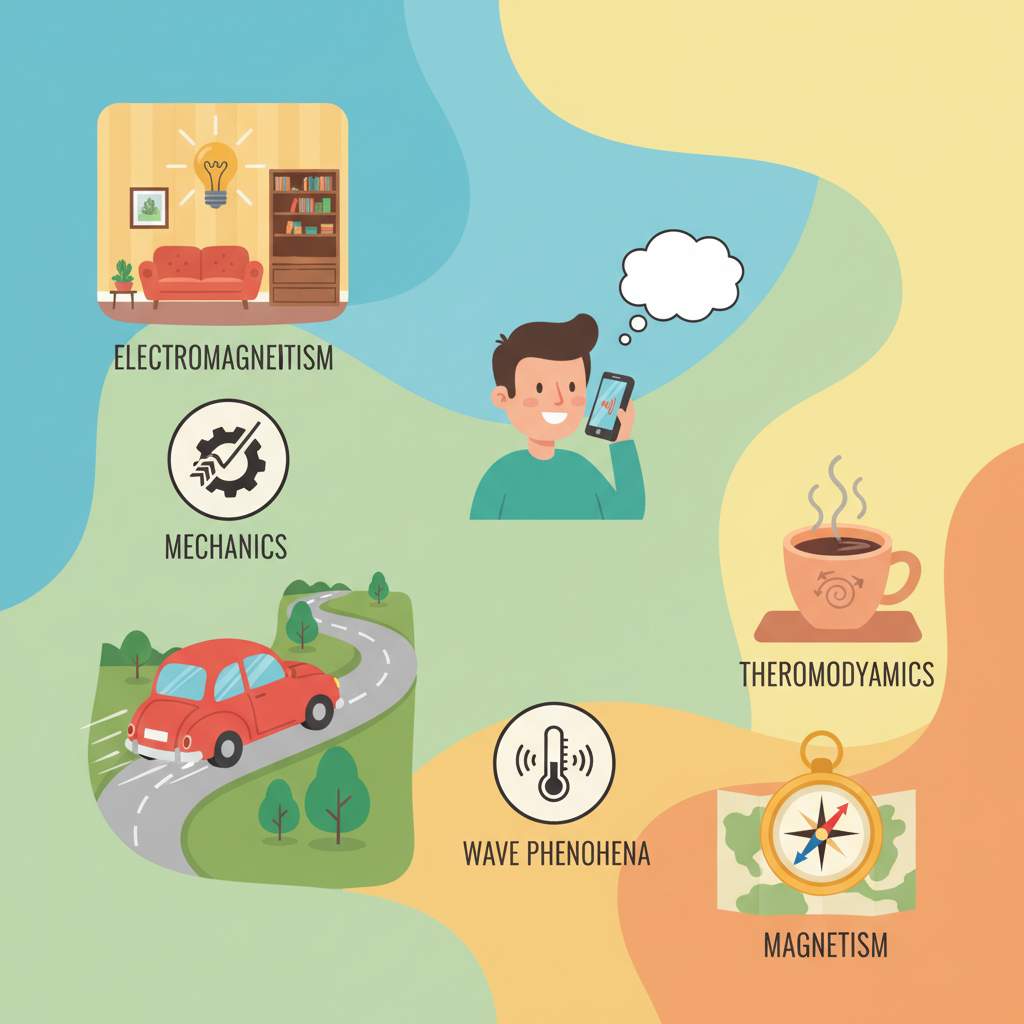 ⚠️ This picture may have spelling mistakes. Trust the words in the lesson.
3. Sound: The Vibrating World
The sounds of music, people talking, birds chirping – all these are thanks to sound. Sound is produced by vibrations. When something vibrates, it creates waves that travel through a medium (like air, water, or solids) to our ears, where our brain interprets them as sound.
a. How Sound Travels
When you speak, your vocal cords vibrate, creating sound waves that travel through the air to the listener's ear. If you hit a drum, the drumhead vibrates and sends sound waves out. Sound needs a medium to travel; it can't travel through empty space (a vacuum), which is why space is silent!
- Analogy: Imagine sound waves like ripples spreading out when you drop a pebble into a pond. The pebble is the vibration, and the ripples are the sound waves traveling through the water (the medium).
b. Echoes: Sound Bouncing Back
An echo is simply reflected sound. When sound waves hit a hard surface like a wall or a mountain, they can bounce back to you. This is very similar to how light reflects off a mirror.
- Analogy: If you shout in a large, empty room, your voice might 'bounce' back to you. That's an echo, like a sound boomerang.
4. Heat and Temperature: The Energy of Jiggling Particles
Why do you feel warm next to a fire? Why does an ice cube melt? Why does your coffee get cold? The answers lie in heat and temperature.
a. Heat: Energy Transfer
Heat is a form of energy that is transferred from a hotter object to a colder object. It's the total energy of all the tiny particles (atoms and molecules) jiggling around inside an object. The more they jiggle, the more heat energy there is.
- Analogy: Think of heat as a 'party' of tiny particles. When they're having a wild party, full of dancing and movement, there's a lot of heat. When they're just chilling, there's less heat. Heat always tries to spread out from the wildest party to the quieter ones.
b. Temperature: How Hot or Cold
Temperature is a measure of the average kinetic energy (energy of motion) of the particles in an object. It tells us how hot or cold something is. A hot object has particles moving faster on average than a cold object.
- Analogy: If heat is the total energy of all the dancers at the party, temperature is like the 'average energy' or 'average excitement level' of each dancer. A high temperature means dancers are, on average, very excited and moving quickly.
c. How Heat Moves: Conduction, Convection, Radiation
- Conduction: Heat transfer by direct contact. When you touch a hot stove, heat conducts into your hand.
- Convection: Heat transfer through the movement of fluids (liquids or gases). This is how a radiator heats a room or how water boils in a pot (hot water rises, cold water sinks).
- Radiation: Heat transfer through electromagnetic waves, no contact or medium needed. This is how you feel the warmth of the sun or a fire, even from a distance.
5. Electricity and Magnetism: The Invisible Powerhouse
Think about your smartphone, the lights in your home, or even a simple refrigerator magnet. These all work thanks to the wonders of electricity and magnetism.
a. Electricity: Flowing Charges
Electricity is the flow of tiny charged particles, usually electrons, through a conductor (like a wire). This flow of energy powers almost everything in our modern lives – from computers and TVs to streetlights and electric cars.
- Analogy: Imagine electricity like water flowing through pipes. The wires are the pipes, and the tiny electrons are the water molecules. When you open a tap, water flows; when you flip a switch, electricity flows.
b. Magnetism: Invisible Forces
Magnetism is a force that attracts or repels certain materials, like iron. Magnets have two poles, North and South. Opposite poles attract, and like poles repel. This force is used in everything from refrigerator magnets to compasses (which use Earth's magnetic field to point North) and even powerful MRI machines in hospitals.
- Analogy: Think of magnets as having 'invisible arms.' North poles have arms that want to hug South poles, but they push away other North poles (and vice versa for South poles).
c. Electromagnetism: The Powerful Duo
Interestingly, electricity and magnetism are closely linked; they are two sides of the same coin called electromagnetism. Moving electricity creates magnetism, and changing magnetic fields can create electricity. This relationship is crucial for electric motors (like in a fan or blender), generators (that produce electricity), and even how your cell phone transmits signals.
Conclusion: Physics is Everywhere!
As you can see, physics isn't just a subject in a textbook; it's the very fabric of your daily existence. Every step you take, every sound you hear, every light you see, every device you use – all are governed by the fundamental laws of physics. By understanding these basic principles, you gain a deeper appreciation for the amazing world around you and the incredible ingenuity behind the technologies we often take for granted. So next time you kick a ball or switch on a light, take a moment to appreciate the fascinating physics at play!
Keep learning, free
Create a free Syllabax account to unlock practice questions and games for this topic.
Visual Learning Enhanced! 🚀
To help you master this topic, we use Advanced Syllabax AI to generate detailed diagrams and visual models.
Note on Visuals: The AI sometimes makes spelling errors in image labels. Please refer to the lesson text for the correct terminology.