Grouping Similar Items
Watch this topic in 60 seconds
Free preview · Lesson 1
Understanding Grouping Similar Items
Let's Learn About Grouping Similar Items!
Hello, young learners! Have you ever looked at a big pile of things and felt a little overwhelmed? Maybe your toy box is super, super messy! You have toy cars, building blocks, dolls, and action figures all mixed up. It can be hard to find your favorite race car when it's buried under a pile of blocks, right?
Well, today we're going to learn a super helpful skill called Grouping Similar Items! It's like having a superpower for making sense of messes and keeping things tidy. When you group things, you put things that are alike, or "similar," together.
What Does "Grouping" Mean?
Think about it like this: Imagine you have a big basket of socks right after laundry. There are red socks, blue socks, striped socks, and plain socks, all mixed up. If you pick out all the red socks and put them in one little pile, and all the blue socks in another pile, you are grouping them!
Grouping simply means putting things that belong together, together. It’s like giving everything its own special family spot.
What Does "Similar" Mean? (This is a Very Important Word!)
The word "similar" means things that are almost the same in some way. They might not be exactly identical, but they share important qualities.
- Analogy 1: Apples! Think about apples. You might have a bright red apple and a crisp green apple. They are different colors, but they are both *apples*, right? They are both fruits, and specifically, apples. So, they are similar because they are both the same kind of fruit. You would put them both in the fruit bowl!
- Analogy 2: Animals! If you see a big furry cat and a tiny playful kitten, they look a little different in size. But guess what? They are both cats! So, they are similar. You'd group them together in a group called "cats."
How Do We Decide What's Similar? We Look for Clues!
To group things, we need to be like detectives and look for clues! These clues help us figure out what things are similar:
Clue 1: Color!
Are they the same color? You can group all your red crayons together, all your blue shirts together, or all your yellow blocks together. This is an easy way to start grouping!
Analogy 3: Crayon Box! Imagine your crayon box. If all the red crayons are together, and all the blue crayons are together, it's super easy to pick out the color you want for your drawing. If they were all mixed up, it would take a long time!
Clue 2: Shape!
Do they have the same shape? You could group all the square blocks together, or all the round balls together. If you have a toy box with a square block, a round ball, and a triangle block, you can group the square blocks with other square blocks, and the round balls with other round balls.
Clue 3: Size!
Are they big or small? Sometimes you group things by size. You could group all the big teddy bears together on one shelf and all the small teddy bears together on another shelf.
Clue 4: What They Are Used For! (This is a Super Helpful Clue!)
Sometimes things look very different, but they are used for the same thing! This is a powerful clue for grouping!
- Analogy 4: School Bag! In your school bag, you might have pencils, erasers, sharpeners, and rulers. They don't all look the same, but they are all "school supplies" that you use for learning and drawing. So, you can group all your pencils together, your erasers together, etc., in different pockets of your bag.
- Analogy 5: Kitchen Food! In your kitchen, grown-ups group foods all the time! All the fruits go in the fruit bowl. All the vegetables go in the fridge drawer. All the cereals go in the pantry. This makes it super easy to find what you need when you're hungry!
Let's Practice Grouping Together!
Imagine you have a big pile of different things. Let's practice grouping them!
Example 1: Grouping Animals!
Look at a picture with a cat, a dog, a bird, and a fish. Then you see another cat, another dog, and another bird. How would you group them?
- You can group all the cats together! Meow!
- You can group all the dogs together! Woof!
- You can group all the birds together! Tweet!
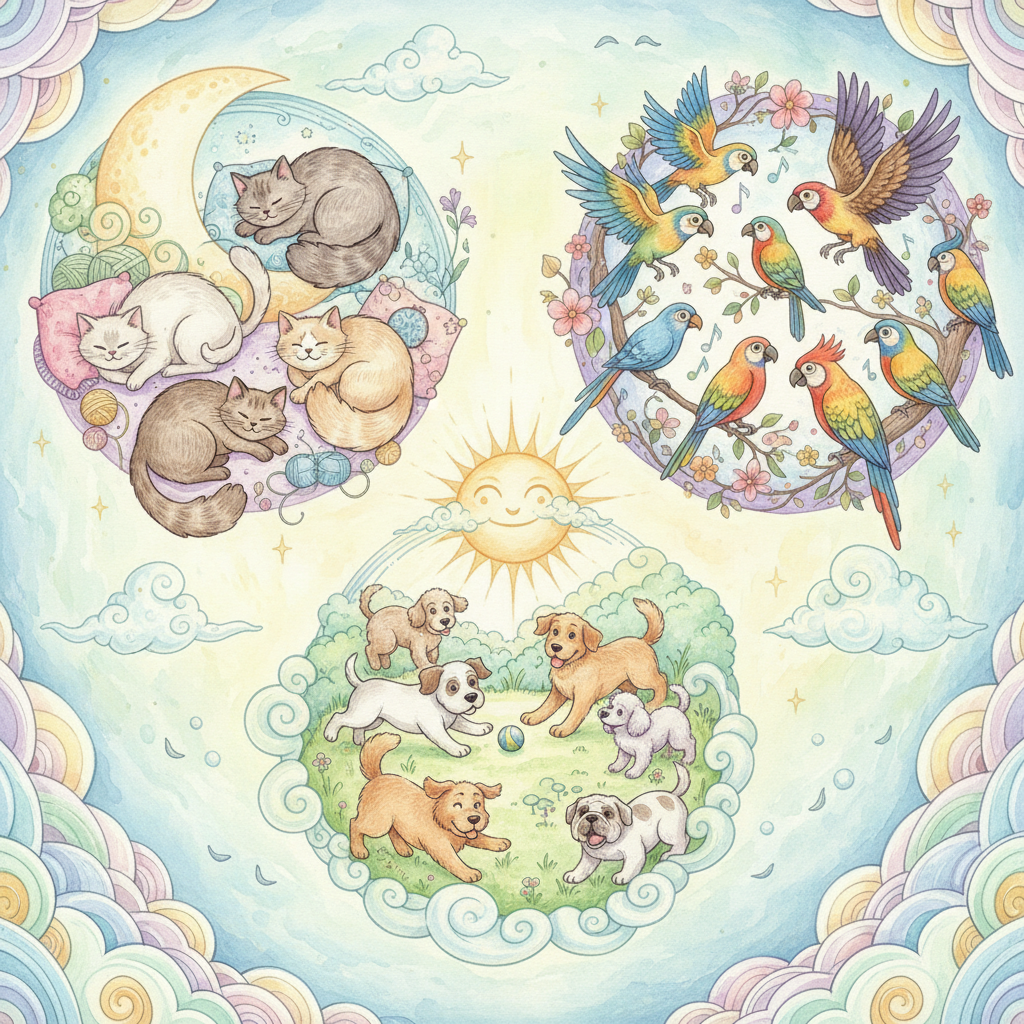 ⚠️ This picture may have spelling mistakes. Trust the words in the lesson.
See? Now it's easy to see how many cats, dogs, or birds you have!
Example 2: Grouping Your Toys!
If you have a mix of toy cars, bouncy balls, and dolls all over your room:
- Put all the toy cars in a special "car basket."
- Put all the bouncy balls in a "ball bin."
- Put all the dolls on a "doll shelf."
Now your toy room is much neater, and you can find your favorite toy much faster!
Why is Grouping Important and Helpful?
Grouping similar items is a super skill because:
- It helps us find things easily! If you group all your blue socks together, you can quickly find a matching pair. No more lost socks or time spent searching!
- It helps us keep things tidy! A messy room or desk becomes a neat room or desk when everything has its special place. It feels good to be organized!
- It helps us understand the world better! When we group things, we learn how they are alike and different. We learn about different "categories" of things, like "fruits," "toys," or "school supplies."
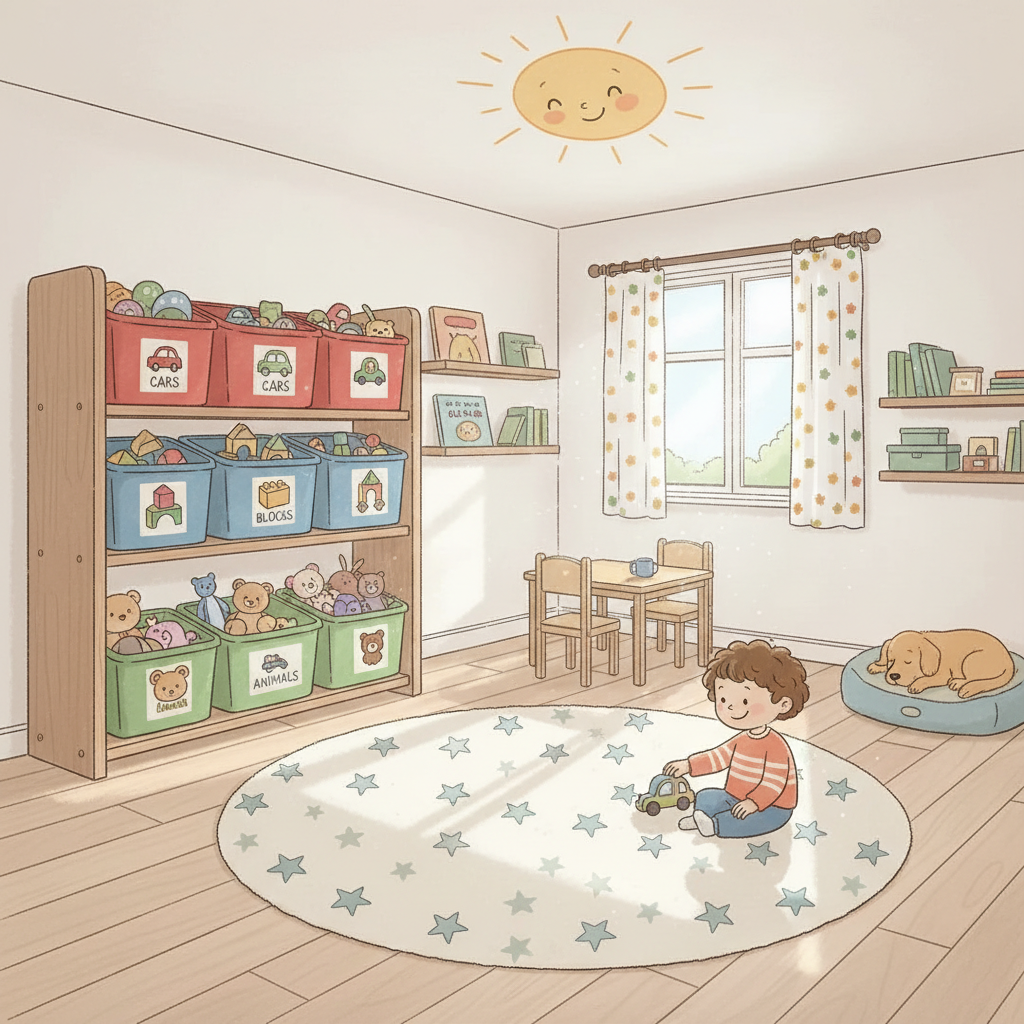
Your Turn to Be a Grouping Expert!
Look around your room right now! Can you find some things that you could group together?
- Can you find things that are all red?
- Can you find things that are all soft?
- Can you find things that are all used for drawing or writing?
Try putting them together! You're already a grouping expert!
Conclusion
Grouping similar items is a powerful skill! It helps us organize our things, find what we need quickly, and understand how different items fit together in our amazing world. Keep practicing this skill every day, and you'll be a grouping superstar!
Keep learning, free
Create a free Syllabax account to unlock practice questions and games for this topic.
Visual Learning Enhanced! 🚀
To help you master this topic, we use Advanced Syllabax AI to generate detailed diagrams and visual models.
Note on Visuals: The AI sometimes makes spelling errors in image labels. Please refer to the lesson text for the correct terminology.