Subtraction without borrowing (Subtraction)
Watch this topic in 60 seconds
Free preview · Lesson 1
Understanding Subtraction without borrowing (Subtraction)
Learning Resource: Subtraction Without Borrowing (First Grade)
Hello young learners! Today, we're going on an exciting adventure to explore subtraction without borrowing! Don't worry, it's like playing a game where we take things away. We'll learn how to find out how many are left when we start with some items and give some away.
What is Subtraction?
Subtraction is like sharing or giving away. Imagine you have a yummy box of 5 cookies, and you give 2 to your friend. Subtraction helps us figure out how many cookies you have left. It's all about taking away!
Let's Use Our Fingers!
Let's try it with our fingers! Hold up 3 fingers. Now, put down 1 finger. How many fingers are still up? That's right, 2! You just did subtraction!
The symbol for subtraction is a little dash: -. It's called a minus sign. When you see it, you know it's time to take away.
Subtraction Vocabulary
- Minuend: This is the bigger number, the number we start with. It's like the total number of toys you have before you give any away.
- Subtrahend: This is the number we take away. It's like the number of toys you give to a friend.
- Difference: This is the answer we get after subtracting. It's how many toys you have left!
Example Time!
Let's say you have 7 shiny red balloons. (Minuend = 7). Then, 3 of the balloons float away. (Subtrahend = 3). How many balloons do you have left? (Difference = ?)
We can write this as: 7 - 3 = ?
Imagine your 7 balloons:
Now, let's make 3 of them float away (we cross them out):
~~🎈~~ ~~🎈~~ ~~🎈~~ 🎈 🎈 🎈 🎈
Count how many balloons are still there. There are 4! So, 7 - 3 = 4. The difference is 4.
Subtraction Without Borrowing: The Easy Way!
Subtraction without borrowing is super simple. It happens when the digit in the top number (the minuend) is bigger than or equal to the digit in the bottom number (the subtrahend) in each place value column (ones, tens, etc.).
Let's Look at Numbers
When we subtract numbers with more than one digit, we line them up carefully, just like building with blocks!
Step 1: Line Up the Numbers! Always put the bigger number on top and the smaller number on the bottom. Make sure the ones digits are in the ones column, and the tens digits are in the tens column.
Step 2: Subtract the Ones! Start with the numbers on the right side, in the ones column. Take the bottom number away from the top number.
Step 3: Subtract the Tens! Now, move to the next column to the left, the tens column. Take the bottom tens number away from the top tens number.
A Fun Analogy: The Toy Shelf!
Imagine you have a shelf with 5 toy cars. (Minuend = 5). Your little sibling takes 2 of them to play with. (Subtrahend = 2).
We write it like this:
  5
- 2
---
First, we look at the ones place. We have 5 cars on top and 2 cars on the bottom. Can we take 2 away from 5? Yes! 5 - 2 = 3.
  5
- 2
---
  3
So, you have 3 toy cars left. The difference is 3!
Another Example: Apples in a Basket!
Let's say you have a basket with 8 delicious apples. (Minuend = 8). You eat 3 of them for a snack. (Subtrahend = 3).
We write it like this:
  8
- 3
---
We look at the ones column. We have 8 on top and 3 on the bottom. Is 8 bigger than 3? Yes! So, we can subtract. 8 - 3 = 5.
  8
- 3
---
  5
You have 5 apples left in the basket!
Working with Tens!
Now, let's try numbers with tens.
Imagine you have 4 sticky notes on a notepad. (Minuend = 4). Your friend uses 1 sticky note. (Subtrahend = 1).
This looks like:
  4
- 1
---
Ones: 4 - 1 = 3.
  4
- 1
---
  3
What if we had 2 tens and 4 ones? That's the number 24! (Minuend = 24). And your friend uses 1 ten and 3 ones? That's the number 13! (Subtrahend = 13).
We line them up:
  2 4
- 1 3
-----
Step 1: Subtract the Ones! Look at the rightmost column (the ones). We have 4 on top and 3 on the bottom. Is 4 bigger than 3? Yes! So, 4 - 3 = 1. We write 1 in the ones place of our answer.
  2 4
- 1 3
-----
      1
Step 2: Subtract the Tens! Now, look at the next column to the left (the tens). We have 2 on top and 1 on the bottom. Is 2 bigger than 1? Yes! So, 2 - 1 = 1. We write 1 in the tens place of our answer.
  2 4
- 1 3
-----
  1 1
So, 24 - 13 = 11. You have 11 left!
Another Tens Example: Building Blocks!
Let's say you have 3 tens blocks and 5 ones blocks. That's 35 blocks in total. (Minuend = 35). You decide to give away 2 tens blocks and 2 ones blocks. That's 22 blocks. (Subtrahend = 22).
Line them up:
  3 5
- 2 2
-----
Ones: 5 - 2 = 3. Write 3 in the ones place.
  3 5
- 2 2
-----
      3
Tens: 3 - 2 = 1. Write 1 in the tens place.
  3 5
- 2 2
-----
  1 3
You have 13 blocks left!
See? Subtraction without borrowing is just about taking away when you have enough, step by step! Keep practicing, and you'll become a subtraction superstar!
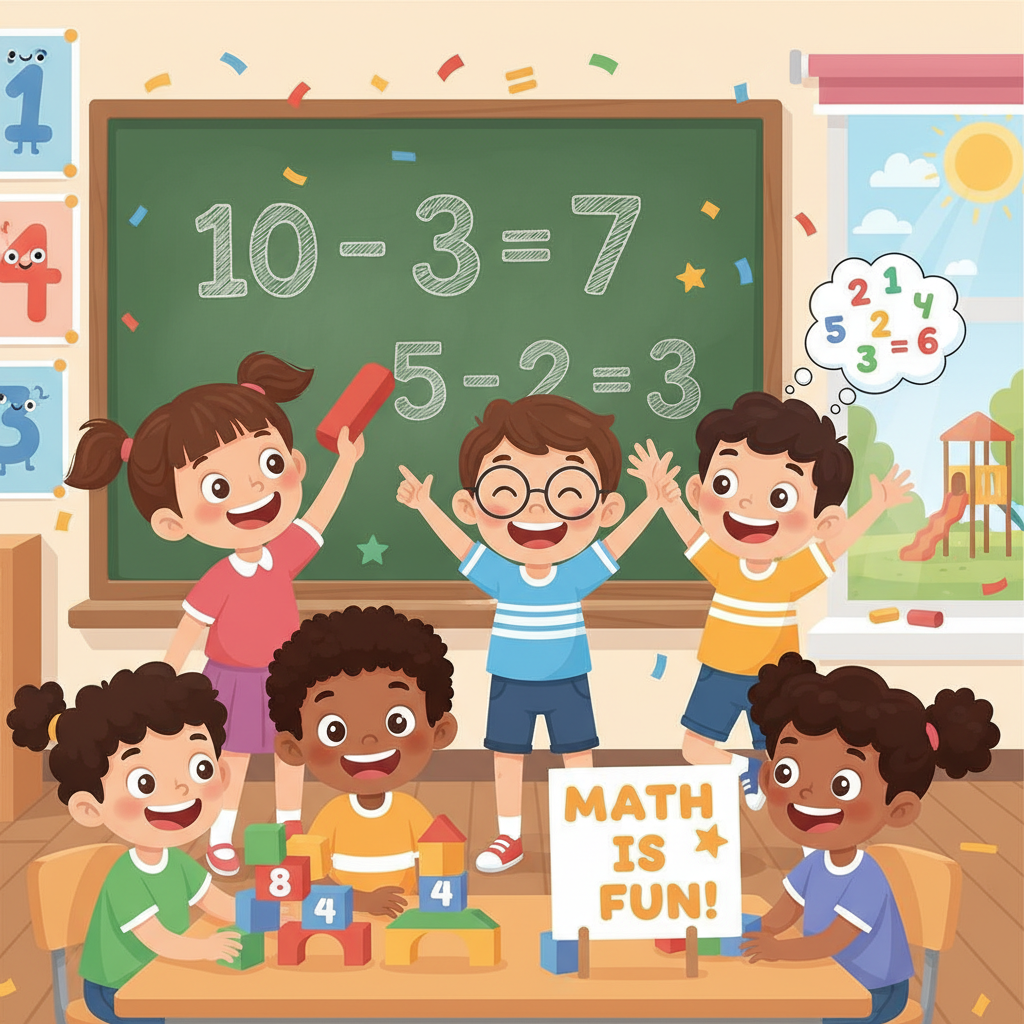 ⚠️ This picture may have spelling mistakes. Trust the words in the lesson.
Keep learning, free
Create a free Syllabax account to unlock practice questions and games for this topic.
Visual Learning Enhanced! 🚀
To help you master this topic, we use Advanced Syllabax AI to generate detailed diagrams and visual models.
Note on Visuals: The AI sometimes makes spelling errors in image labels. Please refer to the lesson text for the correct terminology.