Learning Journey
Watch this topic in 60 seconds
Free preview · Lesson 1
Understanding Recognizing Cyberbullying
Understanding Cyberbullying: Recognizing the Digital Bully
Hey everyone! Imagine you're playing a game of tag, but instead of running around outside, you're playing it online. Most of the time, it's fun and friendly. But what happens if someone starts playing unfairly, saying mean things, or trying to hurt your feelings, not with their hands, but with their words and actions online? That's kind of like cyberbullying. It’s a serious issue that happens when someone uses digital tools – like phones, computers, or tablets – to repeatedly upset, embarrass, or harm another person.
What is Cyberbullying, Really?
Think of traditional bullying as someone pushing you in the hallway or calling you names to your face at school. Cyberbullying is the same kind of mean behavior, but it happens in the digital world. It's like a bully who has learned to use a smartphone or computer as their weapon instead of their fists or voice.
Here’s a simple way to remember it: Cyberbullying = Bullying + Technology. It’s when someone intentionally and repeatedly tries to hurt or embarrass another person using texts, social media, games, or other online platforms.
Key Differences: Why Cyberbullying is Like a "Shadow Bully"
Cyberbullying isn't just regular bullying moved online; it has some unique features that make it especially tricky. Think of it like a shadow bully – it can follow you everywhere and is sometimes harder to see coming.
- The 24/7 Bully: It Never Sleeps!
Imagine if a school bully could follow you home, call you in the middle of the night, or even pop up during your family dinner. That's what cyberbullying can feel like. Unlike traditional bullying, which often stops when school ends, cyberbullying can happen any time, day or night, through texts, social media posts, or gaming messages. It's like having a loud, annoying alarm clock that you can't turn off, ringing at all hours.
- The "Invisible" Audience: Like Yelling in a Stadium!
If someone says something mean to you in the school hallway, only a few people might hear it. But online, a mean comment or rumor can be seen by hundreds, even thousands, of people in an instant! It's like someone spreading a rumor about you not just in your classroom, but yelling it into a megaphone in a giant stadium where everyone can hear and see. This can make the embarrassment feel much bigger and harder to escape.
- The Permanent Mark: Like Ink on Paper!
When someone says something hurtful, the words can fade over time. But online, once something is posted – a mean photo, a cruel message, or a false rumor – it can be incredibly difficult to remove completely. It’s like trying to erase permanent marker from a wall; even if you scrub it, a faint stain might remain. These digital traces can pop up again and again, causing repeated hurt.
- The "Hidden Face": Like a Masked Prankster!
Sometimes, cyberbullies hide behind fake profiles or anonymous usernames. This can make them feel braver and more powerful because they don't have to face you directly. It's like someone throwing rotten eggs at your house from behind a bush; they don't have to see your reaction or take responsibility for their actions. This anonymity can make it harder to know who is hurting you and why.
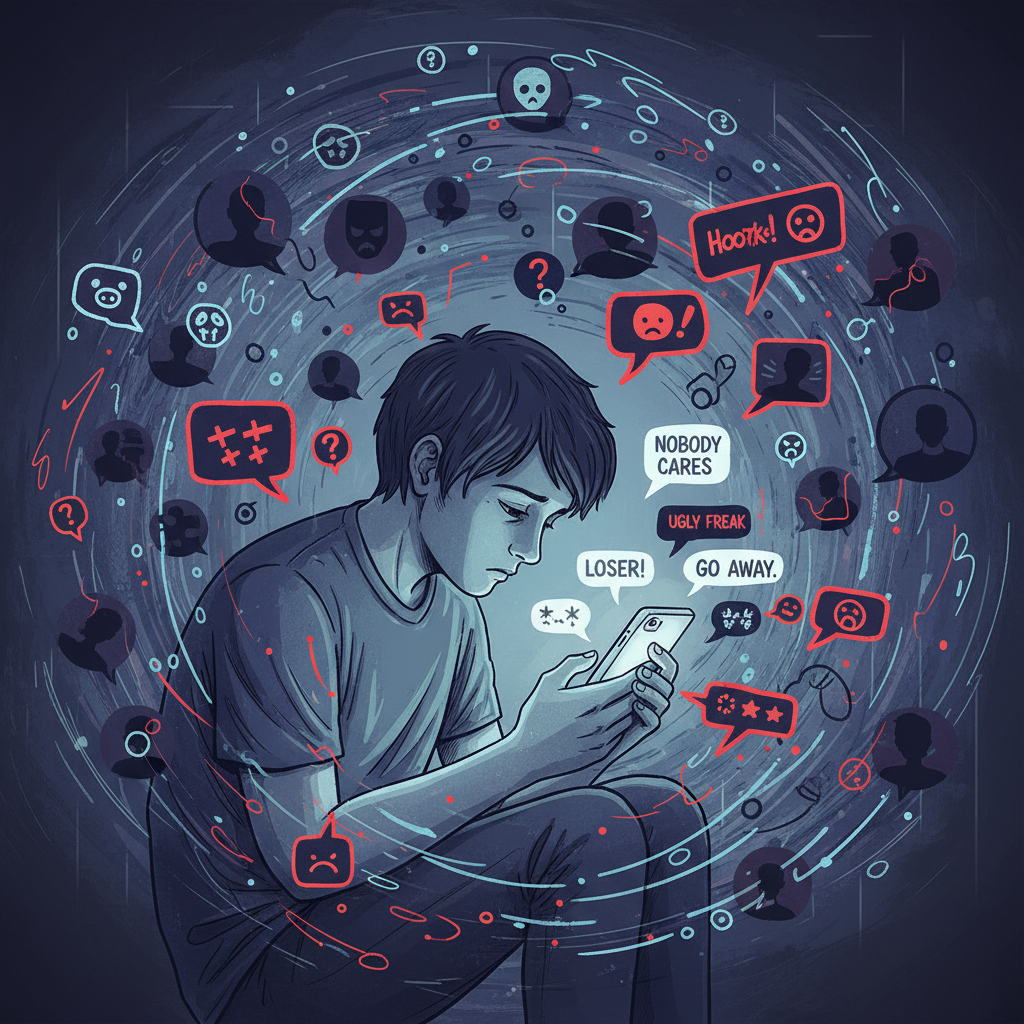 ⚠️ This picture may have spelling mistakes. Trust the words in the lesson.
Different Faces of the Digital Bully: Types of Cyberbullying
Cyberbullying isn't just one thing; it comes in many forms, like different tools in a bully's digital toolbox. Knowing these types can help you spot them.
- Harassment: The Constant Drip!
This is when someone sends repeated mean, nasty, or insulting messages. It's like someone constantly dripping cold water on your head – not a huge attack, but annoying and upsetting over time.
- Exclusion: The Closed Door!
This happens when someone intentionally leaves you out of an online group, chat, or game, even when you usually participate. It's like your friends forming a club and sending you an invite, but then locking you out of the clubhouse when you try to join. They're making you feel unwanted and alone.
- Impersonation: The Masked Pretender!
This is when someone pretends to be you online, using your name, picture, or even creating a fake profile in your name, and then posts embarrassing or mean things. It's like someone stealing your uniform and then doing something bad while wearing it, making it look like it was you.
- Outing: The Leaked Secret!
This occurs when someone shares your private or embarrassing information, pictures, or videos online without your permission. It's like someone finding your secret diary and then reading your most private thoughts out loud to the entire school.
- Trickery: The Sneaky Trap!
This is when a bully tricks you into revealing embarrassing information or secrets about yourself, pretending to be your friend, and then shares that information publicly. It's like someone promising to keep a secret if you tell them, but then immediately broadcasting it to everyone.
- Cyberstalking: The Lingering Shadow!
This involves repeated, unwanted online contact that feels threatening or causes you to fear for your safety. It's like someone constantly watching you from a distance, making you feel uneasy and never truly safe, even when you're at home.
Recognizing the Signs: Is Someone Being Cyberbullied (or are YOU)?
It's super important to recognize the signs, both in yourself and in your friends. Sometimes, kids who are being cyberbullied might not talk about it because they feel ashamed, embarrassed, or scared. Think of these as red flags waving in the wind.
Signs in Behavior and Feelings:
- Sudden sadness, anger, or anxiety: Like a sunny day suddenly turning cloudy without warning.
- Avoiding their phone, computer, or tablet: If someone who loves their phone suddenly doesn't want to touch it, it's like a baker suddenly hating cake.
- Changes in sleep or eating habits: Sleeping too much or too little, or not eating much, can be like an engine running out of fuel or getting stuck.
- Becoming withdrawn or secretive: Not wanting to hang out with friends, or hiding what they're doing online. It's like building a wall around themselves.
- Lower grades or not wanting to go to school: Feeling sick often, or grades suddenly dropping.
- Loss of interest in hobbies they once loved: If someone stops doing their favorite things, it's a big change.
Signs in Online Content:
- Receiving mean texts, comments, or messages: Directly seeing hateful words aimed at someone.
- Being left out of online groups or conversations unfairly.
- Seeing embarrassing photos or videos of themselves posted without permission.
- Rumors or gossip being spread about them online.
- Someone using their account or identity to post things they didn't say.
What to Do if You Spot Cyberbullying (or if it Happens to You)
You are not alone, and it's not your fault! If you or a friend are experiencing cyberbullying, remember these steps. Think of them as your anti-bully superhero moves!
- Don't Respond!
It's like someone throwing a ball at you – if you don't catch it and throw it back, the game can't continue. Responding often makes the bully feel more powerful and can escalate the situation.
- Save the Evidence!
Take screenshots of messages, posts, or comments. This is super important! It's like taking a photograph of a crime scene – it provides proof of what happened. This evidence can be crucial if you need to show it to an adult or school authority.
- Tell a Trusted Adult!
This is the most important step! Talk to a parent, guardian, teacher, school counselor, or another trusted adult. They are there to help you and have experience dealing with tough situations. Think of them as your personal superheroes who can help you fight off the villain.
- Block the Bully!
Most social media apps and devices have a "block" feature. Use it! It's like closing a door in their face so they can't bother you anymore.
- Report It!
Many online platforms have a "report" button for cyberbullying or inappropriate content. Using this button can lead to the content being removed or the bully's account being suspended. It's like telling the referee in a game that someone is cheating.
In Conclusion: Be a Digital Upstander!
Cyberbullying is a big deal, and recognizing it is the first step to stopping it. Remember, your words and actions online have power. Always think before you post, and choose kindness. If you see something, say something! Being an "upstander" – someone who helps instead of just watching – makes a huge difference. Let's make the internet a safer, kinder place for everyone, one click at a time!
Keep learning, free
Create a free Syllabax account to unlock practice questions and games for this topic.
Visual Learning Enhanced! 🚀
To help you master this topic, we use Advanced Syllabax AI to generate detailed diagrams and visual models.
Note on Visuals: The AI sometimes makes spelling errors in image labels. Please refer to the lesson text for the correct terminology.