Data Range: Smallest to Largest
Watch this topic in 60 seconds
Free preview · Lesson 1
Understanding Data Range: Smallest to Largest
Understanding "Smallest to Largest" in Data!
Hello, young mathematicians! Today, we're going on an exciting adventure to explore numbers and how we can put them in a special order. Think of it like organizing your toys, your books, or even the different sizes of clothes you have. When we talk about "Smallest to Largest," we're learning a super important skill called ordering data.
What is Data? (It's not just for computers!)
First, let's understand what "data" means. Don't let the big word scare you! Data is just information or facts, often in the form of numbers.
- If you count how many apples are in a basket, the number you get (like '5') is data.
- If you measure how tall your friends are, those heights (like '45 inches', '48 inches') are data.
- If you record the scores from a game, those scores (like '10 points', '7 points', '12 points') are data.
So, data is simply information, and often it comes in the form of numbers that we can compare!
Meeting the "Smallest" Number!
Imagine you have three different-sized balls: a tiny ping-pong ball, a regular tennis ball, and a big beach ball. Which one is the smallest? The ping-pong ball, right?
In a group of numbers, the smallest number is the one that has the least value. It's the number that is 'closest to zero' if you think about a number line, or the one you'd count first if you were counting up from zero.
Analogy Time!
- Think of your family members. Who is the youngest? Their age would be the smallest number among everyone's ages.
- Imagine different sized puppies. The newborn puppy is the smallest.
Let's look at some numbers: 7, 3, 10, 5. Which one is the smallest? If you start counting from 1, you'd say 3 first among these numbers. So, 3 is the smallest!
Meeting the "Largest" Number!
Now, let's go back to our balls: the ping-pong ball, the tennis ball, and the beach ball. Which one is the largest? The big beach ball!
In a group of numbers, the largest number is the one that has the most value. It's the number that is 'furthest from zero' (in a positive direction) on a number line, or the one you'd count last if you were counting up to reach all the numbers.
Analogy Time!
- Again, with your family members. Who is the oldest? Their age would be the largest number among everyone's ages.
- Imagine different sized trees in a park. The tallest, oldest oak tree is the largest.
Let's use the same numbers: 7, 3, 10, 5. Which one is the largest? If you count up, you'd reach 10 last among these numbers. So, 10 is the largest!
Putting It All Together: Smallest to Largest!
When we arrange numbers from smallest to largest, we are putting them in ascending order. Think of it like climbing a staircase – you start at the bottom (smallest step) and go up to the top (largest step).
How to Order Numbers from Smallest to Largest: A Simple Recipe!
- Look at all the numbers in your group.
- Find the smallest number. Write it down first.
- Cross out the number you just used. This helps you keep track!
- From the remaining numbers, find the new smallest number. Write it down next.
- Repeat steps 3 and 4 until all numbers are used up!
Let's Try an Example!
Imagine you have these scores from a game: 15, 8, 20, 12, 5.
Step 1: Look at all the numbers: 15, 8, 20, 12, 5.
Step 2: Find the smallest number. Looking at 15, 8, 20, 12, 5... the smallest is 5.
Step 3: Cross it out. Our list is now: 15, 8, 20, 12, 5. (We've got 5)
Step 4: From the remaining numbers (15, 8, 20, 12), find the new smallest. It's 8.
Step 5: Repeat.
- Cross out 8. Remaining: 15,
8, 20, 12,5. (We've got 5, 8) - New smallest from (15, 20, 12) is 12.
- Cross out 12. Remaining: 15,
8, 20,12,5. (We've got 5, 8, 12) - New smallest from (15, 20) is 15.
- Cross out 15. Remaining:
15,8, 20,12,5. (We've got 5, 8, 12, 15) - Only 20 is left. It must be the largest!
So, our numbers from Smallest to Largest are: 5, 8, 12, 15, 20.
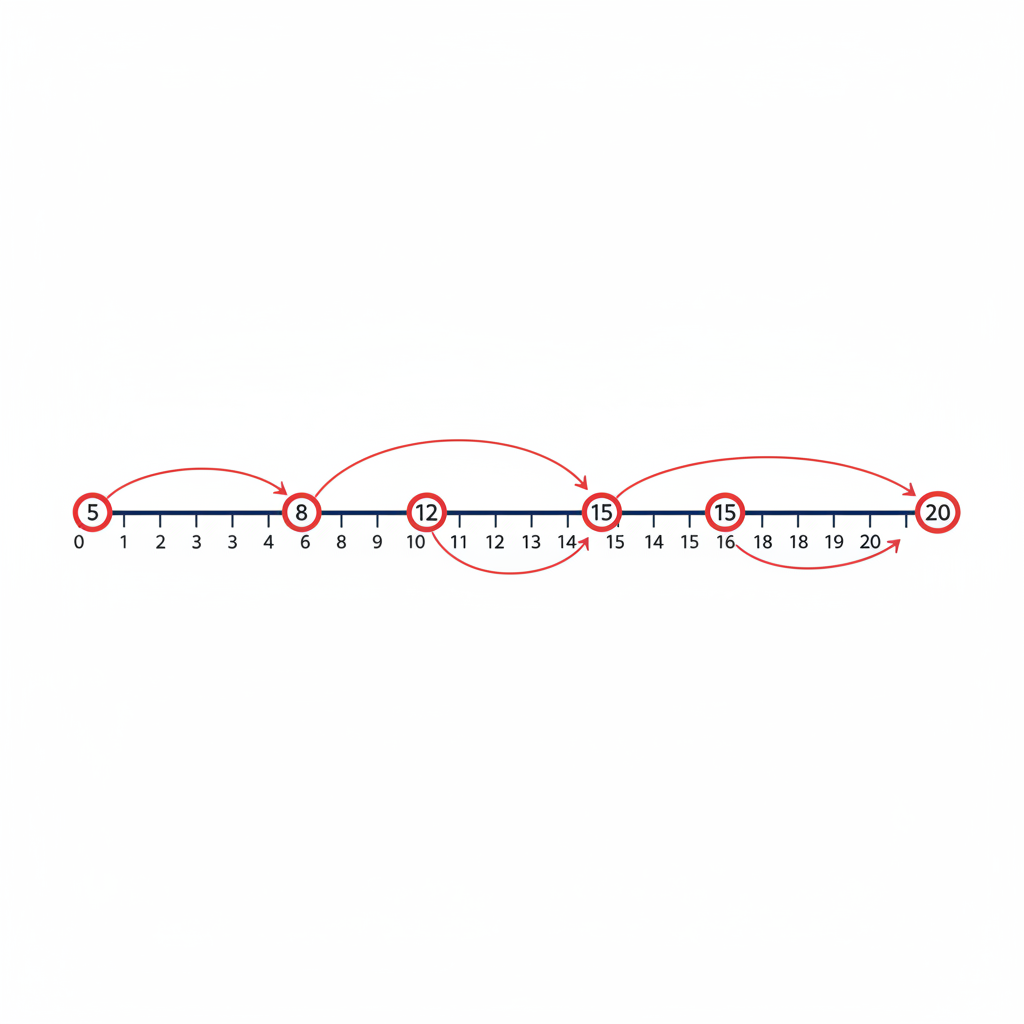 ⚠️ This picture may have spelling mistakes. Trust the words in the lesson.
Why is this skill important?
Learning to order numbers from smallest to largest helps us in many ways:
- Understanding sizes: If you have different sized toys, you can quickly see which is the smallest and which is the largest.
- Comparing things: If you're comparing test scores, you can see who got the lowest score and who got the highest.
- Organizing information: In bigger grades, you'll use this to organize data in tables and graphs to make it easy to understand.
- Finding the "middle": Once numbers are ordered, it's easier to find the number in the middle!
So, remembering to look for the 'tiniest' number first, then the next tiniest, all the way to the 'biggest' number, is a super power for understanding numbers!
Keep learning, free
Create a free Syllabax account to unlock practice questions and games for this topic.
Visual Learning Enhanced! 🚀
To help you master this topic, we use Advanced Syllabax AI to generate detailed diagrams and visual models.
Note on Visuals: The AI sometimes makes spelling errors in image labels. Please refer to the lesson text for the correct terminology.