3D Pattern Visualisation – Non-Verbal Reasoning
Watch this topic in 60 seconds
Free preview · Lesson 1
3D Pattern Visualisation – Non-Verbal Reasoning (Foundational)
3D Pattern Visualisation – Non-Verbal Reasoning (Foundational)
Welcome to the foundational lesson on 3D Pattern Visualisation in Non-Verbal Reasoning. This topic involves understanding and manipulating shapes and patterns in three dimensions. We will focus on the core concepts and definitions to build a strong base.
What is 3D Pattern Visualisation?
3D Pattern Visualisation is the ability to mentally manipulate and understand shapes and patterns in three dimensions. It involves:
- Spatial Reasoning: Understanding the relationship between objects in space.
- Mental Rotation: Mentally rotating objects to see them from different angles.
- Pattern Recognition: Identifying patterns in 3D shapes.
Basic 3D Shapes
Let's review some basic 3D shapes that are commonly used in these types of questions:
- Cube: A 3D shape with six square faces.
- Cuboid: A 3D shape with six rectangular faces.
- Pyramid: A 3D shape with a polygonal base and triangular faces that meet at a point (apex).
- Prism: A 3D shape with two identical ends (bases) and flat rectangular sides.
- Sphere: A perfectly round 3D shape.
- Cylinder: A 3D shape with two parallel circular bases connected by a curved surface.
- Cone: A 3D shape with a circular base and a curved surface that tapers to a point (apex).
Understanding how these shapes can be combined and manipulated is key to solving 3D pattern visualisation problems.
Identifying Patterns in 3D Shapes
One common type of question involves identifying patterns on the surface of a 3D shape, such as a cube. This might involve matching a 2D net (a flattened version of the 3D shape) to the correct 3D shape or identifying which face of a cube is opposite another.
Example: Imagine a cube with different colors on each face. If you know the colors of three adjacent faces, can you deduce the color of the opposite faces?
Mental Rotation
Mental rotation is a crucial skill. You need to be able to imagine how a 3D shape would look if it were rotated in space. This can be tricky, but practice makes perfect!
Tips for Mental Rotation:
- Start with simple shapes.
- Focus on key features or markings on the shape.
- Imagine the shape rotating in small increments.
Example: Imagine a cube with an arrow drawn on one face. If the cube is rotated 90 degrees to the right, how would the arrow appear?
Nets of 3D Shapes
A net is a 2D shape that can be folded to form a 3D shape. Being able to recognize the net of a given 3D shape is a fundamental skill. Some shapes have multiple possible nets, while others have only one.
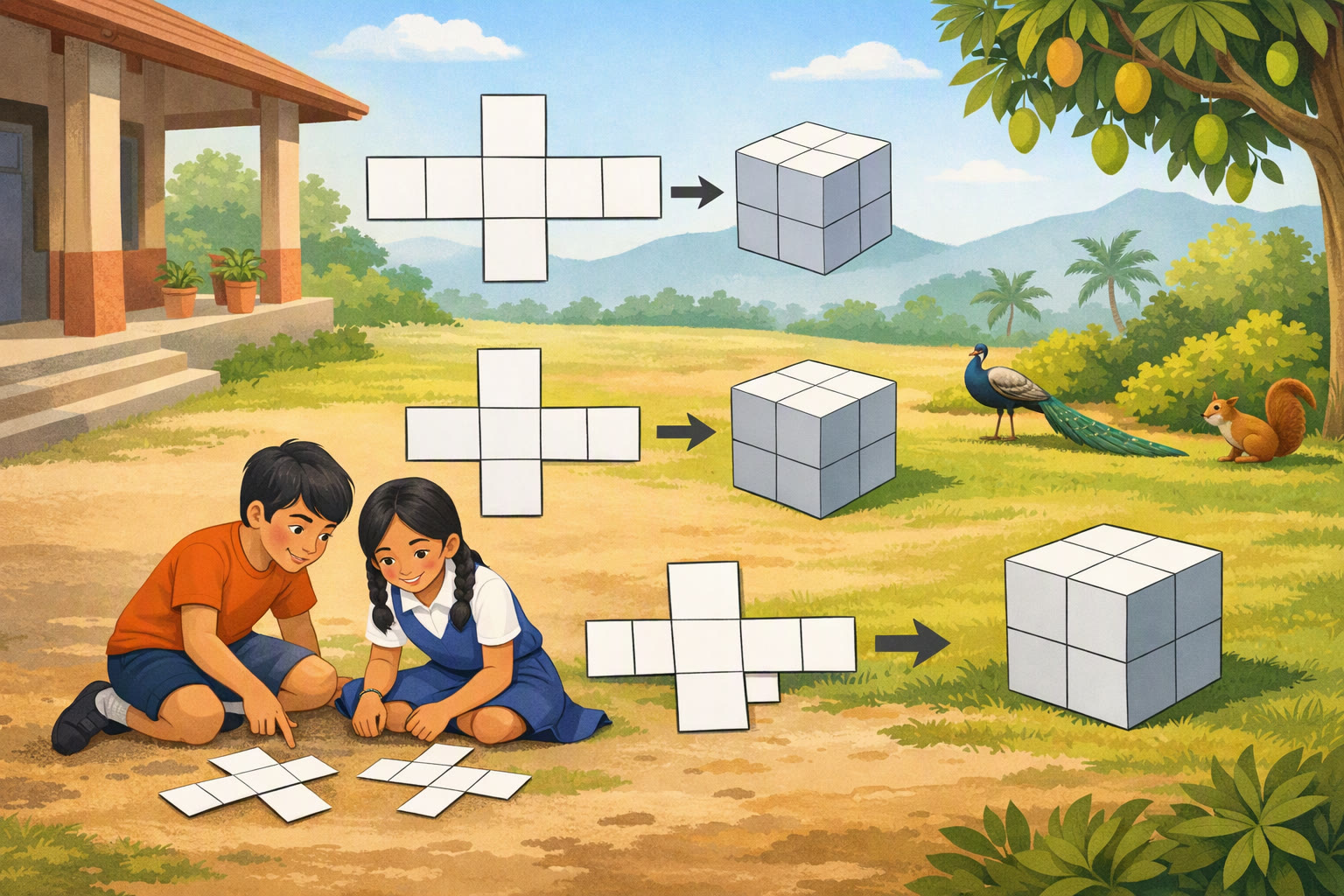
Example: Consider a cube. Several different 2D shapes can be folded to create a cube. Can you visualise how to fold a given net into a cube?
Keep learning, free
Create a free Syllabax account to unlock practice questions and games for this topic.
Visual Learning Enhanced! 🚀
To help you master this topic, we use Advanced Syllabax AI to generate detailed diagrams and visual models.
Note on Visuals: The AI sometimes makes spelling errors in image labels. Please refer to the lesson text for the correct terminology.