Food chain[BIOLOGY]
Watch this topic in 60 seconds
Free preview · Lesson 1
Understanding Food chain[BIOLOGY]
Understanding Food Chains: Who Eats Whom?
Imagine a giant, interconnected meal! That's kind of what a food chain is all about. In the world of biology, a food chain shows us how energy moves from one living thing to another. It's like a list of who eats whom in nature. Think of it as nature's way of passing on a delicious energy snack!
What is a Food Chain?
A food chain is a simple way to illustrate how energy is transferred through an ecosystem. An ecosystem is like a neighborhood where living things and non-living things all interact. Think of a forest, a pond, or even a desert – these are all ecosystems.
In a food chain, we start with something that makes its own food, and then we see who eats that, and then who eats that creature, and so on. It's a one-way street for energy!
The Superstars of the Food Chain: Producers
Every food chain needs a starting point, and these are the amazing producers. Producers are living things that can make their own food, usually using sunlight! Think of them as nature's chefs, whipping up their meals from scratch.
The most common producers are plants, like trees, grass, flowers, and algae (tiny plants that live in water). They use a special process called photosynthesis. It's like they have tiny solar panels on their leaves that capture sunlight. They mix this sunlight with water and carbon dioxide from the air to create sugary food for themselves.
Analogy: Think of a plant like a baker who uses flour (carbon dioxide), water, and an oven powered by sunlight to make a delicious cake (sugar/food).
The Hungry Followers: Consumers
Once we have producers, we need creatures that eat them! These are called consumers. Consumers can't make their own food, so they have to get their energy by eating other living things. They are like the customers lining up at the baker's shop!
There are different types of consumers:
Herbivores: The Plant Eaters
These are consumers that *only* eat plants. They are like the folks who *only* want the cake from the baker.
Examples: Rabbits eating grass, deer munching on leaves, cows chewing on hay, caterpillars chomping on leaves.
Analogy: A rabbit is like someone who only eats salads and vegetables. They are happy getting their energy directly from the plants.
Carnivores: The Meat Eaters
These consumers eat other animals. They are like the customers who want a steak or a burger from a different kind of food stall.
Examples: Lions eating zebras, sharks eating fish, eagles eating mice, snakes eating frogs.
Analogy: A lion is like a chef who specializes in preparing and eating delicious grilled chicken or fish (other animals).
Omnivores: The Everything Eaters
These consumers eat both plants *and* animals. They are the adventurous eaters who will try anything on the menu!
Examples: Humans eating fruits, vegetables, and meat; bears eating berries and fish; birds eating seeds and insects.
Analogy: An omnivore is like a buffet diner who enjoys a little bit of everything – salads, pasta, chicken, and dessert!
The Clean-Up Crew: Decomposers
What happens when plants and animals die? Do they just pile up forever? Nope! Nature has a brilliant clean-up crew called decomposers. These are special organisms that break down dead plants and animals. They are like the recycling center of nature.
When decomposers break down dead things, they return important nutrients back into the soil. These nutrients are then used by plants (the producers!) to grow. It's a continuous cycle of life!
Examples: Bacteria and fungi (like mold and mushrooms).
Analogy: Decomposers are like the recycling workers who take old newspapers and food scraps and turn them back into useful materials (nutrients) that can be used to make new paper or fertilize a garden.
Putting It All Together: A Simple Food Chain Example
Let's look at a simple food chain:
Grass (Producer) → Grasshopper (Herbivore/Primary Consumer) → Frog (Carnivore/Secondary Consumer) → Snake (Carnivore/Tertiary Consumer) → Hawk (Carnivore/Quaternary Consumer)
Here's what's happening:
- Grass makes its own food using sunlight.
- A Grasshopper eats the grass, getting energy from it. The grasshopper is a primary consumer because it's the first consumer in this chain.
- A Frog eats the grasshopper. The frog is a secondary consumer because it eats the primary consumer.
- A Snake eats the frog. The snake is a tertiary consumer because it eats the secondary consumer.
- A Hawk eats the snake. The hawk is a quaternary consumer because it eats the tertiary consumer.
Arrows in a food chain always point in the direction of energy flow. So, the arrow from grass to grasshopper means energy flows *from* the grass *to* the grasshopper.
When the hawk eventually dies, decomposers like bacteria and fungi will break down its body, returning nutrients to the soil, which helps the grass grow. See? It all connects!
Why are Food Chains Important?
Food chains help us understand how energy flows through an ecosystem and how different organisms depend on each other. If one part of the food chain is removed or disrupted, it can affect all the other parts. For example, if all the grasshoppers disappeared, the frogs would have less food, and then the snakes would have less food, and so on.
It's a delicate balance, like a carefully built tower of blocks. If you remove one block, the whole tower can become unstable.
Food Webs: A More Realistic Picture
In reality, most ecosystems are more complicated than a single food chain. Most animals eat more than one type of food, and many animals are eaten by more than one type of predator. This creates a complex network of interconnected food chains called a food web. Think of a food chain as a single thread, and a food web as a beautiful, intricate spider web made of many threads!
Understanding food chains is the first step to understanding these complex food webs and how ecosystems work!
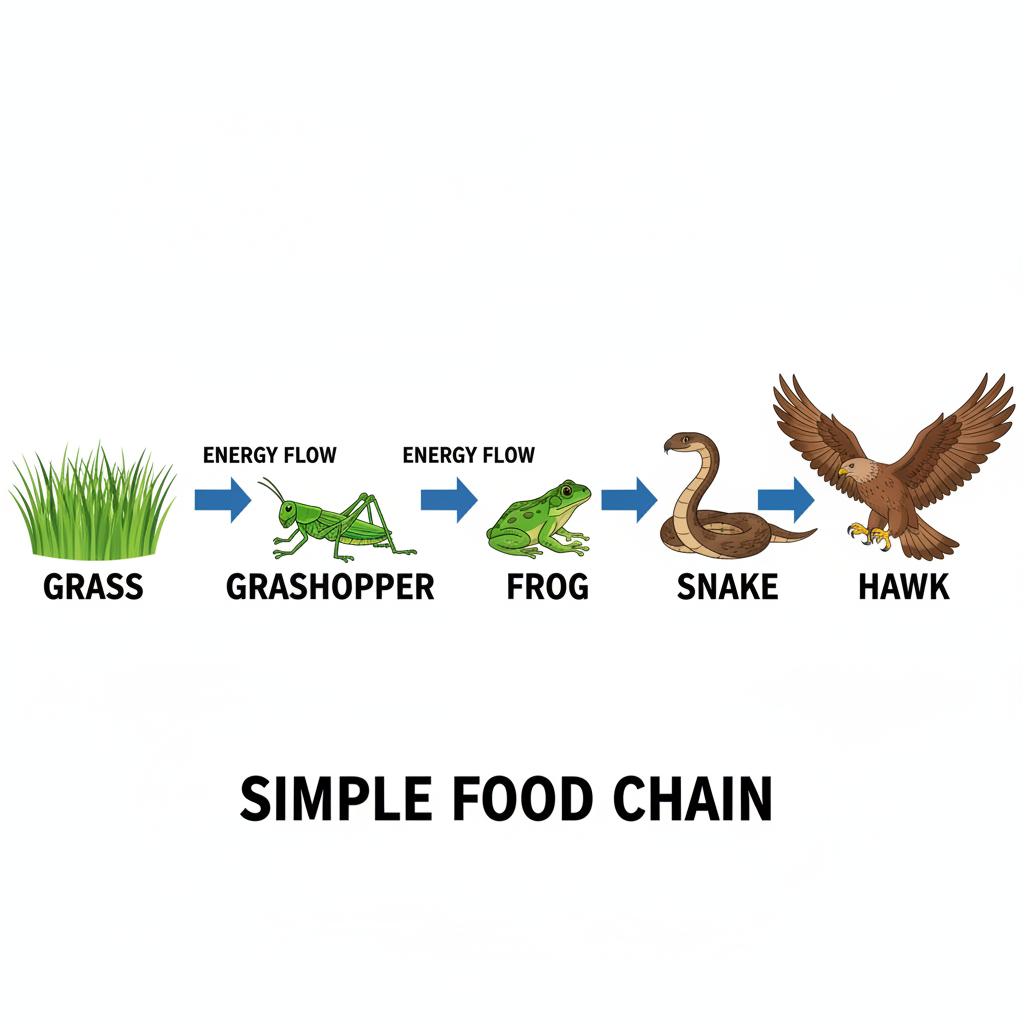 ⚠️ This picture may have spelling mistakes. Trust the words in the lesson.
Keep learning, free
Create a free Syllabax account to unlock practice questions and games for this topic.
Visual Learning Enhanced! 🚀
To help you master this topic, we use Advanced Syllabax AI to generate detailed diagrams and visual models.
Note on Visuals: The AI sometimes makes spelling errors in image labels. Please refer to the lesson text for the correct terminology.