Standard form (Rational Numbers)
Watch this topic in 60 seconds
Free preview · Lesson 1
Understanding Standard form (Rational Numbers)
Understanding Standard Form of Rational Numbers (Grade 7)
Welcome, young mathematicians! Today, we're going on an exciting journey to explore the world of "Rational Numbers" and learn how to write them in their "Standard Form." Don't worry, it sounds fancy, but it's really about making numbers neat, tidy, and easy to understand – just like organizing your backpack or arranging your books on a shelf!
What are Rational Numbers? A Quick Recap!
Before we jump into standard form, let's quickly remember what rational numbers are. Imagine you have a pizza. If you cut it into 8 slices and eat 3 of them, you've eaten 3/8 of the pizza. If you have 5 friends and want to share 10 candies equally, each friend gets 10/5 = 2 candies. Both 3/8 and 2 are examples of rational numbers!
- A Rational Number is any number that can be written as a fraction p/q, where 'p' and 'q' are integers (whole numbers, positive or negative, including zero), and 'q' cannot be zero.
- Think of it like a special club: if a number can be written as one integer divided by another (but not by zero!), it's in the rational number club.
- Examples: 1/2, 3/4, -5/7, 6 (because 6 can be written as 6/1), -2 (because -2 can be written as -2/1), 0 (because 0 can be written as 0/1).
Unveiling "Standard Form": The Neatest Way to Write a Rational Number
Now, let's talk about "Standard Form." Imagine you're getting ready for school. You wouldn't go with your pajamas on, right? You'd put on your uniform or your regular clothes – your "standard" outfit for school. In mathematics, rational numbers also have a "standard outfit" or a "standard form" that makes them look their best, clearest, and easiest to work with.
The standard form is like the 'best dressed' version of a rational number. It helps everyone understand the number in the same way, without any confusion. It's especially useful when you need to compare different rational numbers or perform operations on them.
Why Do We Need Standard Form?
Think about it: Is 2/4 the same as 1/2? Yes! Is -3/5 the same as 3/-5? Yes! Is 10/20 the same as 1/2? Absolutely! While all these fractions represent the same value, some look much simpler and cleaner than others. Standard form ensures that every rational number has one unique, simple, and universally accepted way of being written.
- Clarity: It makes the number easy to read and understand at a glance.
- Consistency: Everyone writes the same rational number the same way.
- Comparison: It's much easier to compare two rational numbers if they are both in standard form. For example, comparing 2/4 and 3/6 is harder than comparing 1/2 and 1/2.
The Golden Rules of Standard Form!
To put a rational number into standard form, it needs to follow three very important rules. Think of these as the dress code for our "best dressed" rational numbers:
Rule 1: Positive Denominator is a Must!
The denominator (the bottom part of the fraction) must always be a positive number. It's like having your feet firmly on the ground – the bottom part should be positive and stable.
- Analogy: Imagine you're standing on a number line. The denominator tells you how many equal parts something is divided into. It just makes more sense for this to be a positive count. You don't divide something into "-3" parts!
- If you see a rational number like 3/-5, it's not in standard form because its denominator (-5) is negative.
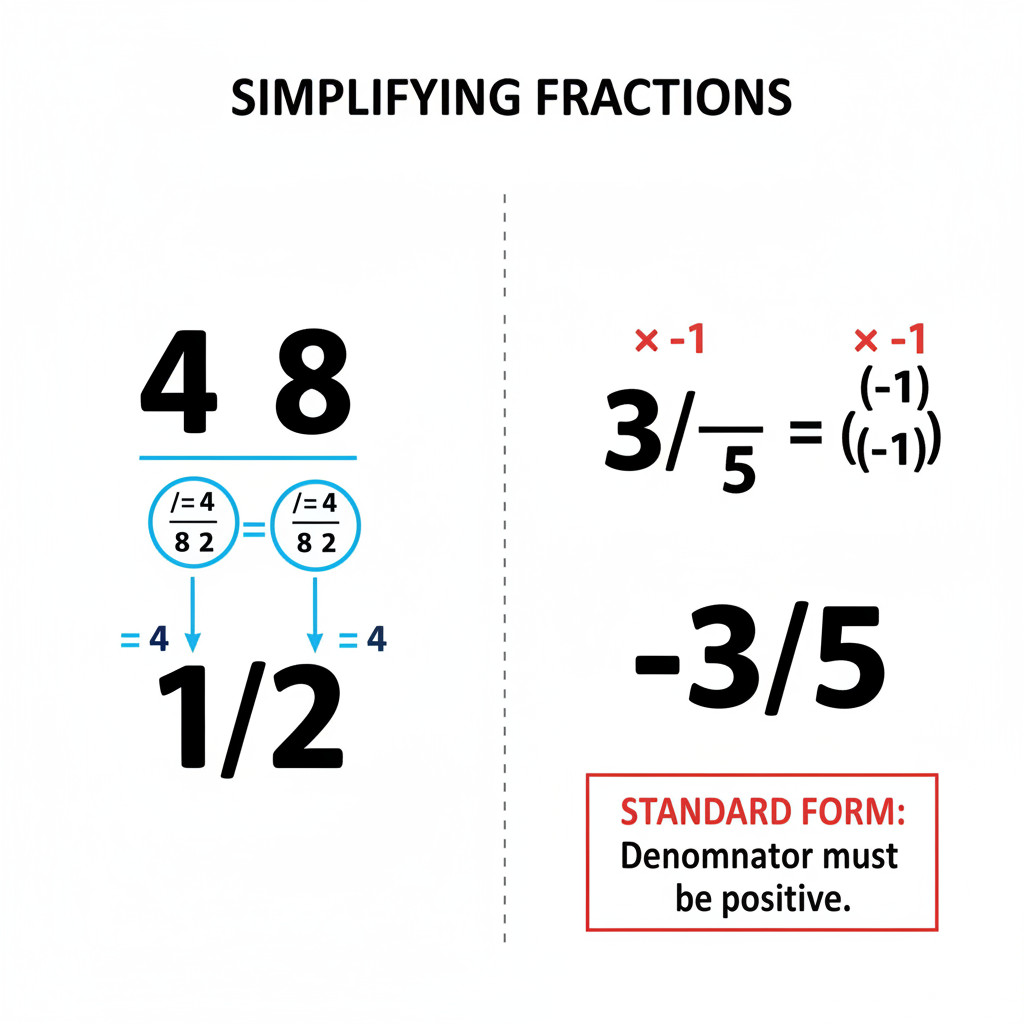
- To fix this, we can multiply both the numerator and the denominator by -1.
- (3 × -1) / (-5 × -1) = -3 / 5
- Now, the denominator is positive (5)!
- Remember: Multiplying both the top and bottom by -1 doesn't change the value of the fraction, just like turning a piece of paper upside down doesn't change what's written on it.
Rule 2: No Common Factors (Except 1)!
The numerator (the top part) and the denominator (the bottom part) should not have any common factors other than 1. This means the fraction must be in its simplest, most reduced form.
- Analogy: Think of it like a team. If you have 6 players and 9 players, you can group them into smaller, equal teams of 3 (6 becomes two teams of 3, 9 becomes three teams of 3). But if you have 2 players and 3 players, you can't group them any further into equal teams (except for teams of 1). When the numerator and denominator can't be simplified any further, they are in their simplest form.
- If you see a rational number like 4/8, it's not in standard form because both 4 and 8 can be divided by 2 (and 4!). Their Highest Common Factor (HCF) is 4.
- To fix this, divide both the numerator and the denominator by their HCF.
- 4 ÷ 4 = 1
- 8 ÷ 4 = 2
- So, 4/8 simplifies to 1/2.
- This is also known as "reducing the fraction to its lowest terms."
Rule 3: The Negative Sign Belongs Up Top (If There Is One)!
If the rational number is negative, the negative sign is usually written with the numerator, not floating in the middle or with the denominator (which is already covered by Rule 1).
- Analogy: Imagine a minus sign as a flag. We prefer to hoist the flag at the top of the pole (numerator) rather than burying it at the base (denominator) or leaving it dangling ambiguously in the middle.
- So, instead of -3/5 or 3/-5, the standard form would explicitly be -3/5.
- This rule is often naturally taken care of by Rule 1 (making the denominator positive). For example, 3/-5 becomes -3/5. And -3/5 is already in this desired format.
 ⚠️ This picture may have spelling mistakes. Trust the words in the lesson.
Putting It All Together: Step-by-Step Conversion to Standard Form
Let's practice converting some rational numbers into their standard form. Follow these easy steps:
Step 1: Make the Denominator Positive
If the denominator is negative, multiply both the numerator and denominator by -1.
- Example: Convert 7/-14 to standard form.
- Current state: Denominator is -14 (negative).
- Action: Multiply both by -1.
- (7 × -1) / (-14 × -1) = -7 / 14
- Now the denominator is positive (14). Good!
Step 2: Find the Highest Common Factor (HCF)
Find the HCF of the absolute values of the numerator and the denominator.
- Example (continuing from above): We have -7/14.
- Absolute value of numerator: |-7| = 7
- Absolute value of denominator: |14| = 14
- Factors of 7: 1, 7
- Factors of 14: 1, 2, 7, 14
- The Highest Common Factor (HCF) of 7 and 14 is 7.
Step 3: Divide by the HCF
Divide both the numerator and the denominator by their HCF.
- Example (continuing from above): We have -7/14 and our HCF is 7.
- Numerator: -7 ÷ 7 = -1
- Denominator: 14 ÷ 7 = 2
- The rational number in standard form is -1/2.
- Let's check the rules for -1/2:
- Positive denominator? Yes, 2 is positive.
- No common factors other than 1? Yes, HCF of 1 and 2 is 1.
- Negative sign in the numerator? Yes, it's -1/2.
- All rules satisfied! So, -1/2 is the standard form of 7/-14.
Let's try another one!
Example 2: Convert -12/-18 to standard form.
- Make the Denominator Positive:
- Current denominator is -18 (negative).
- Multiply by -1/-1: (-12 × -1) / (-18 × -1) = 12 / 18
- Now the denominator is positive (18).
- Find the HCF of 12 and 18:
- Factors of 12: 1, 2, 3, 4, 6, 12
- Factors of 18: 1, 2, 3, 6, 9, 18
- The HCF of 12 and 18 is 6.
- Divide by the HCF:
- Numerator: 12 ÷ 6 = 2
- Denominator: 18 ÷ 6 = 3
- The rational number in standard form is 2/3.
And there you have it! 2/3 is the standard form of -12/-18.
Example 3: Convert 15/25 to standard form.
- Make the Denominator Positive:
- The denominator is 25, which is already positive. No action needed for this step!
- Find the HCF of 15 and 25:
- Factors of 15: 1, 3, 5, 15
- Factors of 25: 1, 5, 25
- The HCF of 15 and 25 is 5.
- Divide by the HCF:
- Numerator: 15 ÷ 5 = 3
- Denominator: 25 ÷ 5 = 5
- The rational number in standard form is 3/5.
The Grand Finale: Why is Standard Form So Useful?
Imagine a world where everyone writes fractions differently. Someone writes 1/2, another 2/4, another 5/10, and yet another 50/100. All these numbers are the same, but they look so different! Standard form is like having a common language for rational numbers. It helps us:
- Easily Compare Numbers: If you want to know if 2/3 is greater than or less than 4/6, it's much easier if you first convert 4/6 to its standard form, which is 2/3. Then you instantly see they are equal!
- Perform Operations: When you add or subtract fractions, you often need to find a common denominator. But before you do that, simplifying the fractions to standard form often makes the numbers smaller and easier to work with.
- Avoid Confusion: Everyone agrees on what the "standard" version of a number looks like. This reduces mistakes and makes mathematical communication clear.
So, next time you see a rational number, challenge yourself to put it into its neat, tidy, and universally understood standard form! It's a fundamental skill that will help you tremendously in your mathematical journey.
Keep learning, free
Create a free Syllabax account to unlock practice questions and games for this topic.
Visual Learning Enhanced! 🚀
To help you master this topic, we use Advanced Syllabax AI to generate detailed diagrams and visual models.
Note on Visuals: The AI sometimes makes spelling errors in image labels. Please refer to the lesson text for the correct terminology.