Learning Journey
Watch this topic in 60 seconds
Free preview · Lesson 1
Understanding Solids, liquids, gases[CHEMISTRY]
Solids, Liquids, and Gases: The Three States of Matter!
Welcome, young scientists! Today, we're going on an amazing adventure into the world of chemistry to explore the building blocks of everything around us. We'll learn about the three main ways that matter can exist: as a solid, a liquid, or a gas. Think of it like different costumes that matter can wear!
What is Matter?
Before we dive into solids, liquids, and gases, let's quickly remember what matter is. Matter is anything that has mass (it's how much "stuff" is in an object) and takes up space (it has volume). Your desk, the air you breathe, even your favorite toy – it's all matter!
The Tiny Building Blocks: Molecules
Everything in the universe, including us, is made up of tiny, tiny particles called molecules. You can't see them with your eyes, but they are always there, wiggling and jiggling! The way these molecules behave is what makes something a solid, a liquid, or a gas.
Solids: The Organized and Sturdy Ones
Imagine a group of friends standing very still in a classroom, holding hands tightly. They are all in their own special spots, and they can't move around much. That's a lot like how molecules behave in a solid!
Key Characteristics of Solids:
- Definite Shape: Solids keep their shape. A block of ice stays in its blocky shape, and a rock stays in its rocky shape. It doesn't just spread out like water does.
- Definite Volume: Solids take up a specific amount of space. A bowling ball always takes up the same amount of space, whether it's in your hands or on the floor.
- Molecules are Tightly Packed: The molecules in a solid are packed very close together, almost like sardines in a can.
- Molecules Vibrate: The molecules in a solid don't move past each other. Instead, they just vibrate, or wiggle, in their fixed positions. Think of them as little dancers doing the same little shuffle in place!
Analogies for Solids:
- A Toy Building Set (like LEGOs): When you build something with LEGOs, it holds its shape. The bricks are connected and don't move around unless you take them apart.
- A Packed Suitcase: When you pack clothes tightly into a suitcase, they stay put and don't easily change their arrangement unless you unpack them.
- A Frozen Lake: The water molecules in ice are locked in place, forming a solid, rigid structure.
Liquids: The Flowy and Adaptable Ones
Now, imagine those same friends, but this time they are standing in a crowded room. They can still hold hands, but they can slide past each other and move around a bit more freely. They might bump into each other, but they stay close together. This is like liquids!
Key Characteristics of Liquids:
- No Definite Shape: Liquids take the shape of their container. If you pour juice into a tall glass, it becomes tall and narrow. If you pour it into a wide bowl, it becomes wide and shallow.
- Definite Volume: Even though liquids change shape, they still take up a specific amount of space. One liter of water is always one liter of water, no matter the container.
- Molecules are Close but Can Move: The molecules in a liquid are still close together, but they have enough energy to slide past each other. Think of them as trying to dance in a crowded room – they can move, but they can't get too far apart.
- Flow Easily: Because the molecules can slide past each other, liquids can flow. This is why water pours and milk spills!
Analogies for Liquids:
- A Jar of Marbles: If you shake a jar of marbles, they slide and roll over each other, taking the shape of the jar.
- A School Cafeteria at Lunchtime: Students (molecules) move around and slide past each other, but they stay within the cafeteria (the container).
- Water in a Bathtub: Water flows and takes the shape of the bathtub.
Gases: The Free and Spread-Out Ones
Finally, imagine your friends have a lot of energy! They're running all over the place, far apart from each other, bumping into walls and each other, and filling up the entire playground. This is how molecules behave in a gas!
Key Characteristics of Gases:
- No Definite Shape: Gases spread out to fill whatever container they are in. If you let a balloon go, the air inside (a gas) spreads out into the atmosphere.
- No Definite Volume: Gases don't have a specific volume because they spread out so much. They can be squeezed into smaller spaces or expand to fill very large ones.
- Molecules are Far Apart and Move Fast: The molecules in a gas are very spread out and move around very quickly, bouncing off everything.
- Fill Entire Space: Gases will always expand to fill the entire volume of their container.
Analogies for Gases:
- Popcorn Popping: When popcorn pops, the kernels (molecules) burst apart and spread throughout the pot or air.
- A Room Full of Balloons: If you blow up balloons in a room, the air inside them (gas) will spread out and try to fill the whole room if the balloons pop.
- The Smell of Perfume: When you spray perfume, the tiny particles of scent spread through the air, and you can smell them far away.
Visualizing the States of Matter
It's helpful to see how the molecules are arranged in each state. Imagine a box representing a container. The tiny dots inside are the molecules.
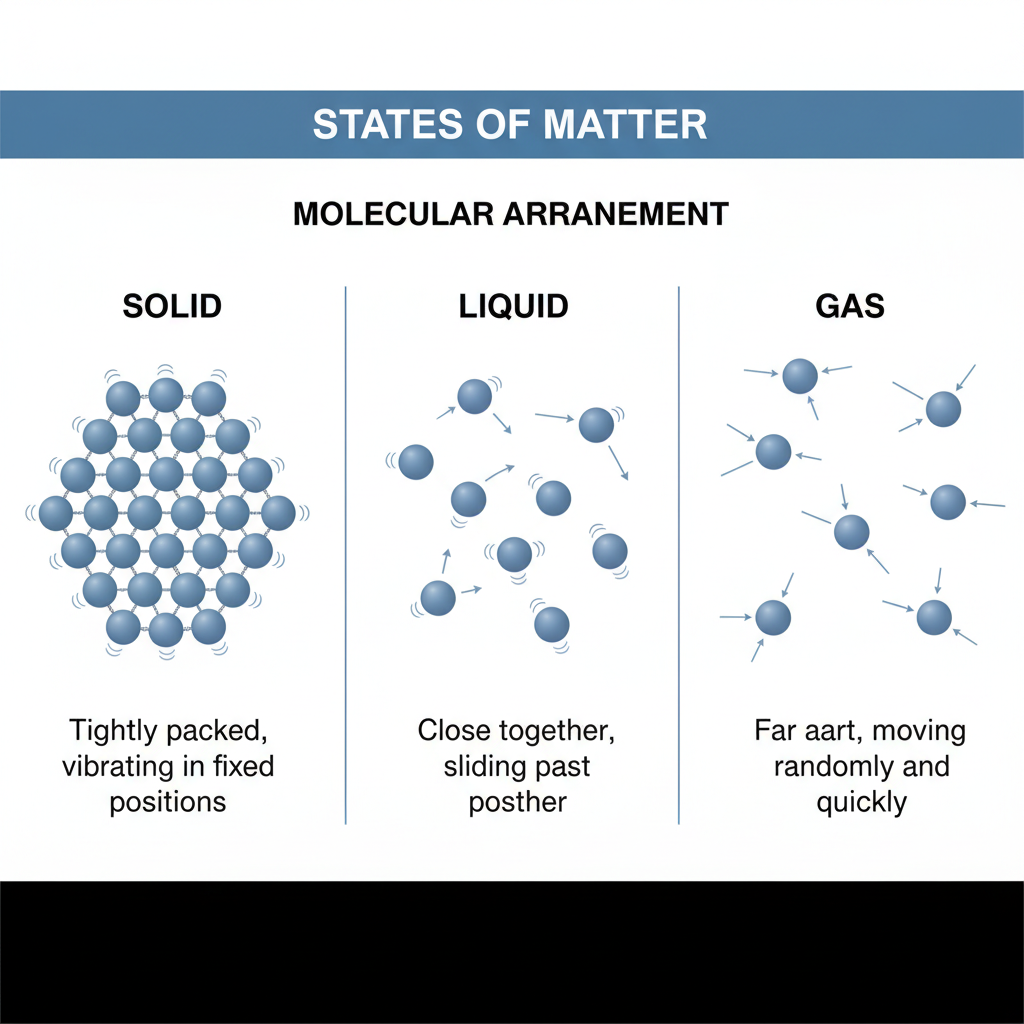 ⚠️ This picture may have spelling mistakes. Trust the words in the lesson.
In the solid box, the dots are neatly arranged and close together. In the liquid box, the dots are still close but a bit more jumbled and can move past each other. In the gas box, the dots are spread far apart and zipping around!
Changing States
Matter can change from one state to another! Have you ever seen ice melt into water? Or water boil and turn into steam?
- Melting: When a solid gains enough heat (energy), its molecules start to vibrate more and more until they can break free and slide past each other, turning into a liquid. (Ice melting into water)
- Freezing: When a liquid loses heat (energy), its molecules slow down and lock into place, forming a solid. (Water freezing into ice)
- Evaporation/Boiling: When a liquid gains enough heat, its molecules get so much energy they break free from each other and spread out as a gas. (Water boiling into steam)
- Condensation: When a gas loses heat, its molecules slow down and come closer together, forming a liquid. (Steam turning back into water droplets on a cold surface)
Why is This Important?
Understanding solids, liquids, and gases helps us understand so many things around us. It explains why rivers flow, why mountains stand tall, and why we can breathe air. It's the foundation for much of chemistry and physics!
Keep learning, free
Create a free Syllabax account to unlock practice questions and games for this topic.
Visual Learning Enhanced! 🚀
To help you master this topic, we use Advanced Syllabax AI to generate detailed diagrams and visual models.
Note on Visuals: The AI sometimes makes spelling errors in image labels. Please refer to the lesson text for the correct terminology.