World Trade Routes – World Geography
Watch this topic in 60 seconds
Free preview · Lesson 1
World Trade Routes – World Geography (Foundational)
World Trade Routes: A Foundational Overview
Welcome to the world of global trade! This lesson will introduce you to the basic concepts of world trade routes, which are the paths that goods and resources travel between countries and regions.
What are Trade Routes?
A trade route is simply a path used for exchanging goods and services between different places. These routes can be on land, across water, or even in the air! Throughout history, trade routes have played a crucial role in connecting different cultures, spreading ideas, and shaping economies.
Why are Trade Routes Important?
- Access to Resources: Trade routes allow countries to obtain resources that they don't have within their own borders. For example, a country with limited farmland might import food from other regions.
- Economic Growth: Trade increases economic activity by allowing businesses to sell their products to a wider market. This leads to increased production, job creation, and overall economic prosperity.
- Cultural Exchange: Trade routes facilitate the exchange of ideas, technologies, and cultural practices between different societies. This can lead to new innovations and a greater understanding between people.
Types of Trade Routes
Trade routes can be classified based on the mode of transportation used:
- Land Routes: These routes involve the movement of goods over land, often using roads, railways, or animal transport. The Silk Road, an ancient trade route connecting East Asia with Europe, is a famous example.
- Sea Routes: These routes utilize ships and waterways to transport goods across oceans and seas. Maritime trade has been essential for global commerce for centuries.
- Air Routes: With the advent of modern aviation, air routes have become increasingly important for the rapid transport of goods, especially high-value items and perishable products.
Historical Examples of Trade Routes
The Silk Road
The Silk Road was a network of ancient trade routes that connected the East and West. It played a vital role in the exchange of silk, spices, tea, and other goods between China, India, the Middle East, and Europe. It also facilitated the spread of ideas, religions, and technologies.
The Transatlantic Slave Trade
This trade route, though a dark chapter in history, connected Europe, Africa, and the Americas. It involved the forced transportation of enslaved Africans to the Americas, where they were forced to work on plantations producing goods like sugar, cotton, and tobacco, which were then shipped to Europe.
Modern Trade Routes
Today, world trade relies on a complex network of shipping lanes, air routes, and land-based transportation systems. Container ships, airplanes, and trucks are used to move goods around the globe. International organizations like the World Trade Organization (WTO) play a role in regulating and facilitating global trade.
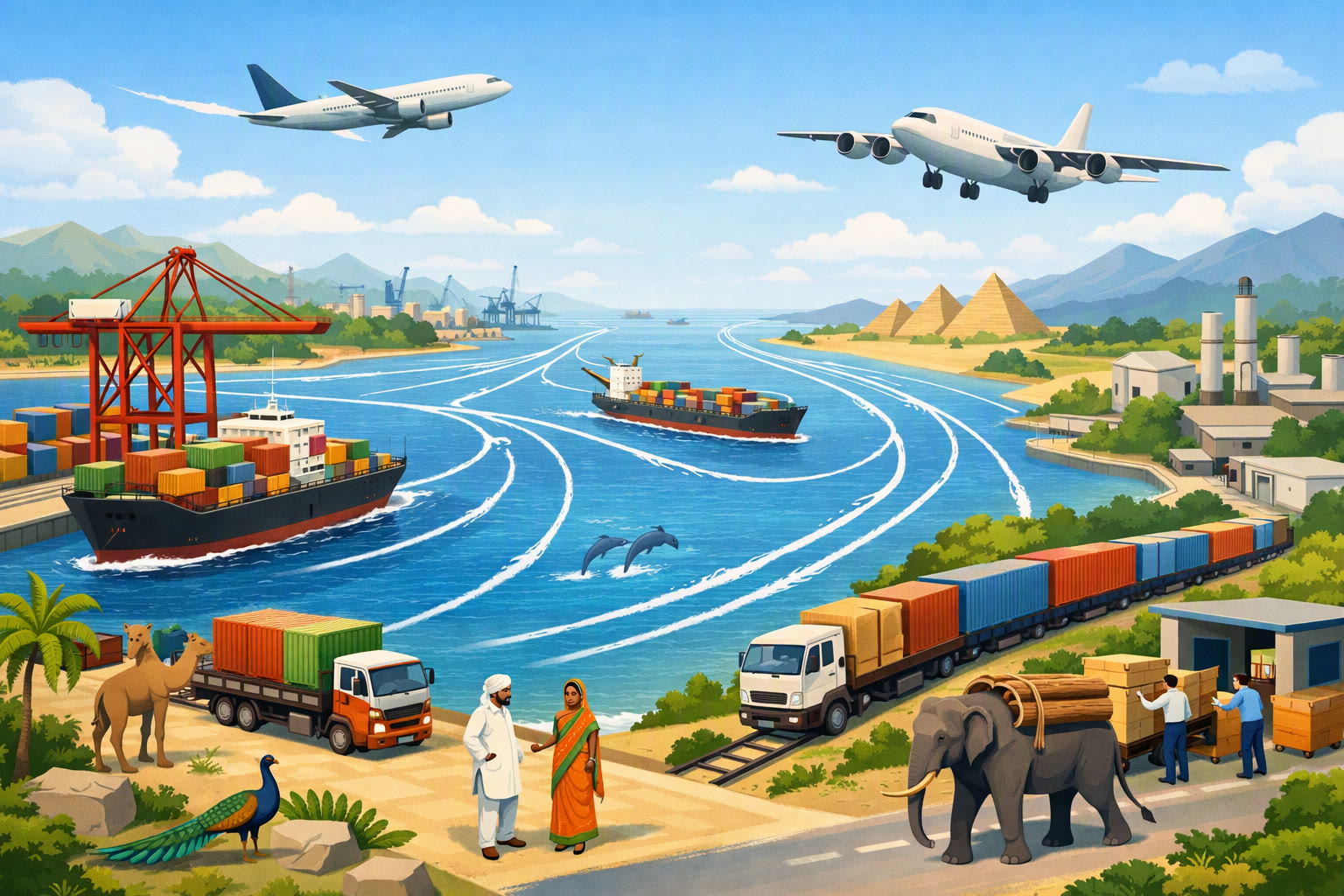
Here's a visual example of how goods move between countries. Raw materials are extracted in one country, manufactured into goods in another, and then distributed to consumers worldwide.
Keep learning, free
Create a free Syllabax account to unlock practice questions and games for this topic.
Visual Learning Enhanced! 🚀
To help you master this topic, we use Advanced Syllabax AI to generate detailed diagrams and visual models.
Note on Visuals: The AI sometimes makes spelling errors in image labels. Please refer to the lesson text for the correct terminology.