Learning Journey
Watch this topic in 60 seconds
Free preview · Lesson 1
Understanding What is a cell?[BIOLOGY]
What is a Cell? The Building Blocks of Life!
Imagine you're building with LEGOs. You have lots of different bricks, right? Some are big, some are small, some are red, some are blue. You use these bricks to build amazing things: a house, a car, a spaceship! Well, in the world of living things, the tiniest, most fundamental building blocks are called cells.
Think of cells as the 'LEGO bricks' of all plants, animals, and even tiny creatures you can't see without a microscope. Everything that is alive is made up of cells!
What is a Cell?
A cell is the smallest unit of life that can perform all the processes of life. It's like a tiny, self-contained factory that can:
- Take in nutrients (food).
- Use those nutrients to make energy.
- Get rid of waste.
- Grow and reproduce (make more cells).
Even the simplest living things, like bacteria, are made of just one cell! Humans, dogs, trees, and flowers are made of billions and billions of cells, all working together.
Why are Cells Important?
Without cells, there would be no life as we know it. They are the foundation for everything that lives and breathes (or grows!).
- For Plants: Plant cells help them make their own food using sunlight (photosynthesis), stand tall, and absorb water.
- For Animals: Animal cells form our muscles, our bones, our brain, and all the parts that help us move, think, and live.
- For Us: Our bodies are complex systems made of trillions of specialized cells. Some cells help us see, others help us digest food, and others carry oxygen in our blood.
Analogy Time: A Cell is Like a Tiny City!
To understand how a cell works, let's imagine it's a miniature city. Each part of the city has a specific job, just like each part of a cell!
1. The City Wall (Cell Membrane):
Imagine a city surrounded by walls with gates. This wall controls what comes in and out of the city. It's like the cell membrane. It lets in good things like food and water, and lets out waste products. It also protects the city!
2. The Power Plant (Mitochondria):
Every city needs power to run its factories, lights, and homes. In our cell city, the mitochondria are the power plants. They take in nutrients (like fuel) and turn them into energy that the cell can use to do all its work.
3. The City Hall or Control Center (Nucleus):
Who's in charge of the city? Who has all the important instructions and plans? That's the nucleus! It's like the city hall or the main control center. The nucleus contains the cell's DNA, which is like the city's blueprints and rulebook, telling the cell exactly what to do and when to do it.
4. The Factory Buildings (Cytoplasm and Organelles):
Inside the city walls, there are many different buildings where work gets done. The jelly-like substance that fills the cell and surrounds all the 'buildings' is called the cytoplasm. Floating in the cytoplasm are tiny 'factories' or 'machines' called organelles. Each organelle has a special job:
- Ribosomes: These are like little construction workers that build important things the cell needs, like proteins.
- Endoplasmic Reticulum (ER): Think of this as a transport system or a network of roads and factories that helps move materials around the cell and build things.
- Golgi Apparatus: This is like the post office or packaging center. It sorts, modifies, and packages materials to be sent out of the cell or to other parts of the cell.
5. The Waste Disposal Area (Lysosomes - in animal cells):
Cities need a place to get rid of trash. In some cell cities (especially animal cells), lysosomes act like the waste disposal units, breaking down old cell parts and waste materials.
Two Main Types of Cells
While all cells share basic functions, there are two main categories:
1. Prokaryotic Cells:
These are like very simple, old-fashioned towns. They are small and don't have a nucleus or many other complex 'buildings' (organelles). Bacteria are a good example of prokaryotic cells. They have their DNA floating around freely in the cytoplasm.
2. Eukaryotic Cells:
These are like modern, bustling cities. They are larger and have a true nucleus (the control center) and many specialized organelles (the factories and machines). Plant cells and animal cells are eukaryotic cells.
The main difference is the presence of a nucleus and membrane-bound organelles in eukaryotic cells, which are absent in prokaryotic cells.
So, remember: cells are the fundamental, amazing building blocks that make up all living things! They are like tiny, self-sufficient cities, each with its own specialized parts working together to keep life going.
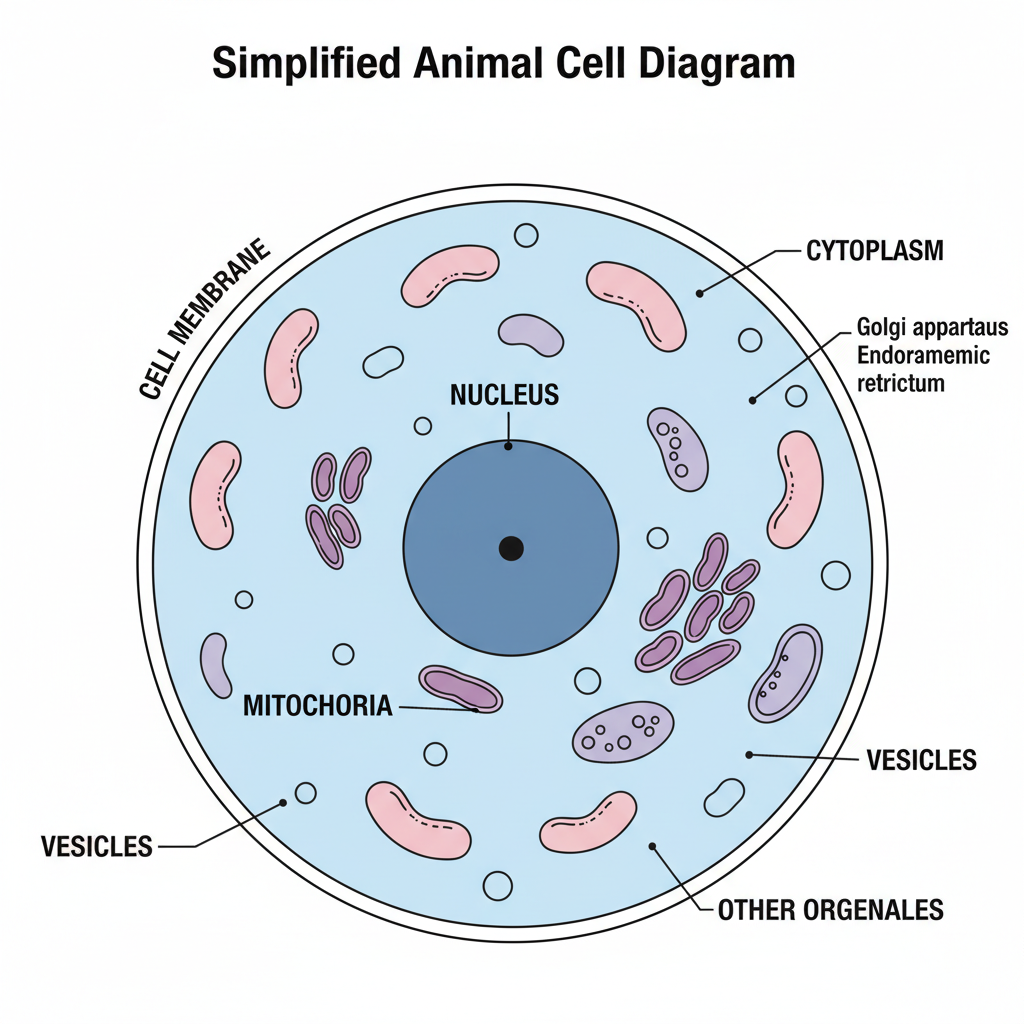 ⚠️ This picture may have spelling mistakes. Trust the words in the lesson.
Keep learning, free
Create a free Syllabax account to unlock practice questions and games for this topic.
Visual Learning Enhanced! 🚀
To help you master this topic, we use Advanced Syllabax AI to generate detailed diagrams and visual models.
Note on Visuals: The AI sometimes makes spelling errors in image labels. Please refer to the lesson text for the correct terminology.