Learning Journey
Free preview · Lesson 1
Understanding Types of quadrilaterals [Triangles & Quadrilaterals]
Understanding Shapes: Triangles and Quadrilaterals
Welcome, young mathematicians! Today, we're going on an exciting adventure into the world of shapes. We'll be focusing on two main families of shapes: triangles and quadrilaterals. Think of them like different types of LEGO bricks. Some have three sides, and some have four, and just like LEGOs, they can be put together to build amazing things!
Part 1: Triangles - The Three-Sided Superstars!
Let's start with triangles. The name "triangle" itself gives us a big clue! "Tri" means three, and "angle" reminds us of the corners. So, a triangle is a shape with three sides and three angles (or corners). Imagine a slice of pizza, a yield sign on the road, or the roof of a little house – these are all examples of triangles!
Why are triangles special?
Triangles are like the strongest shape in the world! If you try to push on a triangle, it's much harder to bend or break than a square. Think about bridges or the Eiffel Tower – you'll see lots of triangles because they are so strong and stable.
Types of Triangles (Let's Keep it Simple for Now!)
While there are many ways to describe triangles, for now, we'll just remember they have three sides and three angles. Sometimes, the angles can be sharp like a tack (acute), one can be like the corner of a book (right angle), and some can be wide like an open door (obtuse). But no matter what, they always add up to the same total angle inside!
Part 2: Quadrilaterals - The Four-Sided Friends!
Now, let's move on to quadrilaterals. The word "quad" means four, just like in "quadruplets" (four babies born at once). So, a quadrilateral is a shape with four sides and four angles. These are super common shapes all around us!
Examples of Quadrilaterals:
- Squares: Think of a checkerboard square, a bite-sized cracker, or a window pane. A square has four sides that are all the same length, and all its corners are perfect right angles (like the corner of a book).
- Rectangles: Imagine a door, a book, or a smartphone. A rectangle is like a "stretched" square. It has four sides, and all its corners are right angles, but its opposite sides are the same length. So, the top and bottom are the same, and the left and right sides are the same, but the top/bottom might be longer than the left/right.
- Rhombus: Picture a diamond shape, like the ones on playing cards! A rhombus has four sides that are all the same length, just like a square. However, its corners aren't necessarily right angles. It can look like a "squished" square.
- Parallelograms: This is a slightly more general shape. Think of a leaning ladder or a parallelogram in a drawing. A parallelogram has four sides, and its opposite sides are parallel (they run side-by-side forever without ever meeting, like train tracks) and equal in length. Rectangles and rhombuses are actually special types of parallelograms!
- Trapezoids (or Trapeziums): Imagine a picnic table top or a slice of bread. A trapezoid has four sides, but it has only one pair of parallel sides. The other two sides might meet if you extended them.
It's important to remember that all these shapes (squares, rectangles, rhombuses, parallelograms, and trapezoids) are special kinds of quadrilaterals because they all have four sides. They are like cousins in the same family!
Visualizing the Shapes
Let's look at a picture to help us see the difference between some of these shapes.
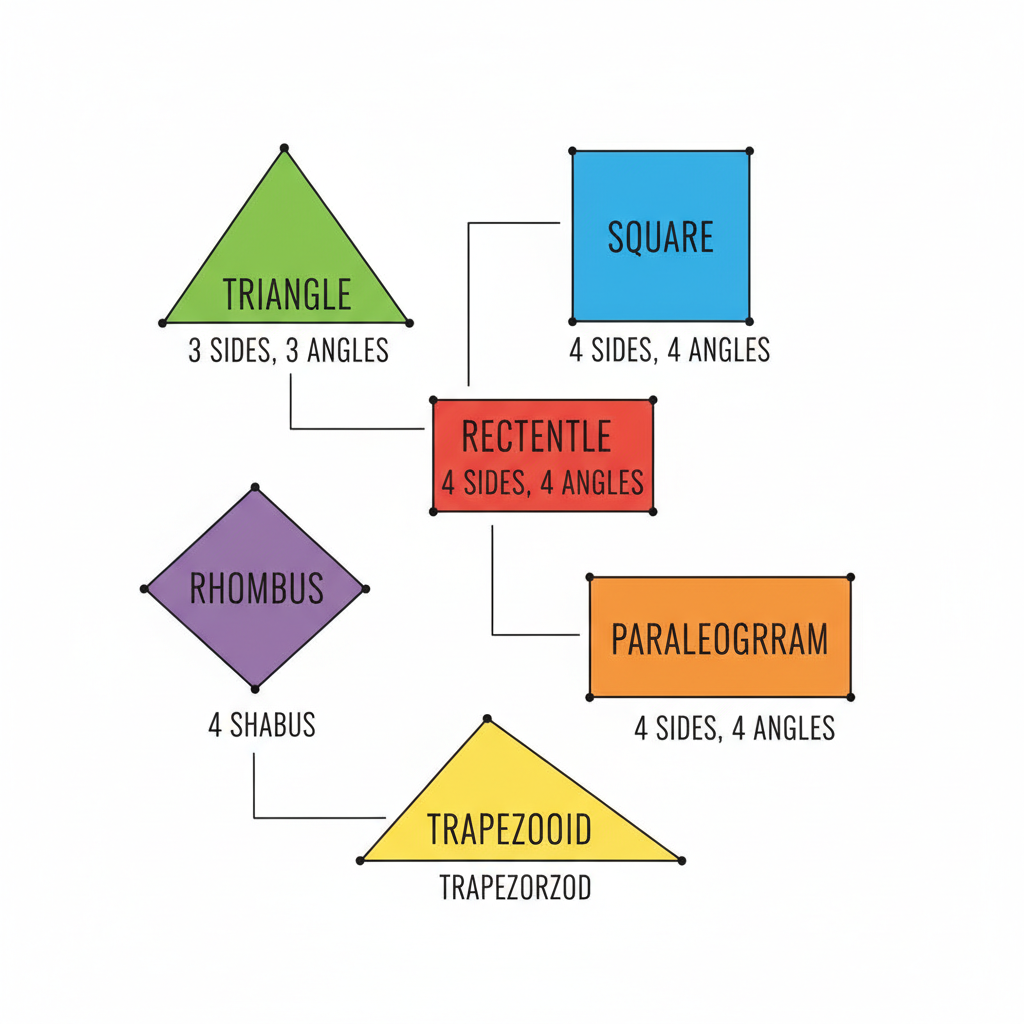 ⚠️ This picture may have spelling mistakes. Trust the words in the lesson.
In this picture, you can see a triangle with its three sides. Then, you see different shapes with four sides. Notice how a square has all equal sides and perfect corners. A rectangle has opposite sides equal and perfect corners. A rhombus has all equal sides but slanted corners. A parallelogram has opposite sides parallel and equal, but slanted corners. And a trapezoid has one pair of parallel sides.
Quick Recap:
- Triangles: 3 sides, 3 angles.
- Quadrilaterals: 4 sides, 4 angles.
- Within quadrilaterals, we have special types like squares, rectangles, rhombuses, parallelograms, and trapezoids.
Keep practicing identifying these shapes in the world around you. You'll be amazed at how many triangles and quadrilaterals you can find!
Keep learning, free
Create a free Syllabax account to unlock practice questions and games for this topic.
Visual Learning Enhanced! 🚀
To help you master this topic, we use Advanced Syllabax AI to generate detailed diagrams and visual models.
Note on Visuals: The AI sometimes makes spelling errors in image labels. Please refer to the lesson text for the correct terminology.