Symmetry in circles [Circles]
Watch this topic in 60 seconds
Free preview · Lesson 1
Understanding Symmetry in circles [Circles]
Exploring Symmetry in Circles: A Fun Journey!
Hello young mathematicians! Today, we're going to dive into the wonderful world of circles and discover a special property they have: **symmetry**. Don't worry, it sounds fancy, but it's actually quite simple and super cool! Think of it like a magic trick that shapes can do.
What is Symmetry?
Imagine you have a shape, and you can fold it exactly in half so that both sides match perfectly. That's symmetry! It's like looking in a mirror – what you see on one side is the same as what you see on the other side.
Let's use some analogies:
- A Butterfly's Wings: A butterfly's wings are a great example of symmetry. If you could draw a line right down the middle of its body, one wing would look exactly like the other.
- A Heart Shape: Think about drawing a heart. If you draw a line straight down the middle, the left side looks just like the right side.
- Your Face: Believe it or not, your face is mostly symmetrical! If you drew a line down the middle of your nose, your left eye area would look a lot like your right eye area, and so would your cheek.
Circles are Super Symmetrical!
Now, let's bring this idea of symmetry to circles. Circles are like the champions of symmetry! They have a special kind of symmetry called **rotational symmetry** and **line symmetry**. Let's break these down.
Line Symmetry: Folding a Circle
Line symmetry, also called **reflectional symmetry**, is what we talked about with the butterfly wings. Imagine a circle. How many ways can you fold it so that the two halves match perfectly?
Let's try it! Grab a piece of paper and cut out a perfect circle. Now, try folding it in half. Does it match? Yes! Now, try folding it again, but in a different direction. Does it match again? Yes!
You can fold a circle in half in so many ways! Every time you fold it right through the middle, the two halves will line up perfectly. This line you fold along is called a **line of symmetry**.
For a circle, any line that passes through the center and connects two points on the edge of the circle is a line of symmetry. These special lines have a name: **diameters**.
Think of it like this:
- A Pizza Cut in Half: Imagine a delicious pizza. If you cut it right through the center, you get two equal halves. That cut line is a diameter and a line of symmetry!
- A Steering Wheel: Look at a steering wheel. If you draw a line through the center from one side to the other, it divides the wheel into two matching parts.
So, a circle has an **infinite** number of lines of symmetry! That means there are too many to count! Every single diameter is a line of symmetry. Isn't that amazing?
Rotational Symmetry: Spinning a Circle
Circles also have something called **rotational symmetry**. This means that if you spin the circle around its center, it will look exactly the same as it did before you started spinning it, after a certain amount of turning.
Imagine a beautiful Ferris wheel. As it spins, each carriage looks the same as the one before it at certain points. A circle is like that, but even more special!
If you spin a circle around its center, it looks exactly the same no matter how much you turn it! You can turn it a tiny bit, a half turn, a full turn, or anywhere in between – it always looks like itself.
This means a circle has **infinite rotational symmetry**. It's like a perfect dancer who can twirl endlessly and always look the same!
Key Parts of a Circle and Symmetry
Let's revisit some important parts of a circle and see how they relate to symmetry:
- Center: This is the very middle point of the circle. All the lines of symmetry (diameters) pass through the center. The center is also the point around which the circle spins for rotational symmetry.
- Radius: The distance from the center to any point on the edge of the circle.
- Diameter: A line segment that goes through the center and connects two points on the edge of the circle. As we learned, every diameter is a line of symmetry for a circle.
Think of the center as the 'ballet master' of the circle. All the symmetry actions happen around this point or along lines that pass through it.
Here's a visual to help:
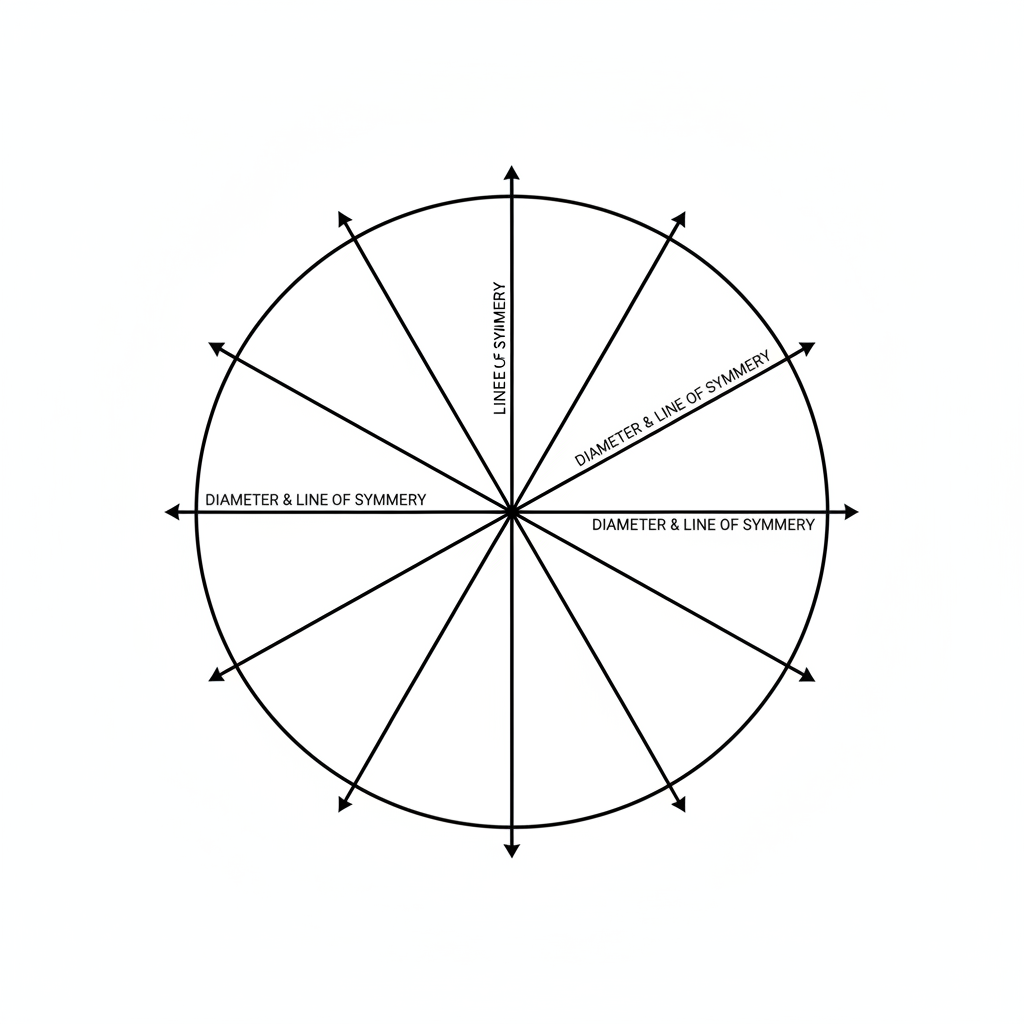 ⚠️ This picture may have spelling mistakes. Trust the words in the lesson.
Why is Symmetry Important?
Symmetry is found everywhere in nature, art, and even in things we build. Understanding symmetry helps us appreciate the balance and beauty in the world around us. Circles, being so perfectly symmetrical, are fundamental shapes in many designs and structures. From the wheels on a car to the design of a clock face, circles and their symmetry are everywhere!
So, next time you see a circle, remember its incredible ability to be symmetrical in so many ways!
Keep learning, free
Create a free Syllabax account to unlock practice questions and games for this topic.
Visual Learning Enhanced! 🚀
To help you master this topic, we use Advanced Syllabax AI to generate detailed diagrams and visual models.
Note on Visuals: The AI sometimes makes spelling errors in image labels. Please refer to the lesson text for the correct terminology.