Tropisms[BIOLOGY]
Watch this topic in 60 seconds
Free preview · Lesson 1
Understanding Tropisms[BIOLOGY]
Understanding Tropisms: How Plants Respond to Their World
Have you ever watched a plant slowly bend towards a window, or noticed how tree roots always seem to grow downwards into the soil? These aren't random actions! Plants, just like us, react to their environment, but they do it in their own unique and often slower ways. The way plants grow or move in response to specific cues from their surroundings is called a tropism.
Think of it like this: Imagine you're in a dark room and someone turns on a light. You'd naturally turn your head towards the light, wouldn't you? Or if you heard the ice cream truck, you'd probably walk towards it! Plants do similar things, but instead of walking or turning their heads, they change their *growth direction*.
What is a Tropism? The Core Idea
At its heart, a tropism is a growth movement of a plant part towards or away from an external stimulus. A 'stimulus' is just anything in the environment that causes a reaction. For plants, common stimuli include light, gravity, water, touch, and even certain chemicals.
There are two main types of tropisms based on the direction of growth:
-
Positive Tropism: This is when a plant part grows towards the stimulus. Think of a plant 'reaching out' for something it needs.
Analogy: Like a hungry child moving towards a plate of cookies. -
Negative Tropism: This is when a plant part grows away from the stimulus. This usually happens when the plant is trying to avoid something harmful or simply doesn't need to go in that direction.
Analogy: Like running away from a loud, scary noise.
Key Tropisms You Need to Know
Let's dive into the most important types of tropisms and how they help plants survive and thrive.
1. Phototropism: Following the Light
Stimulus: Light
Definition: Phototropism is the growth of a plant in response to light. This is one of the most noticeable tropisms.
-
Positive Phototropism: Stems and leaves typically show positive phototropism, meaning they grow towards light. This makes perfect sense because leaves need sunlight for photosynthesis, which is how plants make their food.
Analogy: Imagine a sunbather constantly adjusting their position to get as much sun as possible. Plant stems do the same, 'tilting' their leaves to catch more rays. - Negative Phototropism: Roots usually show negative phototropism, growing away from light and deeper into the soil.
How it works (Simply): Special plant hormones called auxins play a crucial role here. When light shines on one side of a stem, auxins move to the darker side. A higher concentration of auxins on the darker side causes those cells to grow longer and faster. This difference in growth makes the stem bend towards the light source.
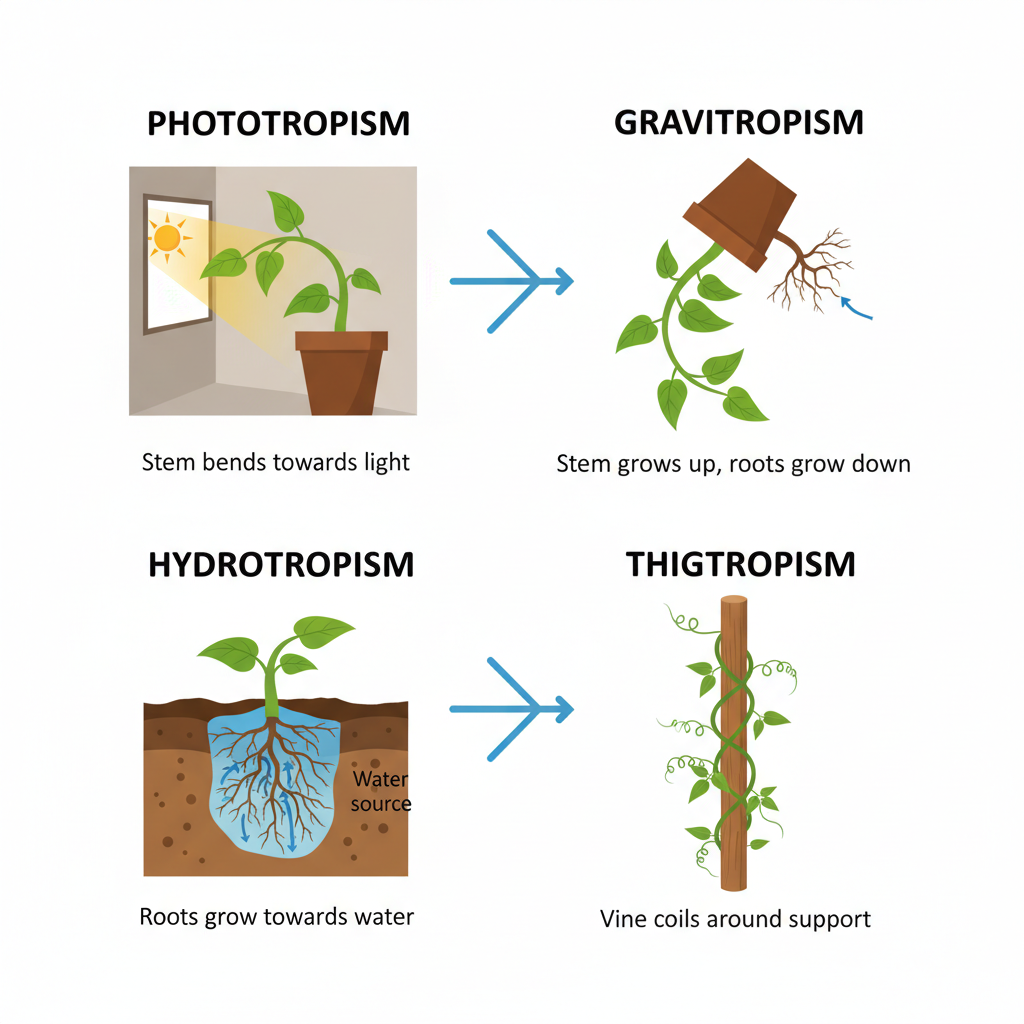 ⚠️ This picture may have spelling mistakes. Trust the words in the lesson.
2. Gravitropism (or Geotropism): Battling Gravity
Stimulus: Gravity
Definition: Gravitropism is the growth of a plant in response to gravity. This is super important for anchoring the plant and making sure its shoots grow upwards.
-
Positive Gravitropism: Roots typically show positive gravitropism, meaning they grow downwards, towards the pull of gravity. This helps them anchor the plant firmly in the soil and reach water and nutrients deep underground.
Analogy: Think of a ship's anchor always dropping downwards to hold the ship in place. Roots are the plant's anchors! -
Negative Gravitropism: Stems and shoots typically show negative gravitropism, meaning they grow upwards, away from the pull of gravity. This helps them emerge from the soil, reach for sunlight, and allows leaves to be exposed to air for gas exchange.
Analogy: Imagine a rocket launching upwards, defying gravity to reach the sky. Plant stems do this naturally!
How it works (Simply): Inside root cap cells, there are tiny, heavy starch granules called statoliths. These statoliths settle at the bottom of the cells due to gravity. This settling somehow signals the plant to distribute auxins unevenly, causing the root to grow downwards.
3. Hydrotropism: The Search for Water
Stimulus: Water
Definition: Hydrotropism is the growth of a plant part in response to water. This tropism is extremely important for roots, as water is vital for a plant's survival.
-
Positive Hydrotropism: Roots show positive hydrotropism, meaning they grow towards areas with higher water concentration. This ensures the plant can find and absorb the water it needs.
Analogy: Imagine a treasure hunter using a map to find buried treasure. Roots are like tiny treasure hunters, always searching for the vital 'treasure' of water!
Hydrotropism is often stronger than gravitropism for roots; if there's a water source sideways, roots might grow sideways towards it, even if it's against gravity.
4. Thigmotropism: The Hugging Climbers
Stimulus: Touch or physical contact
Definition: Thigmotropism is the growth of a plant in response to touch. This is most common in climbing plants.
-
Positive Thigmotropism: Tendrils (specialized climbing parts of plants) show positive thigmotropism. When they touch a support (like a fence or another plant), they coil around it, helping the plant climb upwards.
Analogy: Think of a baby reaching out and grabbing onto your finger, then holding on tightly. Plant tendrils 'grab' onto things they touch to pull themselves up.
This allows weaker-stemmed plants to reach sunlight by using stronger structures for support.
5. Chemotropism: Following Chemical Cues
Stimulus: Chemicals
Definition: Chemotropism is the growth of a plant part in response to a chemical stimulus. This is less visually obvious but crucial for reproduction.
-
Positive Chemotropism: A classic example is the growth of a pollen tube towards the ovule (egg cell) in a flower during fertilization. The ovule releases specific chemicals that guide the pollen tube to it.
Analogy: Imagine a delicious smell wafting from a bakery, guiding you directly to the source. Chemical signals guide the tiny pollen tube to its destination.
Why are Tropisms Important?
Tropisms are not just interesting plant behaviors; they are absolutely essential for a plant's survival and success. They help plants to:
- Find Resources: Roots find water and nutrients, stems find sunlight.
- Anchor Themselves: Roots grow downwards to hold the plant firm.
- Compete: Grow taller or spread leaves to outcompete neighbors for light.
- Reproduce: Pollen tubes reach ovules for fertilization.
- Adapt: Respond to changing environmental conditions.
Without tropisms, plants would be unable to orient themselves correctly, find essential resources, or even reproduce effectively. They are a fundamental part of what makes plants so resilient and successful on Earth.
Keep learning, free
Create a free Syllabax account to unlock practice questions and games for this topic.
Visual Learning Enhanced! 🚀
To help you master this topic, we use Advanced Syllabax AI to generate detailed diagrams and visual models.
Note on Visuals: The AI sometimes makes spelling errors in image labels. Please refer to the lesson text for the correct terminology.