Volcanoes & Earthquakes – World Geography
Watch this topic in 60 seconds
Free preview · Lesson 1
Volcanoes & Earthquakes – World Geography (Foundational)
Volcanoes & Earthquakes – World Geography (Foundational)
Welcome to the foundational lesson on Volcanoes and Earthquakes! In this lesson, we will explore what volcanoes and earthquakes are, where they happen, and why they matter in world geography.
What are Volcanoes?
A volcano is essentially an opening in the Earth's crust through which molten rock, ash, and gases escape from below the surface. This molten rock is called magma when it is underground and lava when it erupts onto the surface.
Parts of a Volcano:
- Magma Chamber: A large underground pool of molten rock.
- Vent: The main opening through which lava flows.
- Crater: A bowl-shaped depression at the top of the volcano.
How Volcanoes are Formed?
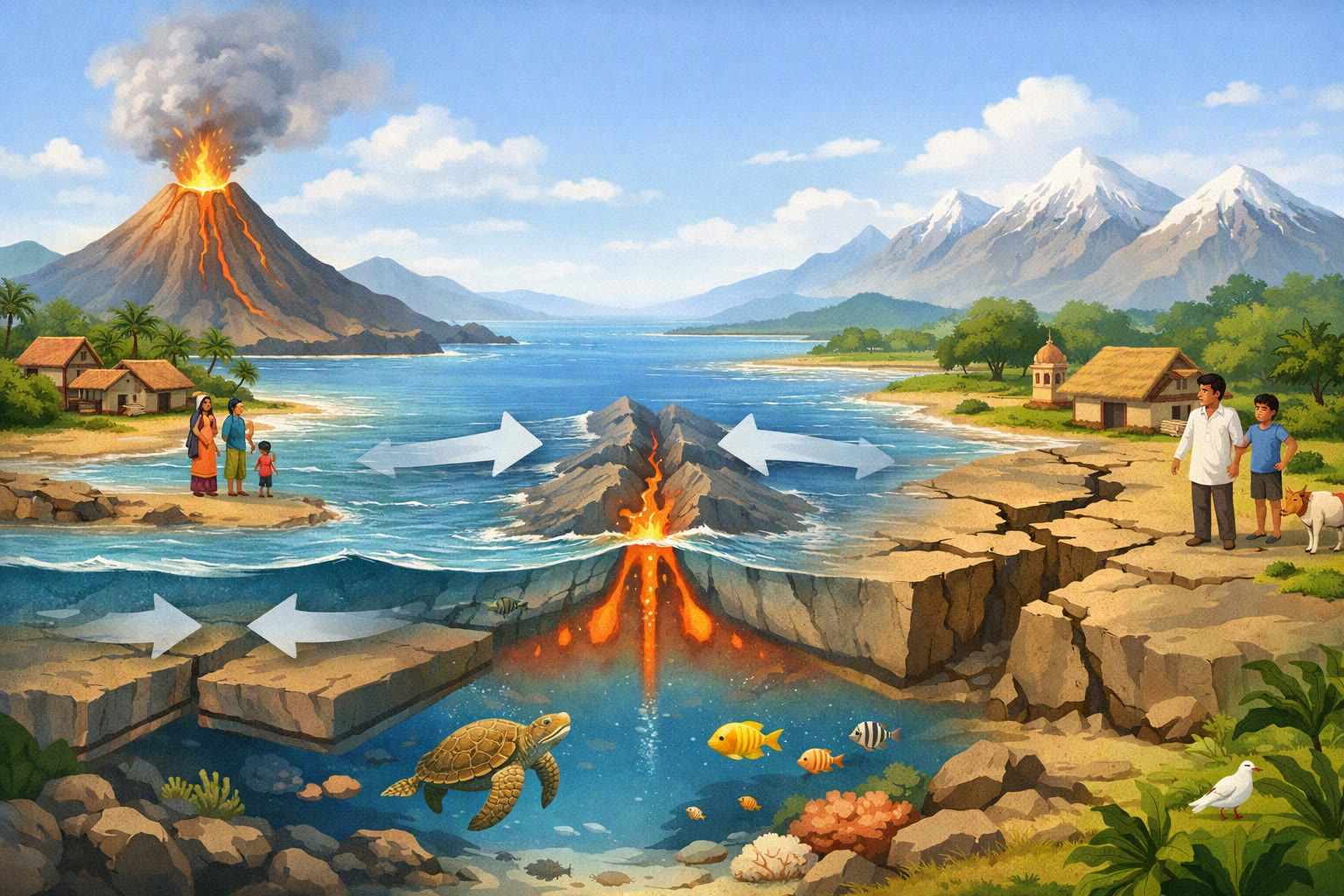
Volcanoes are often formed at plate boundaries, where tectonic plates either collide (convergent boundaries) or move apart (divergent boundaries). They can also form at hotspots, which are areas where magma rises from deep within the Earth's mantle.
What are Earthquakes?
An earthquake is a sudden shaking of the Earth's surface caused by the release of energy in the Earth's lithosphere. This energy release is often due to the movement of tectonic plates.
Key Terms:
- Focus (Hypocenter): The point inside the Earth where the earthquake originates.
- Epicenter: The point on the Earth's surface directly above the focus.
- Seismic Waves: Waves of energy that travel through the Earth, causing the shaking we feel during an earthquake.
Measuring Earthquakes:
The magnitude of an earthquake is commonly measured using the Richter scale. This scale assigns a number to quantify the energy released by an earthquake.
Where do Volcanoes and Earthquakes Occur?
Volcanoes and earthquakes are not randomly distributed across the Earth. They often occur in specific zones, such as the:
- Ring of Fire: A major area in the basin of the Pacific Ocean where a large number of earthquakes and volcanic eruptions occur.
- Mid-Ocean Ridges: Underwater mountain ranges where new crust is formed, often associated with volcanic activity.
Why are Volcanoes and Earthquakes Important?
Volcanoes and earthquakes can have significant impacts on the Earth's surface and human populations. They can cause:
- Destruction: Buildings and infrastructure can be destroyed.
- Tsunamis: Earthquakes under the ocean can trigger devastating tsunamis.
- Landslides: Volcanic eruptions and earthquakes can cause landslides.
- Climate Change: Large volcanic eruptions can release gases that affect the climate.
Keep learning, free
Create a free Syllabax account to unlock practice questions and games for this topic.
Visual Learning Enhanced! 🚀
To help you master this topic, we use Advanced Syllabax AI to generate detailed diagrams and visual models.
Note on Visuals: The AI sometimes makes spelling errors in image labels. Please refer to the lesson text for the correct terminology.