Cube & Dice (cutting, unfolding, numbering) – Non-Verbal Reasoning
Watch this topic in 60 seconds
Free preview · Lesson 1
Cube & Dice (cutting, unfolding, numbering) – Non-Verbal Reasoning (Foundational)
Cube & Dice (Cutting, Unfolding, Numbering) - Foundational
Welcome to the foundational lesson on cubes and dice in non-verbal reasoning. This lesson will cover the basic concepts related to cutting, unfolding, and numbering cubes and dice. We will focus on understanding how a 3D cube can be represented in 2D and vice-versa.
Understanding Cubes and Dice
A cube is a three-dimensional object with six square faces. A standard die (singular of dice) is a cube with numbers 1 through 6 marked on its faces. Opposite faces of a standard die always add up to 7 (1 opposite 6, 2 opposite 5, 3 opposite 4).
Unfolding a Cube (Nets)
Unfolding a cube means flattening it into a two-dimensional shape called a net. There are several possible nets for a cube. The key is to visualize how the faces connect when the net is folded back into a cube.
Important Concepts:
- Adjacent Faces: Faces that share an edge.
- Opposite Faces: Faces that do not share an edge when the cube is folded. These are the key to solving many problems.
Identifying Cube Nets
Not every arrangement of six squares will form a cube. To determine if a net can form a cube, mentally fold the net and see if it closes properly. Also, consider which faces would be opposite each other.
Numbering the Cube/Dice
When a cube is numbered, the relative positions of the numbers are crucial. Remember that opposite faces on a standard die add up to 7. When unfolding, maintaining these relationships is critical for solving problems.
Cutting a Cube
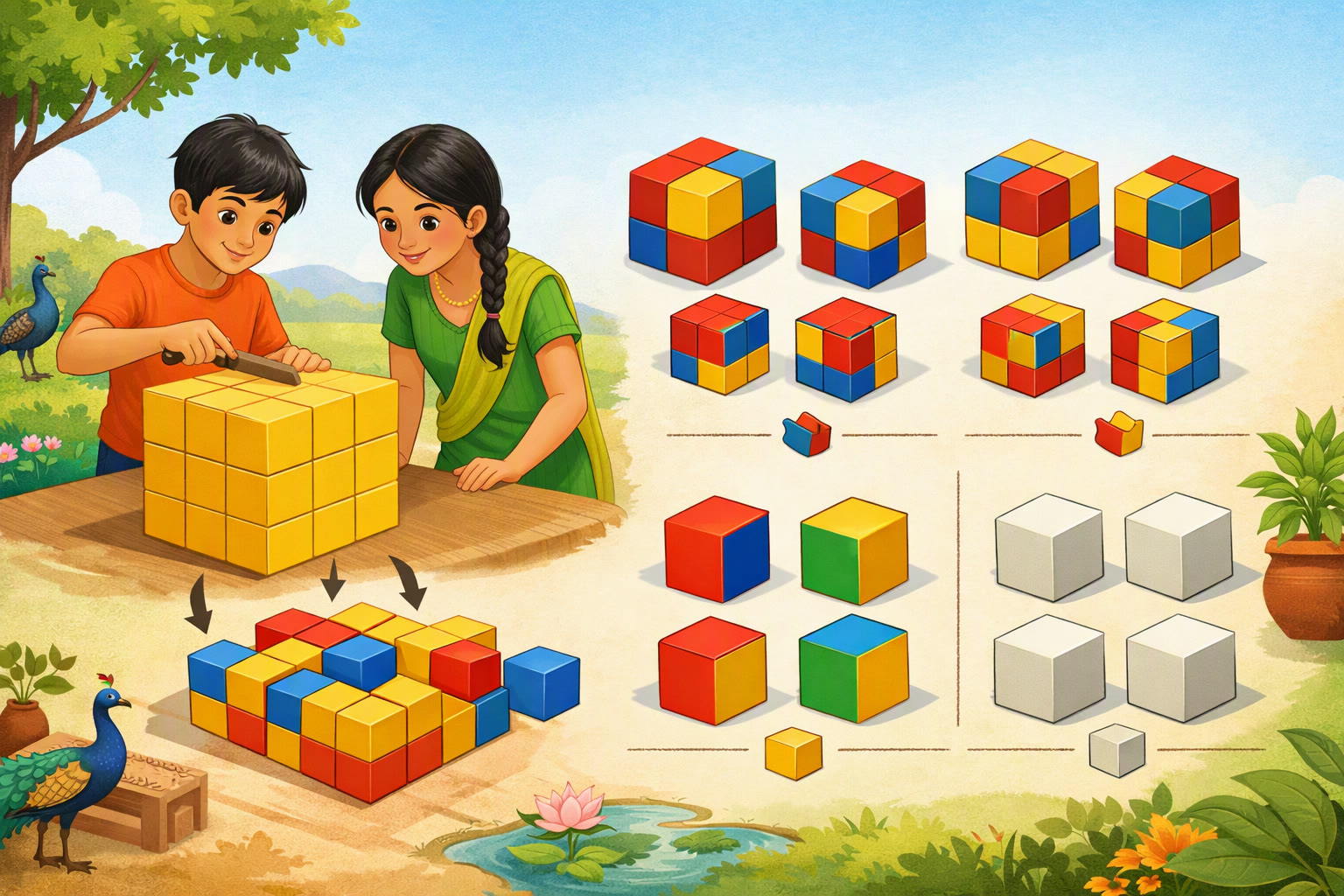
Imagine you have a larger cube which you cut into smaller, identical cubes. The number of smaller cubes created depends on the number of cuts you make along each dimension. For example, if you make two cuts along the length, two cuts along the width, and two cuts along the height of the original cube, it will be divided into 3 x 3 x 3 = 27 smaller cubes.
Types of Smaller Cubes:
- Cubes with 3 painted faces: These are located at the corners of the original cube.
- Cubes with 2 painted faces: These are located along the edges of the original cube (excluding the corners).
- Cubes with 1 painted face: These are located in the center of each face of the original cube.
- Cubes with 0 painted faces: These are located in the interior of the original cube.
Keep learning, free
Create a free Syllabax account to unlock practice questions and games for this topic.
Visual Learning Enhanced! 🚀
To help you master this topic, we use Advanced Syllabax AI to generate detailed diagrams and visual models.
Note on Visuals: The AI sometimes makes spelling errors in image labels. Please refer to the lesson text for the correct terminology.