Kinetic & potential energy[PHYSICS]
Watch this topic in 60 seconds
Free preview · Lesson 1
Understanding Kinetic & potential energy[PHYSICS]
Understanding Energy: Kinetic and Potential (9th Grade Physics)
Welcome to the exciting world of energy! In physics, energy is one of the most fundamental concepts. It's everywhere, constantly at work, and helps us understand how everything from a tiny atom to giant galaxies behave. Simply put, energy is the ability to do work. Think of it as the 'fuel' that makes things happen.
There are many forms of energy – heat, light, sound, chemical, nuclear, electrical – but today, we're going to dive deep into two very important types: Kinetic Energy and Potential Energy. These two concepts are foundational to understanding how objects move and interact in our everyday lives.
1. Kinetic Energy: The Energy of Motion
Imagine a ball rolling down a hill, a car driving on a road, or a bird flying in the sky. What do all these things have in common? They are moving! And anything that is moving has a special kind of energy called Kinetic Energy (KE).
Definition: Kinetic energy is the energy an object possesses due to its motion.
Analogies for Kinetic Energy:
- A Running Back: When a football player runs down the field, they have kinetic energy. The faster they run, the more powerful their impact when they tackle someone!
- A Swingset: When you push someone on a swing, and they move forward and backward, they have kinetic energy because they are in motion.
- A Breeze: The wind blowing through trees is air particles in motion, possessing kinetic energy. That's why strong winds can move things or even knock them over.
- A Moving Car: A car driving at 60 mph has kinetic energy. The faster it goes, the more kinetic energy it has, and the more damage it could cause in an accident.
What Affects Kinetic Energy?
The amount of kinetic energy an object has depends on two main things:
- Mass (how much 'stuff' it's made of): The heavier an object is, the more kinetic energy it will have if it's moving at the same speed.
- Speed (how fast it's moving): The faster an object is moving, the more kinetic energy it will have, even if it has the same mass.
Let's use an analogy to understand this better:
Imagine you have a small toy car and a large truck. If both are moving at the same slow speed, which one would you rather be hit by? The toy car, right? That's because the truck has much more mass, and therefore much more kinetic energy. Now, imagine that same toy car moving very slowly versus moving at top speed. The fast-moving toy car would have more kinetic energy and could cause more impact than the slow-moving one.
Key idea: Both mass and speed contribute to kinetic energy, but speed has a much bigger impact. If you double an object's mass, its kinetic energy doubles. But if you double its speed, its kinetic energy quadruples!
The Simple Formula for Kinetic Energy:
While we won't be doing complex calculations, it's good to know the formula:
KE = ½ * mass * velocity² (often written as KE = ½ mv²)
Here, 'm' stands for mass (in kilograms) and 'v' stands for velocity (speed in meters per second). Don't worry about calculating right now, just understand that it shows the relationship between mass, speed, and kinetic energy.
2. Potential Energy: Stored Energy
Now, let's talk about energy that's just waiting to be used – Potential Energy (PE). This is 'stored' energy, meaning it has the potential to do work, but it's not actually doing work yet.
Definition: Potential energy is the energy an object possesses due to its position, condition, or state.
Analogies for Potential Energy:
- A Stretched Rubber Band: When you stretch a rubber band, you are putting energy into it. It's not moving, but it has the 'potential' to snap back and do work (like launch a paperclip!). This is a form of elastic potential energy.
- A Ball Held High: If you hold a bowling ball above your foot, it's not moving, but you know it could cause a lot of damage if you let go! It has potential energy because of its height.
- Water Behind a Dam: A huge amount of water held back by a dam has a lot of potential energy due to its elevated position. When released, it can spin turbines to generate electricity.
- A Parked Car at the Top of a Hill: A car parked safely at the peak of a steep hill has potential energy. If the brakes fail, that stored energy will turn into kinetic energy as it rolls down.
For foundational 9th-grade physics, we primarily focus on Gravitational Potential Energy (GPE), which is the energy an object has because of its height above the ground.
What Affects Gravitational Potential Energy?
The amount of gravitational potential energy an object has depends on three things:
- Mass (how much 'stuff' it's made of): The heavier an object is, the more GPE it will have at a certain height.
- Height (how high it is): The higher an object is lifted, the more GPE it will have.
- Gravity (the force pulling it down): On Earth, gravity is fairly constant, but if you were on the Moon (where gravity is weaker), an object at the same height would have less GPE.
Another Analogy:
Imagine you're trying to drop something on a target. A small pebble held 1 meter high doesn't have much potential to do damage. But a heavy brick held 10 meters high has a lot of potential energy and could cause serious damage if dropped. More mass and more height mean more potential energy.
The Simple Formula for Gravitational Potential Energy:
GPE = mass * gravity * height (often written as GPE = mgh)
Here, 'm' is mass (in kilograms), 'g' is the acceleration due to gravity (approximately 9.8 m/s² on Earth), and 'h' is height (in meters).
3. The Amazing Transformation: Kinetic and Potential Energy Working Together
Here's where things get really interesting! Kinetic energy and potential energy are often like two sides of the same coin. They can transform into each other. This is part of a bigger concept called the Law of Conservation of Energy, which states that energy cannot be created or destroyed, only transformed from one form to another.
Think about these examples:
- A Bouncing Ball: When you hold a ball up high, it has maximum potential energy and zero kinetic energy (because it's not moving). When you drop it, as it falls, its height decreases (decreasing PE) but its speed increases (increasing KE). Just before it hits the ground, it has maximum kinetic energy and minimum potential energy. As it bounces back up, its speed decreases (decreasing KE) and its height increases (increasing PE), until it momentarily stops at the top of its bounce, with maximum PE again.
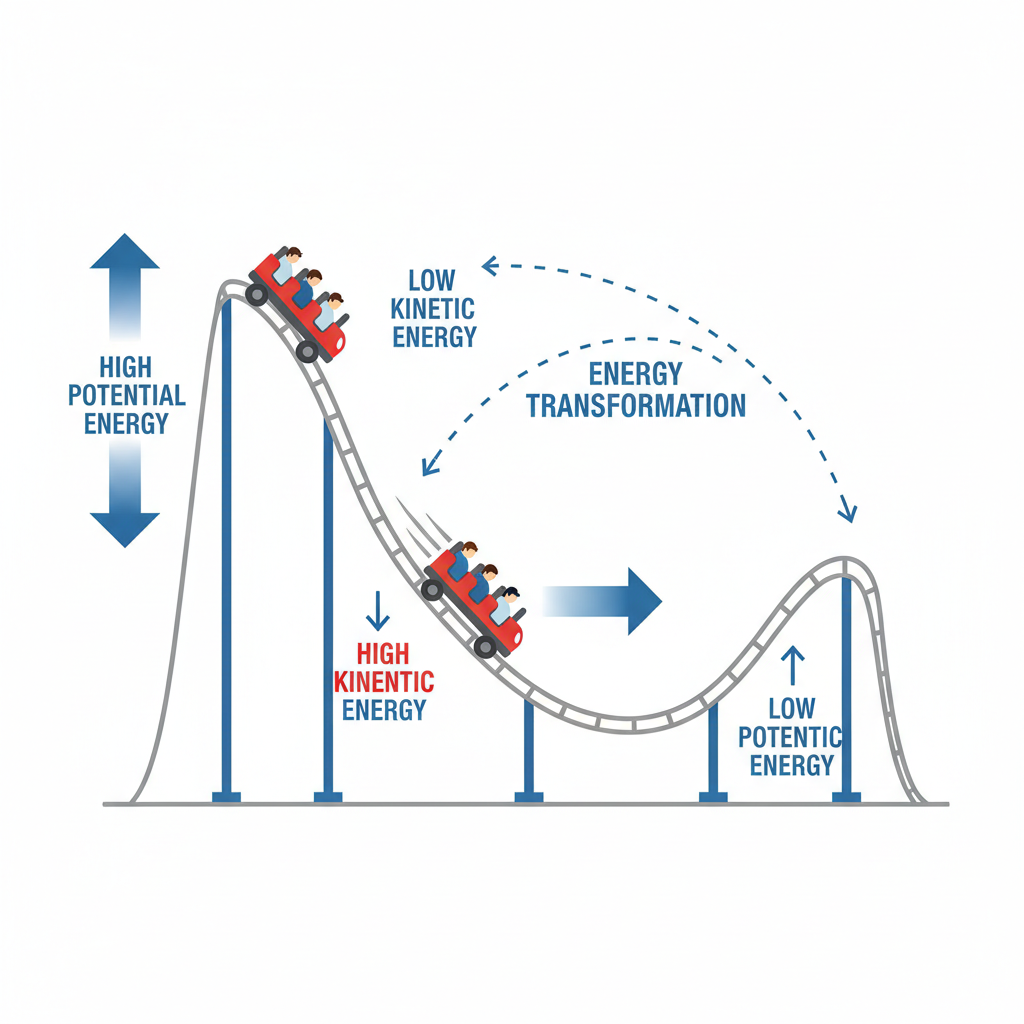
- A Rollercoaster Ride: This is a perfect example! A rollercoaster car is slowly pulled up to the very top of the first big hill. At this peak, it has maximum potential energy and minimum kinetic energy. Then, it's released! As it rushes down the hill, its height decreases rapidly, converting all that potential energy into kinetic energy, making it go super fast. At the bottom of the hill, it has maximum kinetic energy and minimum potential energy. As it climbs the next hill, it slows down as kinetic energy is converted back into potential energy, ready for another thrilling drop!
 ⚠️ This picture may have spelling mistakes. Trust the words in the lesson.
This image perfectly illustrates how potential energy (due to height) at the top of the hill converts into kinetic energy (due to motion) as the rollercoaster car speeds down, and then back into potential energy as it goes up the next hill. The total mechanical energy (KE + PE) remains constant, assuming no energy is lost to friction or air resistance.
Putting It All Together: Why Does This Matter?
Understanding kinetic and potential energy helps us make sense of so many things:
- Designing Safe Cars: Engineers use these principles to design cars that can absorb kinetic energy during a crash to protect passengers.
- Building Power Plants: Hydropower plants convert the potential energy of water stored in reservoirs into kinetic energy as it flows, which then turns turbines to generate electricity.
- Sports: Athletes use potential and kinetic energy in various ways – a high jumper converts kinetic energy from their run into potential energy as they go over the bar, and then back into kinetic energy as they fall.
So, the next time you see something moving, or something perched high up, remember the powerful concepts of kinetic and potential energy at play!
Keep learning, free
Create a free Syllabax account to unlock practice questions and games for this topic.
Visual Learning Enhanced! 🚀
To help you master this topic, we use Advanced Syllabax AI to generate detailed diagrams and visual models.
Note on Visuals: The AI sometimes makes spelling errors in image labels. Please refer to the lesson text for the correct terminology.