Power formula[PHYSICS]
Watch this topic in 60 seconds
Free preview · Lesson 1
Understanding Power formula[PHYSICS]
Unlocking the Power Formula in Physics: How Fast is Work Done?
Welcome, future physicists! Today, we're diving into a fundamental concept in physics: Power. You might use the word 'power' in everyday conversations to describe anything from a powerful car to a powerful speaker. But in physics, 'power' has a very specific and crucial meaning. It tells us not just if work is done, but how quickly that work is accomplished. Think of it as the 'speed' of doing work.
1. What is Work, Again? A Quick Recap
Before we can talk about how fast work is done, we need to remember what work itself means in physics. In simple terms:
- Work (W) is done when a force (F) causes an object to move a certain distance (d) in the direction of the force.
- The formula for work is:
- The standard unit for work is the Joule (J). One Joule is the amount of work done when a force of one Newton moves an object by one meter.
Analogy: Lifting a Backpack
Imagine you lift your heavy backpack off the floor and place it on your desk. You applied a force upwards, and the backpack moved a distance upwards. You did work! If you just held the backpack still, even if it felt tiring, no work (in the physics sense) was done because there was no movement over a distance.
2. The Missing Piece: Why Time Matters
Now, let's bring in the concept of time. Suppose two people, Alex and Ben, both lift the same heavy backpack onto the same desk. According to the physics definition of work, they both do the exact same amount of work, because they applied the same force over the same distance.
However, what if Alex lifts the backpack very quickly, in just 2 seconds, while Ben struggles and takes 10 seconds? Intuitively, we know Alex is more 'capable' or 'efficient' in this task. This 'capability' or 'efficiency' in terms of how quickly work is done is precisely what physics defines as Power.
Analogy: The Marathon Runner vs. The Sprinter
Imagine a marathon runner and a sprinter. Both can run a race, doing work by moving their bodies over a distance. But a sprinter does the work of covering 100 meters much, much faster than a marathon runner would. The sprinter has more power for that short burst of effort because they complete the work in a significantly shorter time.
3. The Power Formula Revealed!
This brings us to the core of our lesson: the power formula! Since power is about the rate at which work is done, it's defined as work divided by time.
Let's break down what each symbol means:
- P stands for Power
- W stands for Work done (in Joules)
- t stands for Time taken (in seconds)
4. Units of Power: Introducing the Watt
Just like work is measured in Joules and time in seconds, power has its own special unit. Since
However, in honor of James Watt, a Scottish inventor who made significant improvements to the steam engine, this unit has a special name:
The standard unit of power is the Watt (W).
1 Watt (W) = 1 Joule per second (J/s)
So, if a machine does 100 Joules of work every second, its power output is 100 Watts. Light bulbs, appliances, and even engines often have their power ratings in Watts (or kilowatts, which are 1000 Watts).
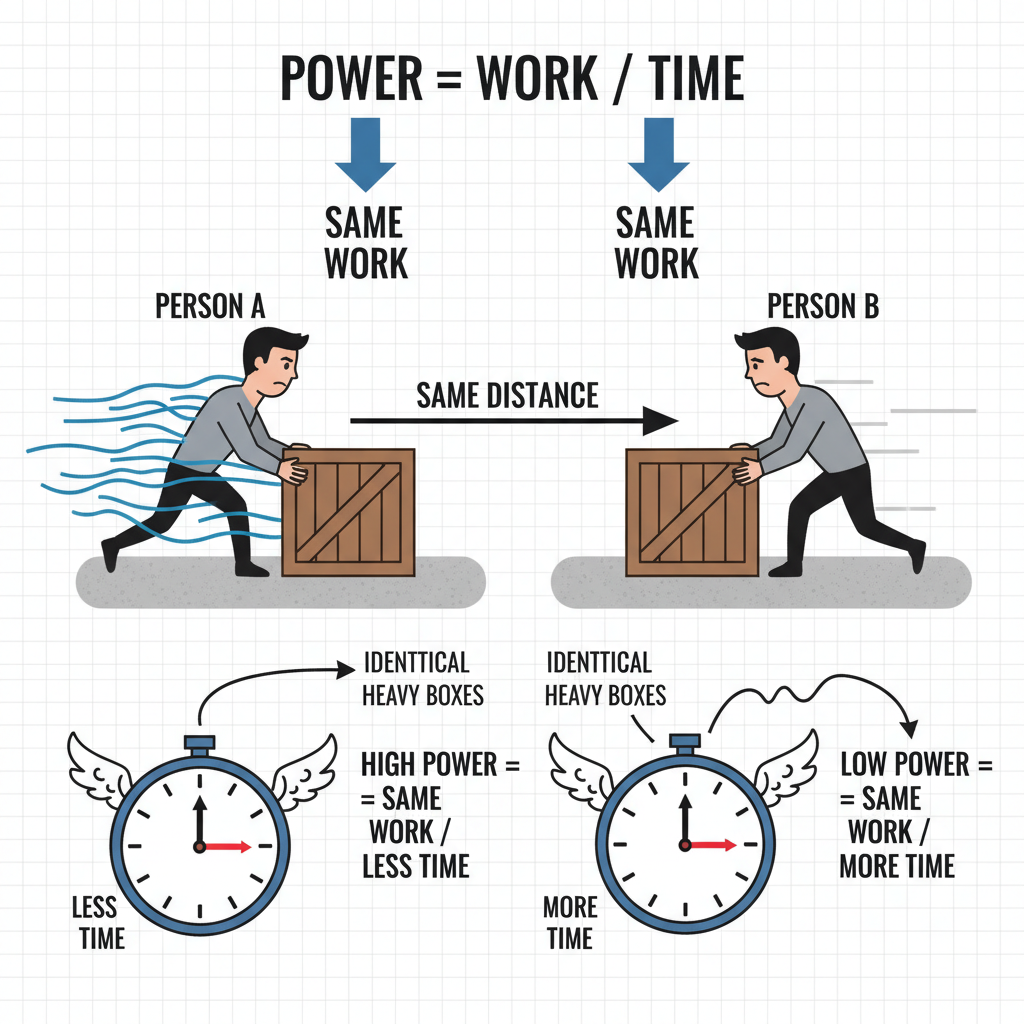 ⚠️ This picture may have spelling mistakes. Trust the words in the lesson.
This image visualizes power: the same amount of work (pushing a box) done in different amounts of time results in different power outputs.
5. Deeper Dive: Understanding the Variables
Work (W)
Remember, work is not just effort. It's effort that results in movement over a distance. If you push against a wall, you're exerting force, but if the wall doesn't move, you're doing zero work in physics. Only when there's displacement in the direction of the force is work done. It's the 'output' of energy transfer.
Time (t)
Time is the duration over which the work is performed. Whether it's 5 seconds, 5 minutes, or 5 hours, this value directly impacts the calculated power. The shorter the time for a given amount of work, the greater the power.
Power (P)
Power, therefore, quantifies how quickly energy is converted or transferred to do work. A high-power device can do a lot of work in a short time, or a moderate amount of work very, very fast.
Analogy: Filling a Bucket with Water
Imagine you need to fill a large bucket with water using a smaller cup. The total amount of water you put in the bucket represents the 'work' done. If you fill the bucket scoop by scoop very quickly, you have a high 'power' output. If you fill it slowly, taking long breaks, you have a low 'power' output, even though the total 'work' (the amount of water in the bucket) is the same in the end.
6. Power in Different Scenarios
Scenario 1: Constant Work, Varying Time
If you perform 500 Joules of work:
- If you do it in 10 seconds:
- If you do it in 5 seconds:
- If you do it in 2 seconds:
Observation: For the same amount of work, less time means more power.
Scenario 2: Constant Time, Varying Work
If you have 5 seconds to do work:
- If you do 100 Joules of work:
- If you do 200 Joules of work:
- If you do 500 Joules of work:
Observation: For the same amount of time, more work means more power.
Example Problem 1: Lifting Weights
A weightlifter lifts a 100 kg barbell from the floor to a height of 2 meters in 3 seconds. Calculate the power generated by the weightlifter.
(Hint: First, calculate the work done. Remember, force needed to lift is the weight of the barbell, which is mass × gravity. Use
Solution:
1. Calculate the Force (Weight):
2. Calculate the Work Done:
3. Calculate the Power:
The weightlifter generates approximately 653.33 Watts of power.
7. Power in Terms of Force and Velocity (Extension)
Sometimes, it's not straightforward to calculate work first. What if an object is moving at a constant speed against a constant force? There's another useful way to express power, which is particularly handy for engines or situations involving constant motion:
We know
So, we can substitute W into the power formula:
Do you notice something familiar in
Therefore, another important formula for power is:
Where:
- P is Power (in Watts)
- F is the applied Force (in Newtons)
- v is the velocity of the object (in meters per second)
This formula highlights that a powerful engine can exert a large force or move something at a very high speed, or both!
Analogy: Car Engine
Think about a car engine. It applies a force to move the car forward at a certain speed (velocity). A more powerful engine can either apply a greater force to accelerate the car faster or maintain a higher speed against resistance (like air drag). So, a powerful engine means it can do more 'work' (move the car) quickly.
8. Key Takeaways and Why Power Matters
Understanding power is crucial because it helps us design and evaluate machines, understand energy efficiency, and compare the performance of various systems. Whether it's about how much electricity an appliance consumes per second, or how quickly an elevator can lift people to the top floor, power is the concept that ties it all together.
Remember, power isn't just about strength; it's about strength applied effectively and efficiently over time!
Keep learning, free
Create a free Syllabax account to unlock practice questions and games for this topic.
Visual Learning Enhanced! 🚀
To help you master this topic, we use Advanced Syllabax AI to generate detailed diagrams and visual models.
Note on Visuals: The AI sometimes makes spelling errors in image labels. Please refer to the lesson text for the correct terminology.