Understanding Sampling Techniques
Watch this topic in 60 seconds
Free preview · Lesson 1
Understanding Understanding Sampling Techniques
Understanding Sampling Techniques: Getting a True Picture!
Have you ever tried to guess what a huge pile of candies tastes like by just eating one? Or maybe you've tried to understand how ALL the students in your school feel about a new rule by only asking your friends? If so, you've already started to think about the big ideas behind 'sampling'! In this lesson, we're going to dive into the world of sampling, which is a super important skill in science, surveys, and even everyday life.
What's the Big Idea? Population vs. Sample
Imagine you want to know the favorite ice cream flavor of everyone in your entire town. That's a lot of people, right? It would take forever and cost a lot of money to ask every single person. This 'everyone in your town' is what we call the Population. A population is the entire group of individuals or objects that you are interested in studying.
Now, instead of asking everyone, what if you just pick a smaller group of people from your town and ask them? Maybe you ask 100 people at the local park, or 50 people from different neighborhoods. This smaller group that you actually talk to, observe, or experiment on, is called a Sample. A sample is a smaller, manageable subgroup chosen from the population.
Think of it like this:
- Population: A giant pot of delicious soup.
- Sample: A single spoonful of that soup you take to taste if it needs more salt.
You hope that your spoonful (sample) gives you a good idea of what the whole pot (population) tastes like. If your spoonful is too salty, you might assume the whole pot is too salty. If your spoonful is perfectly seasoned, you might assume the whole pot is too!
Why Do We Even Need Samples? The Practical Side!
You might be wondering, why don't we just study the whole population every time? Great question! Here are the main reasons why sampling is so crucial:
- Time: It takes a lot of time to collect data from everyone in a large population. Imagine surveying every single high school student in your country!
- Cost: Interviewing, observing, or testing every individual can be incredibly expensive. Think about the resources, travel, and personnel needed.
- Feasibility: Sometimes it's just plain impossible. If you're testing the durability of light bulbs by seeing how long they last, you can't test every single light bulb produced, or you'd have none left to sell!
- Accuracy: Surprisingly, a well-chosen sample can sometimes give more accurate results than trying to study an entire population, especially when the population is very large and difficult to manage. Mistakes are more likely to happen when dealing with vast amounts of data.
How Do We Pick a Good Sample? Basic Sampling Techniques!
The goal of sampling is to pick a sample that is representative of the population. This means the sample should look like a mini-version of the population, having similar characteristics. If your town is 50% male and 50% female, your sample should ideally also be around 50% male and 50% female. If your sample isn't representative, your conclusions might be misleading! Here are some common ways to pick samples:
1. Simple Random Sampling (SRS): The Lottery Ticket Method!
This is the purest form of probability sampling. Every individual in the population has an equal chance of being selected for the sample. It's like putting everyone's name into a giant hat, mixing them up, and then blindly pulling out a certain number of names.
- Analogy: Drawing names from a hat for a prize, or a lottery where every ticket has an equal chance of winning.
- How it works: Assign a unique number to each member of the population, then use a random number generator (like on a calculator or computer) to pick the sample members.
- Best for: Smaller, well-defined populations where you can easily get a list of everyone.
2. Systematic Sampling: The Every 'Nth' Person Method!
In this method, you pick a starting point at random and then select every 'nth' (e.g., every 5th, every 10th) individual from a list.
- Analogy: You're in a line for a roller coaster, and the attendant decides to give a special pass to every 7th person in the line.
- How it works: You get a list of your population (like students in a directory). You decide on a 'sampling interval' (n). For example, if you want 100 students from a list of 1000, your interval is 1000/100 = 10. You randomly pick a starting number between 1 and 10 (say, 3), and then pick the 3rd, 13th, 23rd, 33rd, and so on, students.
- Best for: When you have a complete, ordered list of the population.
3. Stratified Sampling: The Group-Then-Pick Method!
Sometimes, your population has important subgroups (like different grades in a school, or different age groups in a town). Stratified sampling ensures that each of these subgroups is represented proportionally in your sample.
- Analogy: Imagine you want to know students' opinions on school lunch. You know there are 9th, 10th, 11th, and 12th graders. Instead of just picking randomly from everyone, you first divide the school into these four grade levels (strata). Then, you pick a random sample from each grade level. If 9th graders are 30% of the school, then 30% of your sample should be 9th graders.
- How it works: Divide the population into distinct subgroups (strata) based on a shared characteristic (e.g., age, gender, grade level). Then, use simple random sampling within each stratum.
- Best for: When you want to ensure specific subgroups are well-represented in your sample.
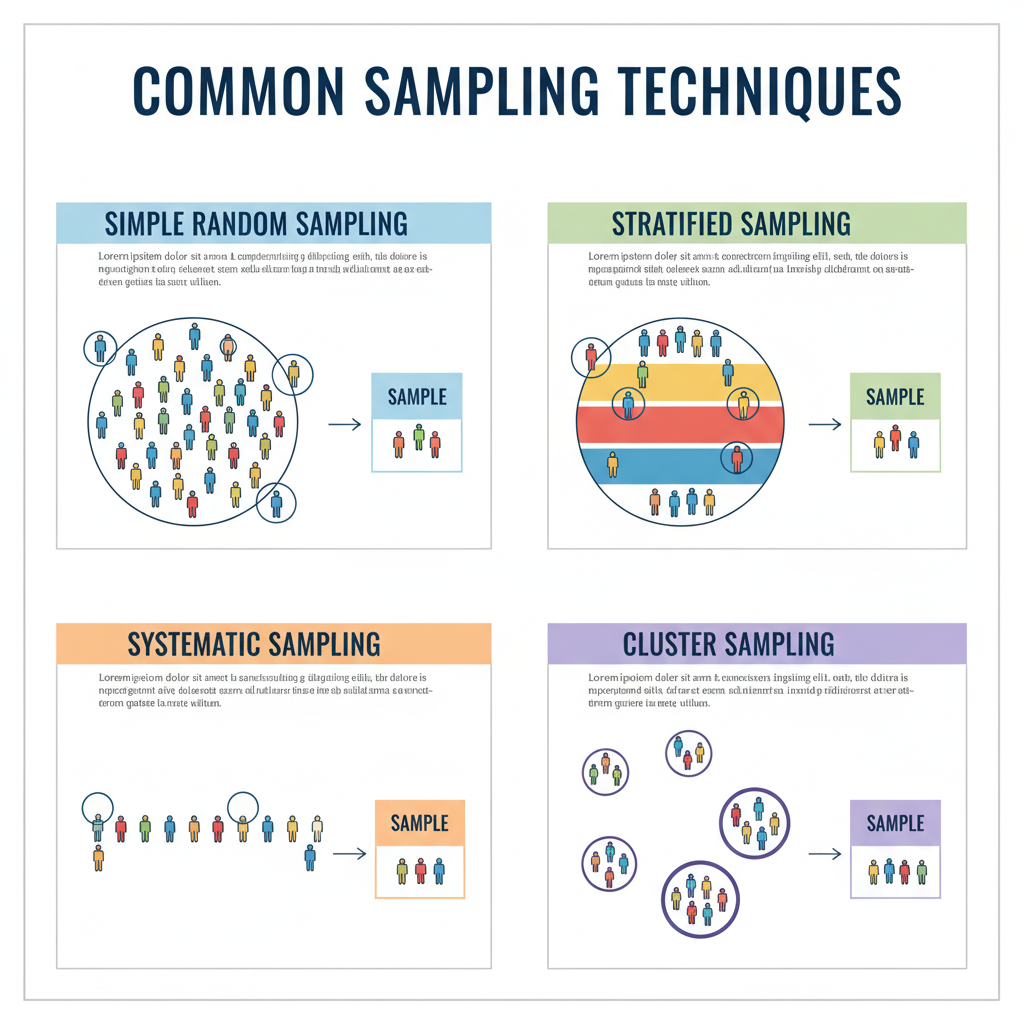
4. Cluster Sampling: The Pick-Whole-Groups Method!
This method is useful when your population is naturally divided into groups (clusters) that are geographically spread out or otherwise naturally separated.
- Analogy: You want to survey high school students in a large state. It would be too much work to go to every single high school. Instead, you randomly pick a few high schools (clusters) and then survey all the students within those chosen high schools.
- How it works: Divide the population into clusters (e.g., schools, neighborhoods, city blocks). Randomly select a few clusters. Then, collect data from all individuals within the selected clusters.
- Best for: Large, geographically dispersed populations where it's impractical to get a list of all individuals.
5. Convenience Sampling: The Easiest Option (But Be Careful!)
This is exactly what it sounds like: you select individuals who are the easiest to reach or most readily available. It's often used when quick, informal data is needed, but it has a big downside.
- Analogy: Standing outside your classroom and asking the first 10 people who walk by for their opinion on a school project.
- How it works: Just pick people who are conveniently accessible.
- Best for: Preliminary studies, quick informal opinions, or when other methods are impossible.
- Be Careful! This method is often NOT representative of the population. The people who are 'convenient' might be very different from the rest of the population, leading to biased (unfair or slanted) results. For example, asking only your friends about a new school rule might not give you the full picture of what the entire student body thinks.
Why Does a Good Sample Matter?
Imagine your spoonful of soup (sample) was only the broth from the top, and not the delicious noodles and vegetables from the bottom! Your taste test wouldn't give you an accurate idea of the whole pot, would it? Similarly, if your sample isn't chosen carefully, your conclusions about the population can be wrong or misleading. This is called bias.
For example, if you want to know how much teenagers use social media, but you only survey kids at a technology club, your results would probably show much higher usage than among all teenagers. That's bias!
Choosing the right sampling technique helps us make informed decisions, understand trends, and draw accurate conclusions about large groups, without having to talk to every single person!
Keep learning, free
Create a free Syllabax account to unlock practice questions and games for this topic.
Visual Learning Enhanced! 🚀
To help you master this topic, we use Advanced Syllabax AI to generate detailed diagrams and visual models.
Note on Visuals: The AI sometimes makes spelling errors in image labels. Please refer to the lesson text for the correct terminology.