Tessellation basics (Patterns in Geometry)
Watch this topic in 60 seconds
Free preview · Lesson 1
Understanding Tessellation basics (Patterns in Geometry)
Tessellation Basics: Patterns in Geometry
Welcome, young mathematicians! Today, we're going to explore a super cool idea in geometry called tessellation. Have you ever looked at a tiled floor, a honeycomb, or even a checkerboard and noticed how the shapes fit together perfectly, with no gaps or overlaps? That's tessellation in action! It's like putting together a giant puzzle made of shapes.
What is a Tessellation?
Imagine you have a bunch of identical shape cookies. A tessellation is when you can arrange these cookies on a plate so that they cover the entire plate without any empty spaces and without any cookies overlapping. It's all about shapes fitting snugly together.
Let's break it down:
- Shapes: Tessellations use geometric shapes. The simplest shapes to use are polygons, which are closed shapes made of straight lines. Think of squares, triangles, and hexagons.
- Fit Together Perfectly: The edges of the shapes meet exactly. There are no tiny holes left over, and no shape sticks out over another. It's like building a wall with bricks – each brick fits neatly next to its neighbors.
- Cover an Area: The arrangement of shapes completely covers a flat surface, like a floor or a wall, without any gaps.
Why are Tessellations Important?
Tessellations are everywhere in the world around us! They aren't just pretty patterns; they have important uses:
- Nature: Look at a honeycomb! Bees build hexagonal cells for their honey. Hexagons are perfect for tessellating because they fit together so efficiently, using the least amount of wax and providing the most storage space.
- Art: Artists have used tessellations for centuries to create stunning designs. M.C. Escher was a famous artist who created mind-bending artworks using tessellations of animals and other figures.
- Architecture and Design: Tiled floors, bathroom walls, and even the patterns on some fabrics are examples of tessellations. They make surfaces look beautiful and can also be very practical, like protecting a floor.
- Science: Understanding how shapes fit together helps scientists design things like solar panels or even think about how molecules arrange themselves.
Common Tessellating Shapes
Some shapes are much better at tessellating than others. Let's look at some common ones:
1. Squares
Squares are one of the easiest shapes to tessellate. Think of a checkerboard or a simple tiled floor. You can place squares side-by-side, and they will fit perfectly without any gaps. If you put four squares together at a point, they form a flat surface. This is because the angles of a square are all 90 degrees, and 90 + 90 + 90 + 90 = 360 degrees. A full circle or a flat surface is 360 degrees, so they meet perfectly!
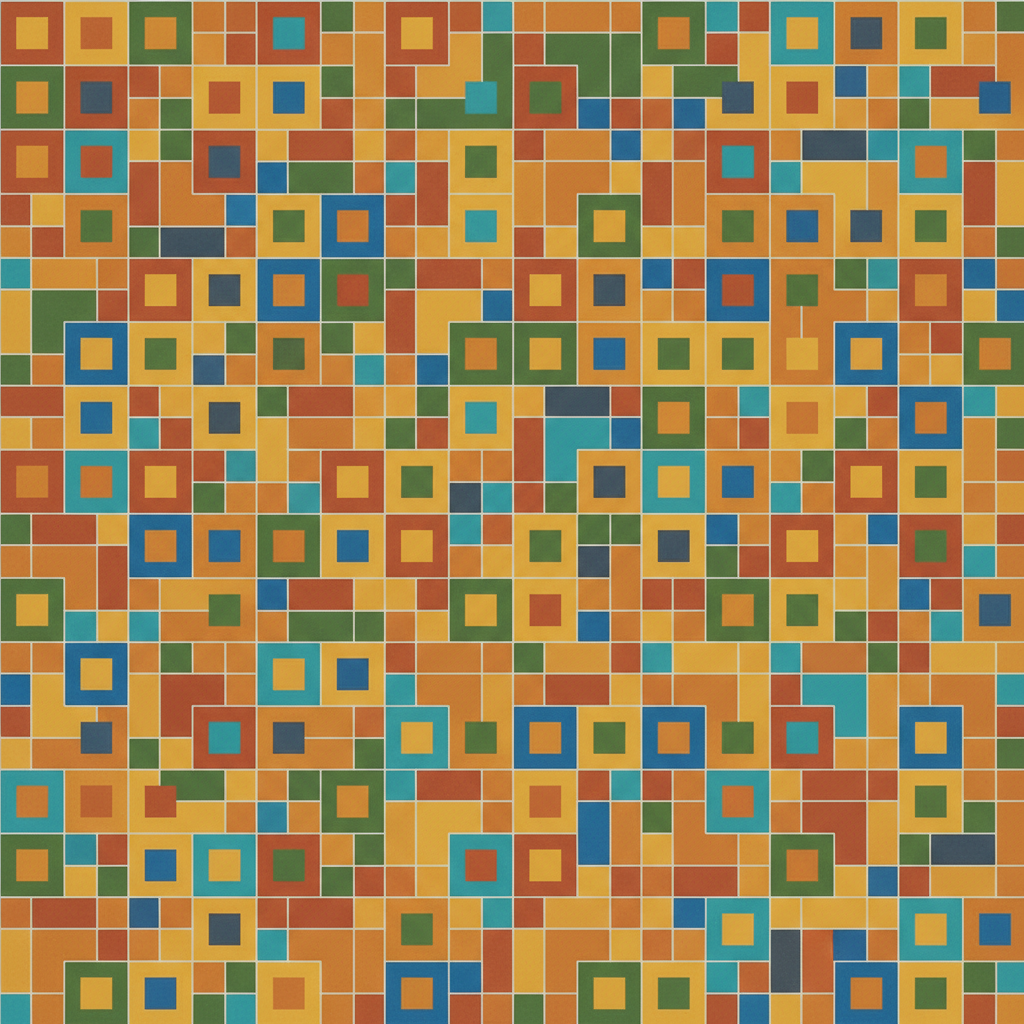 ⚠️ This picture may have spelling mistakes. Trust the words in the lesson.
2. Equilateral Triangles
An equilateral triangle is a triangle with all three sides the same length and all three angles equal. Each angle in an equilateral triangle is 60 degrees. If you put six equilateral triangles together at a single point, their angles add up: 60 + 60 + 60 + 60 + 60 + 60 = 360 degrees. This means they can fit together perfectly to cover a surface!
3. Regular Hexagons
A regular hexagon has six equal sides and six equal angles. Each angle in a regular hexagon is 120 degrees. When you place three regular hexagons together at a point, their angles add up: 120 + 120 + 120 = 360 degrees. This is why hexagons are so common in nature, like in honeycombs! They are very efficient at filling space.
Can Any Shape Tessellate?
Not every shape can tessellate by itself. For example, a regular pentagon (a five-sided shape with equal sides and angles) cannot tessellate on its own. Each angle of a regular pentagon is 108 degrees. If you try to put them together, 108 + 108 + 108 = 324 degrees, which is less than 360. This leaves a gap. You'd need 3.33 pentagons to make 360 degrees, and you can't have a fraction of a shape!
However, sometimes different shapes can be combined to create a tessellation. For example, you can tile a floor with a pattern that uses squares and triangles together, as long as at every corner where shapes meet, the angles add up to exactly 360 degrees.
The Key: Angles Around a Point
The most important rule for a tessellation of identical shapes is that the sum of the angles around any single point where the shapes meet must be exactly 360 degrees. Think of it like a complete turn or a full circle. If the angles add up to less than 360, there's a gap. If they add up to more than 360, the shapes will overlap.
This is why squares (90°), equilateral triangles (60°), and regular hexagons (120°) are so great for tessellating by themselves. They have angles that can perfectly add up to 360°!
Let's Recap!
A tessellation is a pattern made of shapes that fit together perfectly to cover a flat surface with no gaps or overlaps. It's like a beautiful, never-ending puzzle. We've seen how squares, equilateral triangles, and regular hexagons can create amazing tessellations because their angles add up to 360 degrees around any meeting point. Tessellations are all around us, from nature to art to the buildings we live in!
Keep learning, free
Create a free Syllabax account to unlock practice questions and games for this topic.
Visual Learning Enhanced! 🚀
To help you master this topic, we use Advanced Syllabax AI to generate detailed diagrams and visual models.
Note on Visuals: The AI sometimes makes spelling errors in image labels. Please refer to the lesson text for the correct terminology.