Safety measures[CHEMISTRY]
Watch this topic in 60 seconds
Free preview · Lesson 1
Understanding Safety measures[CHEMISTRY]
Safety Measures in Chemistry: Keeping Your Experiments Awesome and Safe!
Welcome to the exciting world of chemistry! Chemistry is all about understanding the stuff that makes up everything around us – from the air you breathe to the snacks you love. While exploring this amazing world, we often perform experiments. Think of experiments like mini-adventures where we mix things, heat things, and observe what happens. But just like any adventure, it's super important to be prepared and know how to stay safe!
Why is Safety So Important in Chemistry?
Imagine you're building with LEGOs. You wouldn't just start stacking pieces randomly, right? You'd want to follow the instructions, make sure the pieces fit, and maybe even ask an adult for help if a step is tricky. Chemistry experiments are similar. We're working with substances that, if not handled carefully, can cause harm. Safety measures are like the rules and tools that protect us from bumps, spills, or anything that could go wrong. They ensure our experiments are fun learning experiences, not scary ones!
Your Lab Coat is Your Superhero Cape! (Personal Protective Equipment - PPE)
When you put on a lab coat, it's like putting on a superhero costume! Its main job is to protect your clothes and your skin from any accidental spills of chemicals. Think of it as a shield for your regular clothes.
Safety Goggles: Protecting Your Precious Eyes!
Your eyes are incredibly important for seeing all the cool reactions happening. Safety goggles are like miniature shields for your eyes. They fit snugly around your eyes to protect them from splashes, fumes, or tiny flying particles that might pop out during an experiment. Never wear regular glasses or contact lenses instead of safety goggles when working with chemicals. If a chemical splashes into your eye, it can cause serious damage. Safety goggles are designed to provide a much better barrier.
Gloves: Keeping Your Hands Happy and Healthy!
Some chemicals can irritate or even burn your skin. Gloves act like a protective layer for your hands, similar to how dishwashing gloves protect your hands when you do chores. You'll often use disposable gloves made of latex or nitrile. Make sure they fit well so you can still handle your equipment properly.
Closed-Toe Shoes: No Sneaky Toes Allowed!
Imagine dropping something heavy on your bare foot. Ouch! In a lab, there's always a chance something might be dropped. Closed-toe shoes protect your feet from spills and falling objects. So, leave the flip-flops and sandals for the beach – in the lab, it's boots or sturdy sneakers!
Tying Back Long Hair: Keep it Out of the Way!
Long hair can be beautiful, but it can also be a hazard in the lab. It can catch fire if you're working near a flame, or it can get caught in equipment. Tying it back securely is like tucking away a loose string so it doesn't get snagged. A hair tie or a hairnet works wonders!
Handling Chemicals: Treat Them with Respect!
Chemicals are the ingredients in our science recipes. Some are harmless, but others need to be treated with great care. Always remember these rules:
- Read the Labels Carefully: Every chemical bottle has a label, like a food package. It tells you what the chemical is and often has warnings about how to use it safely. Don't just grab a bottle; make sure you know what's inside!
- Never Taste or Smell Directly: Imagine smelling a really strong perfume right up close – it can be overwhelming! With chemicals, it's even more important. You should never taste chemicals (that's a big no-no!). To smell a chemical, gently waft the vapors towards your nose with your hand, like you're fanning a scented card.
- Use the Right Amount: Just like you only need a little bit of salt to make food taste good, you usually only need a small amount of a chemical for an experiment. Using too much can be dangerous.
- Dispose of Chemicals Properly: When you're done with a chemical, you can't just pour it down the sink like leftover juice. There are special bins for different types of chemical waste. This is like recycling – it helps keep our environment clean and safe. Your teacher will tell you exactly how to dispose of each chemical.
Working with Equipment: Tools of the Trade!
In chemistry, we use special tools like beakers, test tubes, and Bunsen burners. Knowing how to use them correctly is part of safety.
Heating Things Up Safely:
Sometimes we need to heat chemicals. A Bunsen burner is like a controlled gas flame. You should only use it when instructed and never leave it unattended. Imagine leaving a candle burning without watching it – not a good idea! Always point the opening of a test tube away from yourself and others when heating it, just in case it bubbles over unexpectedly.
Glassware: Be Gentle!
Glassware can break. If you notice any cracks or chips, don't use it! It's like using a mug with a crack – it might break when you put hot liquid in it. Report any broken glass to your teacher immediately. Clean up broken glass very carefully.
Following Instructions: The Experiment's GPS!
Every experiment comes with instructions, like a map for your adventure. Read them carefully *before* you start. Make sure you understand each step. If anything is unclear, ask your teacher. Don't guess – it's better to ask!
Emergency Procedures: What If Something Goes Wrong?
Even with the best safety measures, accidents can sometimes happen. Knowing what to do in an emergency is crucial.
Know the Location of Safety Equipment:
- Eyewash Station: If a chemical gets into your eyes, this is your best friend! It's a special faucet that sprays water to rinse your eyes thoroughly.
- Safety Shower: If a large amount of a chemical spills on your skin or clothes, a safety shower can rinse you off quickly.
- Fire Extinguisher: For small fires, a fire extinguisher can help put them out.
- First-Aid Kit: For minor cuts or burns, a first-aid kit has supplies to help.
Report Accidents Immediately: Even if it seems small, tell your teacher right away if you spill something, get a chemical on your skin, or injure yourself. They know what to do next.
Evacuate if Necessary: If there's a big emergency, like a fire or a large chemical spill, your teacher will tell you to evacuate the room. Follow their instructions calmly and quickly.
General Lab Etiquette: Being a Good Lab Citizen
Being safe in the lab is also about being considerate of others.
- No Food or Drinks: Never eat or drink in the lab. Chemicals can accidentally get into your food or drink, which could make you very sick. Imagine finding a tiny bug in your sandwich – it's gross! Now imagine finding a bit of chemical instead.
- Keep Your Workspace Tidy: A messy workspace is an accident waiting to happen. Keep your bench clear of unnecessary items.
- Wash Your Hands: Always wash your hands thoroughly with soap and water after an experiment, especially before leaving the lab.
- Listen to Your Teacher: Your teacher is the captain of the chemistry ship! Always listen to their instructions and advice.
By following these safety measures, you can explore the fascinating world of chemistry with confidence and have a fantastic time learning!
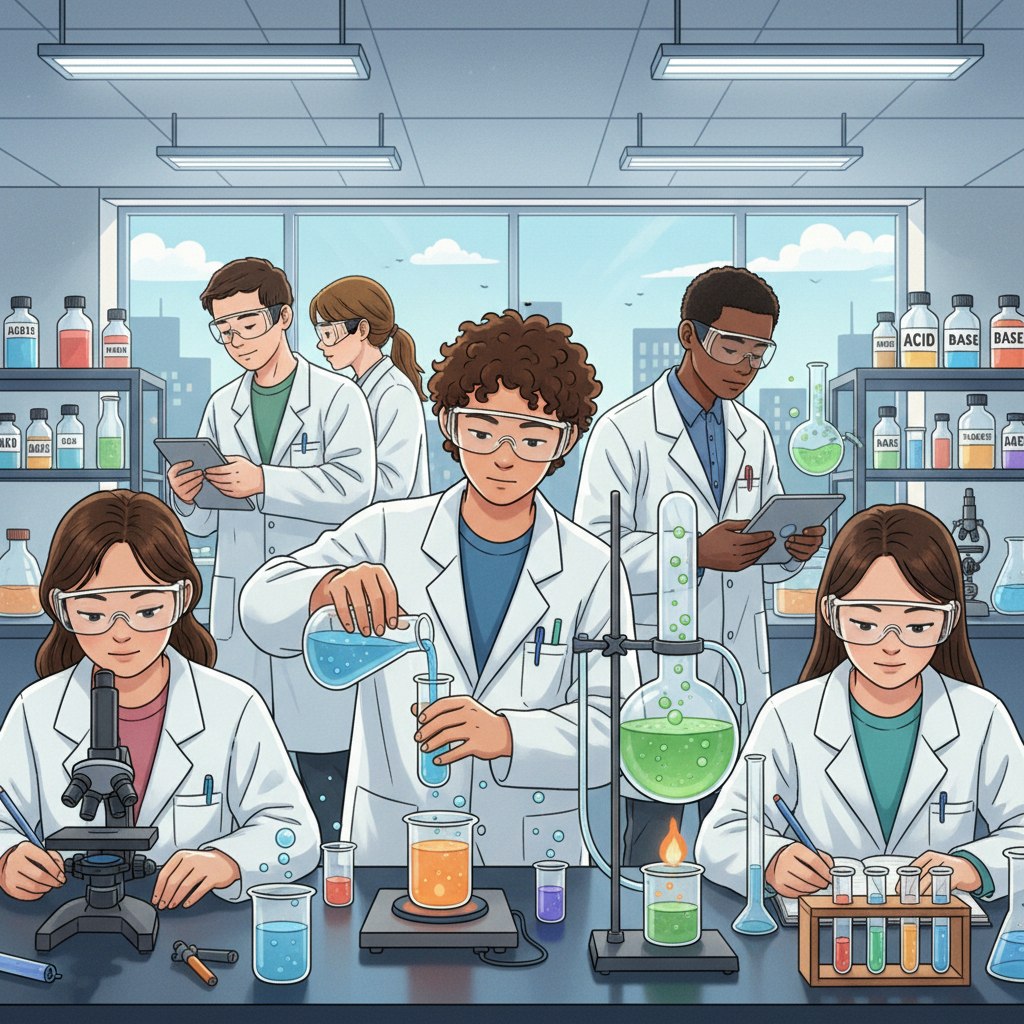 ⚠️ This picture may have spelling mistakes. Trust the words in the lesson.
Keep learning, free
Create a free Syllabax account to unlock practice questions and games for this topic.
Visual Learning Enhanced! 🚀
To help you master this topic, we use Advanced Syllabax AI to generate detailed diagrams and visual models.
Note on Visuals: The AI sometimes makes spelling errors in image labels. Please refer to the lesson text for the correct terminology.