Trapezium and parallelogram (Perimeter & Area)
Watch this topic in 60 seconds
Free preview · Lesson 1
Understanding Trapezium and parallelogram (Perimeter & Area)
Journey into Quadrilaterals: Trapeziums and Parallelograms!
Welcome, young mathematicians! Today, we're going on an exciting adventure to explore two special members of the 'quadrilateral family': the Trapezium and the Parallelogram. Don't worry if these words sound big; we'll break them down into simple pieces, just like building with LEGO bricks!
What are Quadrilaterals Anyway?
Imagine any shape with exactly four straight sides and four corners (or angles). That's a quadrilateral! Think of a square, a rectangle, a kite, or even a wonky table top. They all have four sides. Our focus today will be on two very important types of quadrilaterals.
Analogy: Think of the 'quadrilateral family' like a big family reunion. Everyone has four limbs (sides), but some family members have very specific traits, like always standing up straight (rectangles) or always leaning a bit (parallelograms).
Part 1: The Trapezium (or Trapezoid)
What is a Trapezium?
A Trapezium (pronounced 'trap-ee-zee-um'), sometimes called a Trapezoid in other parts of the world, is a four-sided shape where exactly one pair of opposite sides are parallel. Parallel lines are like two train tracks that run side-by-side forever and never meet, no matter how far they go!
Analogy: Imagine a slide at a playground. The top edge and the bottom edge of the slide are parallel, but the sides where you hold on are usually slanted and would meet if extended. That's a trapezium! Another analogy: Think of a common 'yield' sign on the road – it's often a trapezium (inverted).
Key Features of a Trapezium:
- Parallel Sides (Bases): The two sides that are parallel are called the 'bases' (we often call them Base 1 and Base 2, or 'a' and 'b').
- Non-Parallel Sides (Legs): The other two sides that are not parallel are sometimes called the 'legs'.
- Height (h): This is super important! The height of a trapezium is the perpendicular distance between its two parallel bases. 'Perpendicular' means it forms a perfect 90-degree angle, like the corner of a square.
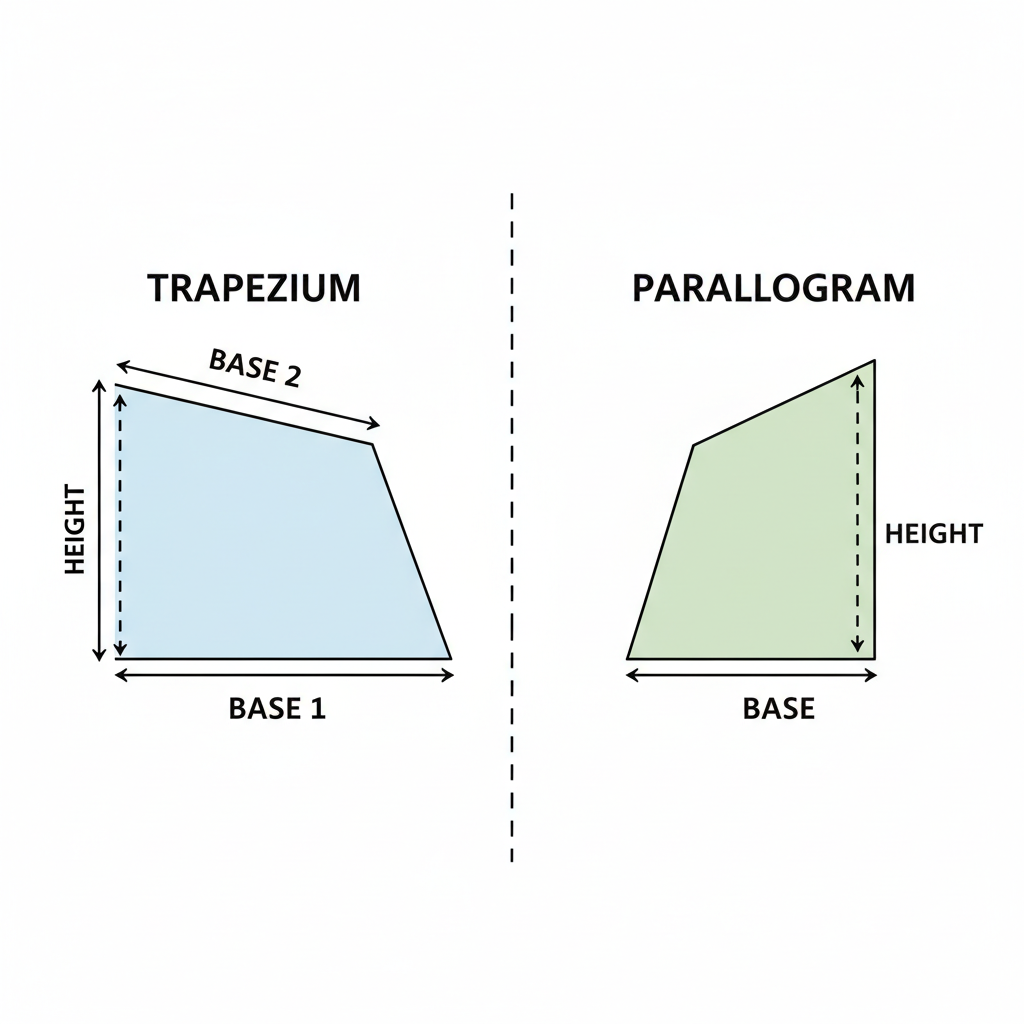 ⚠️ This picture may have spelling mistakes. Trust the words in the lesson.
Perimeter of a Trapezium
The perimeter is like walking all the way around the edge of a shape and measuring the total distance. For any polygon (a shape with straight sides), including a trapezium, finding the perimeter is simply adding up the lengths of all its sides.
If a trapezium has sides with lengths 's1', 's2', 's3', and 's4', then:
Perimeter = s1 + s2 + s3 + s4
Analogy: If you put a fence around a trapezium-shaped garden, the perimeter is the total length of the fence you'd need.
Area of a Trapezium
The area is the amount of flat space inside the shape, like how much carpet you'd need to cover the floor. For a trapezium, the formula for area might look a little tricky at first, but it makes perfect sense when you understand it!
Area = 0.5 * (Base 1 + Base 2) * Height
Or, written using our letters:
Area = 0.5 * (a + b) * h
Why does this work?
Analogy: Imagine you have two identical trapeziums. If you flip one upside down and place it next to the other, they form a parallelogram! The base of this new parallelogram would be (a + b), and its height would be 'h'. The area of this parallelogram would be (a + b) * h. Since we used two trapeziums, the area of just one trapezium is half of that: 0.5 * (a + b) * h. Pretty clever, right?
Another way to think about it: You're finding the 'average' length of the two parallel bases [(a+b)/2] and then multiplying it by the height. It's like turning the trapezium into a rectangle with that 'average' base length!
Part 2: The Parallelogram
What is a Parallelogram?
A Parallelogram (pronounced 'pair-uh-lel-oh-gram') is another four-sided shape, but it's even more special! In a parallelogram, both pairs of opposite sides are parallel. Not just one pair, but both!
Analogy: Think of a rectangle that's been 'pushed over' or 'slanted'. If you imagine a stack of playing cards, and you push the top cards slightly to the side, you get a parallelogram shape. Another common example is the diamond shape on a deck of cards (if it's not perfectly upright).
Key Features of a Parallelogram:
- Parallel Sides: Opposite sides are parallel (this is the definition!).
- Equal Sides: Opposite sides are also equal in length. So, if one side is 5 cm, the side opposite it is also 5 cm.
- Equal Angles: Opposite angles are equal.
- Height (h): Just like with a trapezium, the height of a parallelogram is the perpendicular distance between its parallel bases. It's not necessarily the length of the slanted side!
- Base (b): Any side of the parallelogram can be chosen as the base. The height must be perpendicular to that chosen base.
Perimeter of a Parallelogram
Since opposite sides of a parallelogram are equal, we only need to know the lengths of two adjacent sides to find the perimeter. Let's call the lengths of the two different sides 'L' (length) and 'W' (width, or the adjacent side).
Perimeter = L + W + L + W
Which can be simplified to:
Perimeter = 2 * (L + W)
Analogy: It's exactly like finding the perimeter of a rectangle, even though it's slanted! You're still going along the two long sides and the two short sides. If you were framing a parallelogram-shaped picture, you'd need two pieces of wood for the 'long' sides and two for the 'short' sides.
Area of a Parallelogram
This is where parallelograms become super easy! The formula for the area of a parallelogram is one of the simplest:
Area = Base * Height
Or, written using our letters:
Area = b * h
Analogy: This is a fantastic trick! Imagine you have a parallelogram. You can 'cut off' a right-angled triangle from one end and 'slide' it to the other end. What do you get? A perfect rectangle! The base of this new rectangle is the same as the base of the parallelogram, and its height is also the same. Since the area of a rectangle is length times width (or base times height), the area of the parallelogram is also base times height! It's like magically transforming a slanted shape into a neat, upright one without changing the amount of space it covers.
Keep learning, free
Create a free Syllabax account to unlock practice questions and games for this topic.
Visual Learning Enhanced! 🚀
To help you master this topic, we use Advanced Syllabax AI to generate detailed diagrams and visual models.
Note on Visuals: The AI sometimes makes spelling errors in image labels. Please refer to the lesson text for the correct terminology.