Counting Fun to 10
Watch this topic in 60 seconds
Free preview · Lesson 1
Understanding Counting Fun to 10
Let's Have Counting Fun to 10!
Hello, young mathematicians! Are you ready for some super fun with numbers? Today, we're going on an adventure to learn all about counting, from number 1 all the way to number 10! Counting is like having a superpower that helps you know "how many" of something there are. It's super useful every single day!
What is Counting?
Imagine you have a basket full of yummy apples. If someone asks, "How many apples do you have?", how would you know? You'd count them! Counting means saying numbers one by one as you touch or point to each item. Each item gets its very own number. This is called 'one-to-one correspondence' – fancy words that just mean one number for one thing!
Let's Meet the Numbers!
Number 1: The Lonesome One!
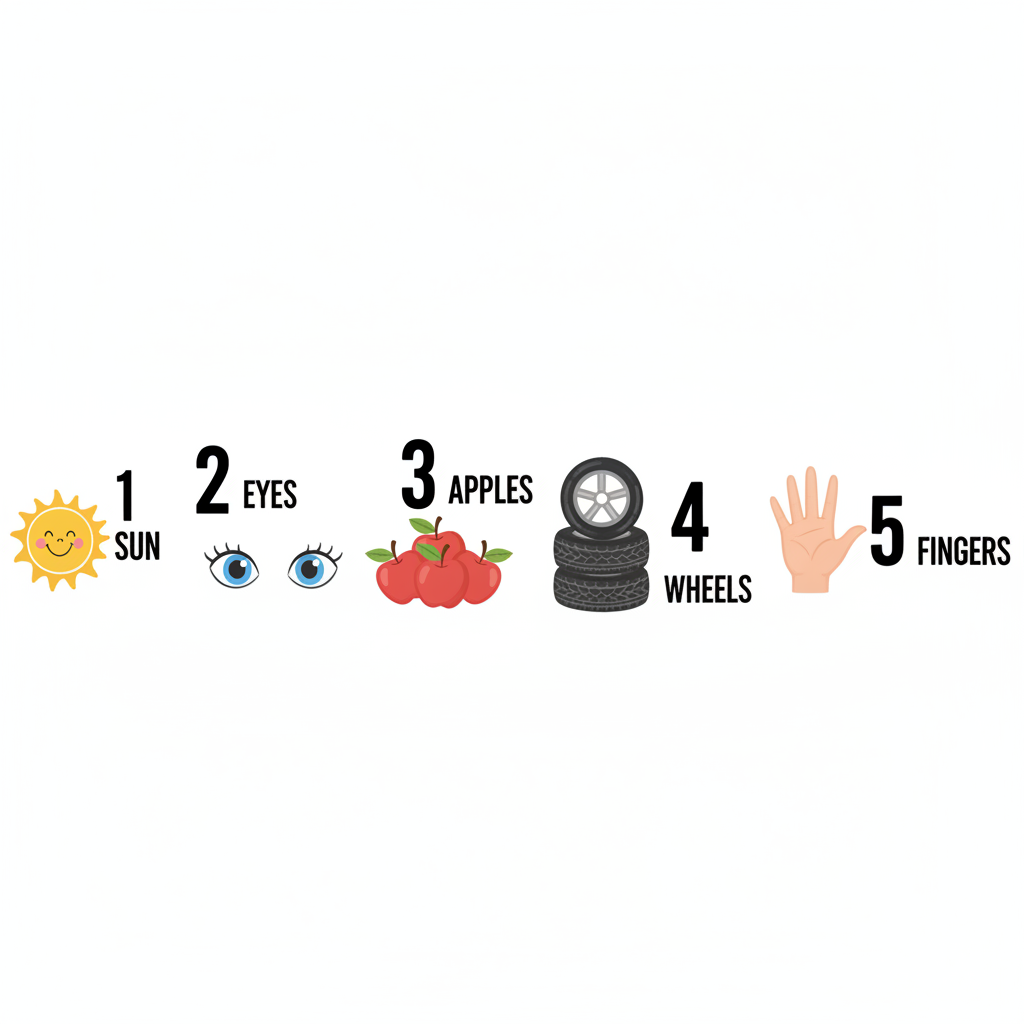
Look around you! What do you see just one of? Maybe you see one sun in the sky, one nose on your face, or one special toy that's your favorite. The number 1 means there's just a single item. It's like having just one super cool cookie!
Analogy: Think of a lone wolf, just one wolf howling at the moon. That's number 1!
Number 2: The Buddy System!
What comes in twos? You have two eyes to see, two ears to hear, and two hands to clap! When you put on your shoes, you put on two shoes, one for each foot. A bicycle has two wheels! The number 2 means you have a pair, like two best friends always together.
Analogy: Like wearing two comfy socks, one for each foot!
Number 3: The Tricycle Trippers!
Do you know what has three wheels? A tricycle! It's a bike for three! Also, a traffic light usually has three colors: red, yellow, and green. The number 3 means you have a small group of three things. Think of three little pigs building their houses!
Analogy: Imagine a yummy ice cream cone with three scoops! Yummy!
Number 4: The Table Talkers!
Look at a table or a chair. How many legs does it have? Usually four! A car has four wheels. Many animals like dogs and cats have four legs. The number 4 means you have a small group of four items. It's like the four corners of a square.
Analogy: A busy little car driving on its four wheels! Vroom vroom!
Number 5: The Handful Helpers!
Hold up one of your hands. How many fingers do you see? That's right, five! The number 5 is super important because we use our fingers to count all the time. A star usually has five points. The number 5 is like having a whole hand full of awesome!
Analogy: Think of a beautiful star with five shining points!
 ⚠️ This picture may have spelling mistakes. Trust the words in the lesson.
Number 6: The Busy Bees!
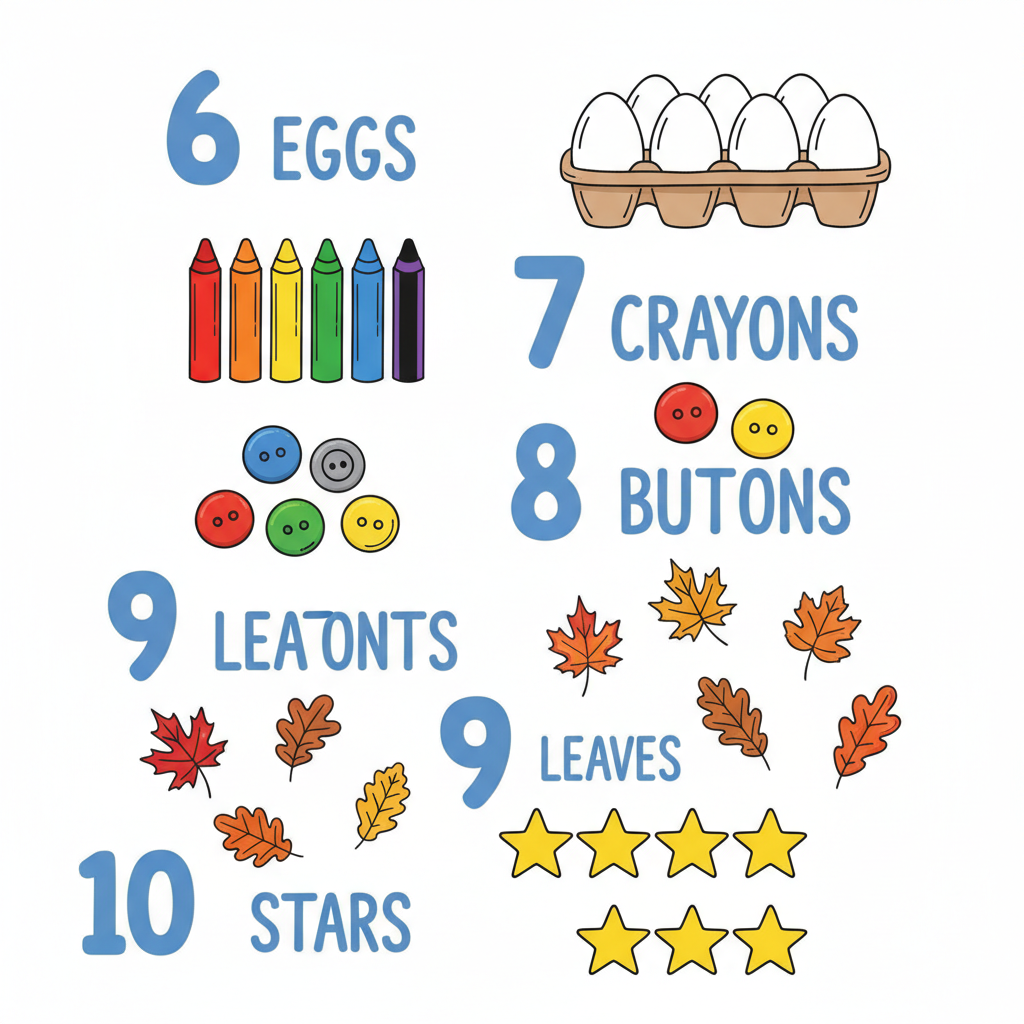
Have you ever seen a ladybug? Many ladybugs have six spots on their back! A dice, which you use to play board games, has sides with up to six dots. The number 6 means you have a group of six. It's like having a special little carton with six eggs inside.
Analogy: Imagine a hexagon, a shape with six straight sides, like a honeybee's comb!
Number 7: The Rainbow Wonders!
After it rains, sometimes we see a beautiful rainbow! Do you know how many colors are in a rainbow? There are seven! Also, there are seven days in a week (Sunday, Monday, Tuesday, Wednesday, Thursday, Friday, Saturday). The number 7 means you have a group of seven special things.
Analogy: Think of the seven days of the week, one for each day until the next one starts!
Number 8: The Spider's Steps!
Can you count how many legs a spider has? It has eight legs! Wow! That's a lot of legs. The number 8 is like having two groups of four. It's almost like having two hands full of fingers if you count your thumbs too (but we're sticking to 5 for now!).
Analogy: Imagine a busy spider carefully walking with its eight legs!
Number 9: The Almost Ten!
The number 9 is just one step away from 10! If you have nine balloons, and you get one more, then you'll have ten! The number 9 is like having almost a full basket of fruit, just one space left. It's a big number that's very close to a round number.
Analogy: Think of a baseball team on the field, with nine players ready to play!
Number 10: The Two-Hand High-Five!
Hold up both of your hands. How many fingers do you have in total? Let's count them: 1, 2, 3, 4, 5, 6, 7, 8, 9, 10! You have ten fingers! And you also have ten toes! The number 10 is a super important number because it's usually how we group things. We count to 10 a lot!
Analogy: Giving a big high-five with both of your hands, using all ten fingers!
 ⚠️ This picture may have spelling mistakes. Trust the words in the lesson.
Putting Counting to Practice!
Now that you know how to count to 10, let's practice! Remember to touch or point to each item as you say its number. This helps you keep track and not count the same thing twice, or miss anything!
- Count the number of windows in your room.
- Count how many pencils you have in your pencil case.
- Count how many steps it takes to get from your bed to your door.
- Count how many red toys you have.
- Count how many fingers and toes you have in total (that's a big one!).
Why is Counting Important?
Counting helps us with so many things every single day!
- When you play with toys, you can count how many blocks you have.
- When you share snacks with friends, counting helps make sure everyone gets the same amount.
- When you get ready for school, you can count how many books are in your backpack.
- When you help in the kitchen, you can count how many plates are needed.
Counting is the first step to becoming a math wizard! Keep practicing, and you'll be a counting champion in no time!
Keep learning, free
Create a free Syllabax account to unlock practice questions and games for this topic.
Visual Learning Enhanced! 🚀
To help you master this topic, we use Advanced Syllabax AI to generate detailed diagrams and visual models.
Note on Visuals: The AI sometimes makes spelling errors in image labels. Please refer to the lesson text for the correct terminology.