Maps: Latitude–Longitude Basics – Indian Geography
Watch this topic in 60 seconds
Free preview · Lesson 1
Maps: Latitude–Longitude Basics – Indian Geography (Foundational)
Maps: Latitude & Longitude Basics - Indian Geography (Foundational)
Hey there, future geographers! Get ready to explore the world – and India specifically – using the magic of maps! Today, we'll learn about two super important lines that help us find any place on Earth: latitude and longitude.
What are Latitude and Longitude?
Imagine Earth has a grid drawn all over it. These lines aren't really there, of course, but they help us pinpoint locations. Think of it like a giant treasure map!
- Latitude: These are lines that run east to west, like belts around the Earth. The most famous latitude line is the Equator, which is at 0 degrees. It divides the Earth into the Northern and Southern Hemispheres. Lines of latitude measure the distance north or south of the Equator.
- Longitude: These are lines that run north to south, like slices of an orange. The most famous longitude line is the Prime Meridian, which is at 0 degrees and runs through Greenwich, England. Lines of longitude measure the distance east or west of the Prime Meridian.
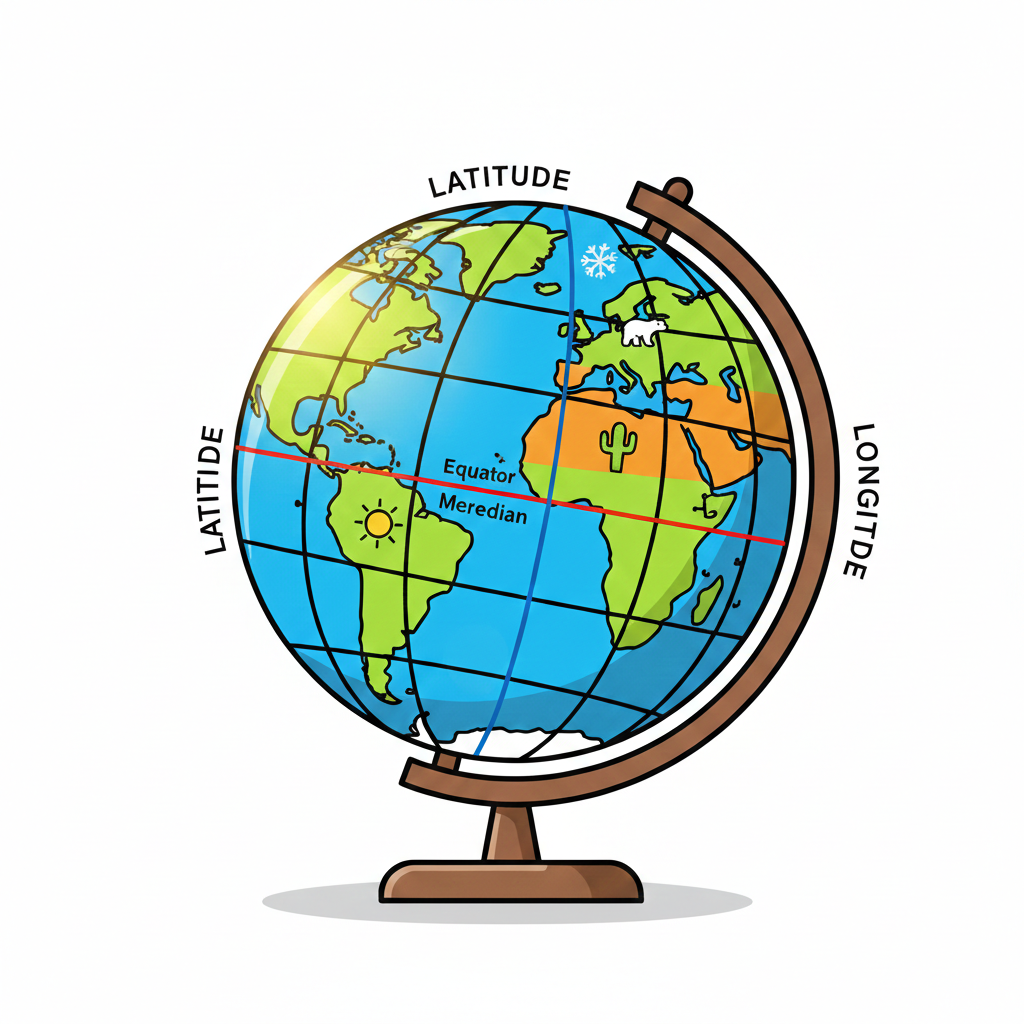 ⚠️ This picture may have spelling mistakes. Trust the words in the lesson.Latitude and Longitude in India
Now, let's focus on India! India is located in the Northern Hemisphere. That means its latitude coordinates will be north of the Equator.
Here's some important info about India's location:
- India's mainland extends between 8°4'N and 37°6'N latitude.
- India's mainland extends between 68°7'E and 97°25'E longitude.
- The Tropic of Cancer passes through the middle of India, dividing the country roughly into two halves.
Key Terms:
- Equator: The imaginary line circling the Earth halfway between the North and South Poles. It is at 0° latitude.
- Prime Meridian: The imaginary line running from the North Pole to the South Pole, passing through Greenwich, England. It is at 0° longitude.
- Tropic of Cancer: The imaginary line of latitude at approximately 23.5 degrees North of the equator.
- Northern Hemisphere: The half of the Earth that is north of the Equator.
- Southern Hemisphere: The half of the Earth that is south of the Equator.
Understanding latitude and longitude is the first step to becoming a map-reading pro! Keep practicing, and soon you'll be able to find any place on Earth!
Keep learning, free
Create a free Syllabax account to unlock practice questions and games for this topic.
Visual Learning Enhanced! 🚀
To help you master this topic, we use Advanced Syllabax AI to generate detailed diagrams and visual models.
Note on Visuals: The AI sometimes makes spelling errors in image labels. Please refer to the lesson text for the correct terminology.