Law of conservation of energy[PHYSICS]
Watch this topic in 60 seconds
Free preview · Lesson 1
Understanding Law of conservation of energy[PHYSICS]
The Law of Conservation of Energy: The Universe's Unbreakable Rule
Welcome, future physicists! Today, we're diving into one of the most fundamental and fascinating concepts in science: the Law of Conservation of Energy. It might sound like a mouthful, but it's actually a super intuitive idea once you get the hang of it. Think of energy as the 'currency' of the universe – it's what makes everything happen, from a car moving to a light bulb glowing, or even your own body staying warm and active. But unlike money, which you can earn or spend, energy in the universe has a very special rule: it can't be created, and it can't be destroyed!
Meet the Main Characters: Kinetic and Potential Energy
Before we fully understand the 'conservation' part, let's get acquainted with two very important types of energy that often play starring roles in many situations:
Kinetic Energy: The Energy of Motion
Imagine a soccer ball rolling across the field, a car speeding down the highway, or even you running to catch a bus. What do all these things have in common? They're moving! Kinetic energy is simply the energy an object has because it's in motion. The faster an object moves, and the more mass it has, the more kinetic energy it possesses. Think of it this way: a tiny pebble rolling slowly doesn't have much kinetic energy, but a huge truck moving at high speed has a tremendous amount!
Potential Energy: The Stored-Up Energy
Now, imagine that same soccer ball, but this time it's sitting motionless at the top of a hill. Or a stretched rubber band held taut. Or water held back by a giant dam. These objects aren't moving yet, but they have the potential to do work or cause motion. This 'stored' energy is called potential energy.
- Gravitational Potential Energy (GPE): This is the energy an object has because of its position, specifically its height above the ground. The higher you lift something, the more gravitational potential energy it gains. Think of a diver standing on a high platform – they have a lot of GPE because of their height.
- Elastic Potential Energy (EPE): This is the energy stored in objects that are stretched or compressed, like a spring, a rubber band, or a bowstring pulled back. When you let go, this stored energy can turn into motion.
 ⚠️ This picture may have spelling mistakes. Trust the words in the lesson.
The Star of the Show: The Law of Conservation of Energy
Now that we know about kinetic and potential energy, we can fully understand the big idea: The Law of Conservation of Energy states that energy cannot be created or destroyed. It can only be transformed, or changed, from one form to another.
Let's use an analogy: Imagine you have a certain amount of money, let's say
Another way to think about it is with LEGO bricks. You start with a box of 100 LEGO bricks. You can build a house, then take it apart and build a spaceship, then take that apart and build a car. The form changes completely, but you still have the same 100 LEGO bricks. You haven't created any new bricks, and you haven't destroyed any either.
Energy Transformations in Action
This idea of energy changing forms is happening all around us, all the time!
1. The Bouncing Ball
Let's drop a ball. When you hold it up, it has maximum gravitational potential energy. As you release it, the GPE starts converting into kinetic energy, and the ball speeds up. Just before it hits the ground, it has maximum KE and minimum GPE. When it hits the ground, the ball briefly deforms (squishes), storing energy as elastic potential energy. Then, this EPE converts back into KE, propelling the ball upwards, where it starts gaining GPE again as it slows down. This cycle of PE → KE → EPE → KE → PE continues, though each bounce is a little lower than the last.
2. The Rollercoaster
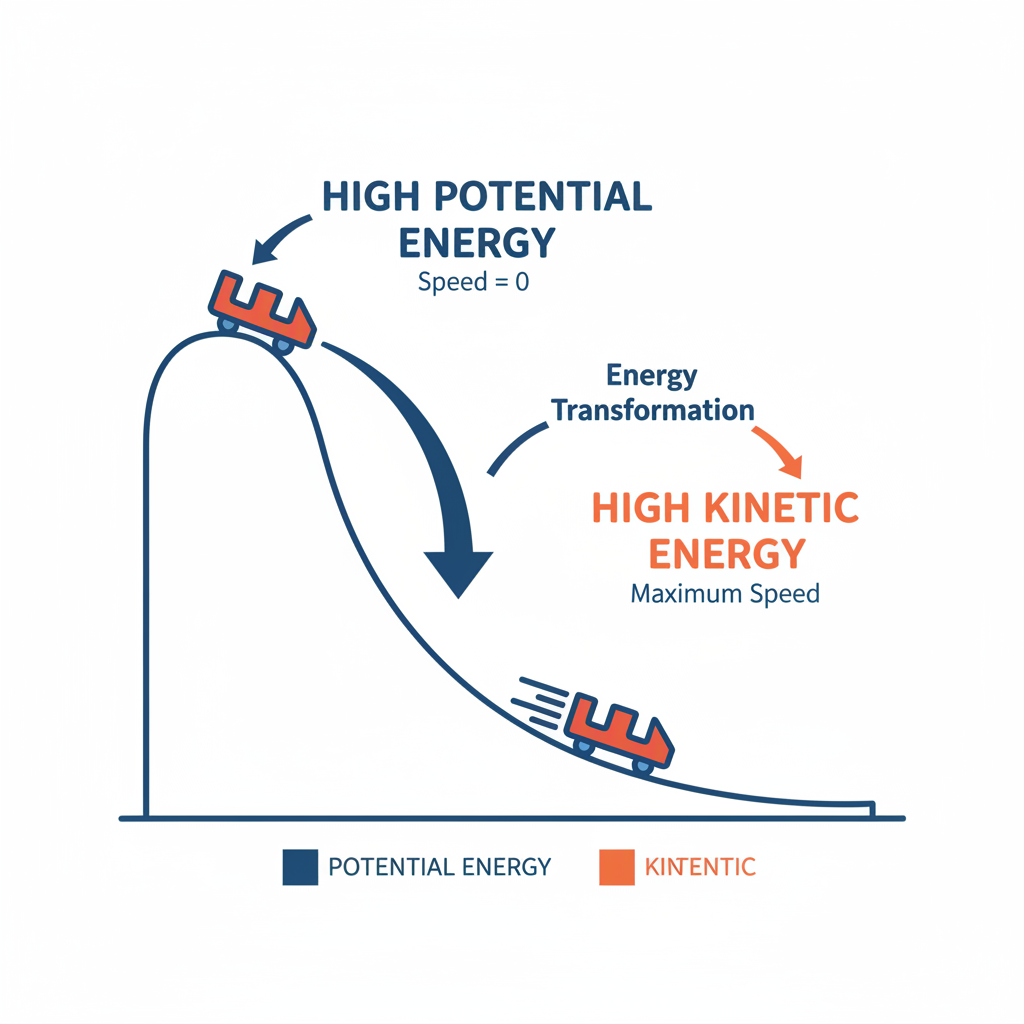
A rollercoaster is a perfect example! As the car is pulled to the top of the first, tallest hill, it gains a huge amount of gravitational potential energy. At the very peak, it has maximum GPE and almost no KE. As it plunges down the hill, its GPE rapidly converts into kinetic energy, making it go incredibly fast. At the bottom of the hill, it has maximum KE and minimum GPE. This KE then carries it up the next hill, converting back into GPE (though often not as high as the first hill).
3. What About Heat and Sound?
You might be thinking, "If energy is always conserved, why does the bouncing ball eventually stop?" or "Why does a rollercoaster eventually need power to keep going?" This is where other forms of energy come into play, particularly heat and sound.
When the ball bounces, or the rollercoaster moves, there's always some friction (resistance between surfaces, like the wheels and the tracks, or the ball and the air). This friction converts some of the mechanical energy (kinetic and potential) into thermal energy (heat) and sound energy. So, while the ball isn't bouncing as high, the 'lost' mechanical energy hasn't vanished! It has simply transformed into heat (making the ball and ground slightly warmer) and sound (the thud you hear). These forms of energy are still energy, and the total amount of energy in the system (ball + ground + air) is still conserved. It just might not be in a form that's useful for the original task (bouncing high).
The "Closed System" Concept
When we talk about energy being conserved, we're often thinking about a "system." A system is simply the part of the universe we're interested in studying (e.g., the ball, the rollercoaster, a specific engine). A closed system (or isolated system) is one where no matter or energy can enter or leave it. In a perfectly closed system, the total amount of energy is always constant.
In the real world, it's very difficult to have a perfectly closed system. Energy often leaks out in the form of heat or sound to the surroundings. For example, your car engine burns fuel (chemical energy) to make the car move (kinetic energy), but a lot of that energy escapes as heat (making the engine hot) and sound. So, while the energy within the engine itself might not be fully conserved in its 'useful' form, if you consider the car, the air around it, and everything else interacting, the total energy of the larger, overall system is still conserved.
Why Does This Matter? Real-World Impacts
The Law of Conservation of Energy isn't just a cool scientific fact; it's a cornerstone of engineering, environmental science, and even biology!
- Power Plants: They don't create electricity; they transform energy from one form (like the chemical energy in coal, or the potential energy of water) into electrical energy.
- Our Bodies: When you eat food, your body breaks it down to release chemical energy. This energy then transforms into the kinetic energy that allows you to move, and thermal energy that keeps you warm.
- Designing Machines: Engineers use this law to design everything from efficient engines to solar panels, understanding how to best transform energy for a specific purpose.
In summary, the Law of Conservation of Energy is a powerful idea. It tells us that energy is a fundamental, unchanging quantity in the universe, simply changing costumes as it performs its endless dance of transformations. Understanding this law helps us make sense of the world around us and design better solutions for the future!
Keep learning, free
Create a free Syllabax account to unlock practice questions and games for this topic.
Visual Learning Enhanced! 🚀
To help you master this topic, we use Advanced Syllabax AI to generate detailed diagrams and visual models.
Note on Visuals: The AI sometimes makes spelling errors in image labels. Please refer to the lesson text for the correct terminology.