Magnetic poles[PHYSICS]
Watch this topic in 60 seconds
Free preview · Lesson 1
Understanding Magnetic poles[PHYSICS]
Understanding Magnetic Poles: The Pushing and Pulling Forces
Imagine you have a toy car that can magically move on its own. Sometimes, it zooms towards you, and other times, it pushes away. Magnets work a bit like that, but instead of magic, they use something called magnetic poles. Let's dive in and discover what these poles are and how they make magnets do their fascinating work!
What is a Magnet?
A magnet is a special object that creates an invisible force field around it. This force field is called a magnetic field. Think of it like a superhero's aura, but instead of looking like light, it's invisible and can push or pull certain materials, especially other magnets and things made of iron, nickel, or cobalt.
The Two Faces of a Magnet: North and South Poles
Every single magnet, no matter how big or small, has two special ends called poles. These poles are like the magnet's two personalities. One pole is called the North Pole (often marked with an 'N'), and the other is called the South Pole (often marked with an 'S').
You can't break a magnet into two separate North and South poles. If you snap a magnet in half, you don't get a North pole and a South pole. Instead, you get two smaller magnets, and each of those smaller magnets will have its own North and South pole!
Analogy: Think of a handshake. You need two hands to shake! Similarly, a magnet needs both a North and a South pole to be a magnet. You can't have just one hand in isolation for a handshake. If you break a magnet, you're just creating more opportunities for handshakes (more North-South pairs).
How Poles Interact: The Rule of Attraction and Repulsion
The most interesting thing about magnetic poles is how they interact with each other. They follow a simple, yet powerful, rule:
- Opposites Attract: When you bring the North Pole of one magnet close to the South Pole of another magnet, they pull towards each other. This is called attraction.
- Likes Repel: When you try to bring two North Poles together, or two South Poles together, they push away from each other. This is called repulsion.
Analogy: Imagine two friends and two strangers.
- Attraction (Opposites Attract): Think of two people who haven't met before but are really excited to meet each other. They will happily walk towards each other for a handshake. That's like a North Pole and a South Pole getting together!
- Repulsion (Likes Repel): Now, imagine two best friends who are so comfortable they don't need to hug or even talk much. They might just stand side-by-side comfortably. However, if you try to force them into a tight hug, they might squirm away because they are too close and want their personal space. That's a bit like two North Poles or two South Poles being pushed apart – they don't want to get too close!
The Invisible Magnetic Field
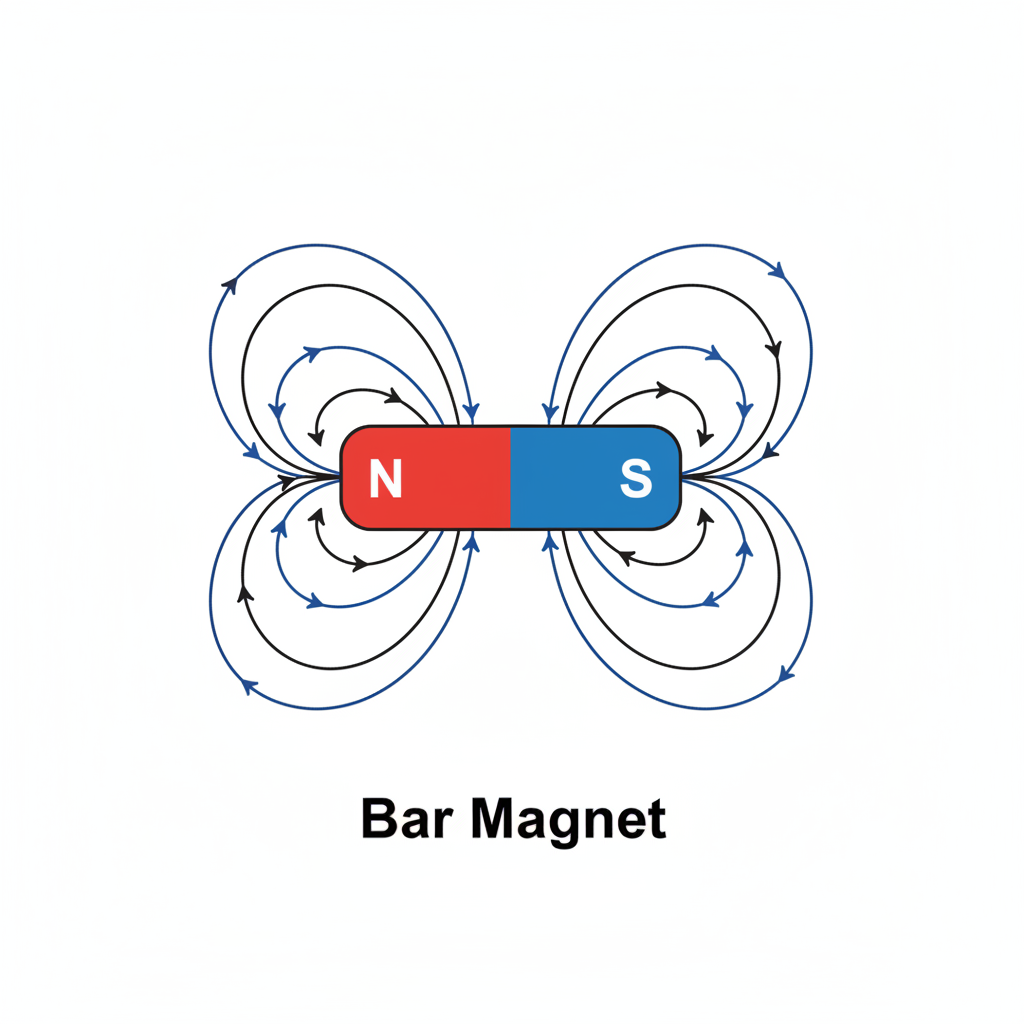
Remember that invisible force field we talked about? That's the magnetic field. We often draw magnetic fields as lines that show the direction of the force. These lines always start at the North Pole and end at the South Pole, going *outside* the magnet. Inside the magnet, the lines go from the South Pole back to the North Pole, forming a complete loop.
Analogy: Think of a crowd at a concert.
- The stage is like the magnet.
- The North Pole is like the main entrance where everyone is eager to get in.
- The South Pole is like the exit, where people leave after the show.
- The magnetic field lines are like the paths people take. They move from the entrance (North) to the exit (South) outside the stage area. Inside the stage area (the magnet itself), the paths lead back from the exit (South) to the entrance (North) to get ready for the next show.
The closer the magnetic field lines are, the stronger the magnetic force is. This means the magnetic force is strongest at the poles.
Why Are Magnetic Poles Important?
Understanding magnetic poles is key to understanding how many things work:
- Compasses: A compass has a small magnet (its needle) that always points towards the Earth's geographic North Pole. This is because the Earth itself acts like a giant magnet with its own magnetic poles! The Earth's magnetic North Pole is actually a magnetic South pole, and the Earth's magnetic South Pole is actually a magnetic North pole. So, the 'N' end of your compass needle (which is a magnetic North pole) is attracted to the Earth's magnetic South pole (which is near the geographic North Pole).
- Electric Motors: Magnets are used in motors to create the spinning motion that powers toys, fans, and many appliances. The pushing and pulling of the magnetic poles make parts of the motor move.
- Data Storage: Technologies like hard drives in computers use magnets to store information.
- Medical Equipment: Powerful magnets are used in MRI (Magnetic Resonance Imaging) machines to see inside the human body.
Summary of Key Concepts
Let's quickly recap the main ideas:
- Magnets have two poles: a North Pole and a South Pole.
- You cannot separate the poles; breaking a magnet creates smaller magnets, each with its own poles.
- Opposite poles attract (North attracts South).
- Like poles repel (North repels North, South repels South).
- The invisible force around a magnet is called the magnetic field, which is strongest at the poles.
Now you know the secret behind how magnets push and pull!
Keep learning, free
Create a free Syllabax account to unlock practice questions and games for this topic.
Visual Learning Enhanced! 🚀
To help you master this topic, we use Advanced Syllabax AI to generate detailed diagrams and visual models.
Note on Visuals: The AI sometimes makes spelling errors in image labels. Please refer to the lesson text for the correct terminology.