Learning Journey
Watch this topic in 60 seconds
Free preview · Lesson 1
Understanding Plant breeding[BIOLOGY]
Understanding Plant Breeding: Making Better Plants!
Have you ever wondered why the fruits and vegetables you eat today look and taste so much better than their wild ancestors? Or how scientists manage to create plants that can survive harsh weather or fight off pesky insects? The answer lies in something called Plant Breeding. Think of plant breeding as a special kind of 'matchmaking' for plants, where humans carefully choose which plants get to have babies, all to make the next generation even better!
For Grade 9, we're going to explore the foundational ideas of plant breeding. We'll keep it simple, use lots of analogies, and understand why this amazing science is so important for feeding the world.
Imagine you're building a LEGO castle. You want it to be tall, strong, and have cool turrets. You wouldn't just grab any random LEGO bricks, would you? You'd pick the specific bricks you need for each part to make your dream castle. Plant breeding works in a very similar way, but instead of LEGOs, we're dealing with living plants and their 'building blocks' called genes.
What is Plant Breeding? The Big Picture
At its heart, Plant Breeding is the science of changing the characteristics (or 'traits') of plants to create desired properties. It’s like being a chef who wants to create the perfect recipe. A chef constantly tries different combinations of ingredients and techniques to make a dish tastier, healthier, or easier to prepare. Plant breeders do the same thing with plants – they try to combine the best 'ingredients' (traits) from different plants to create new, improved varieties.
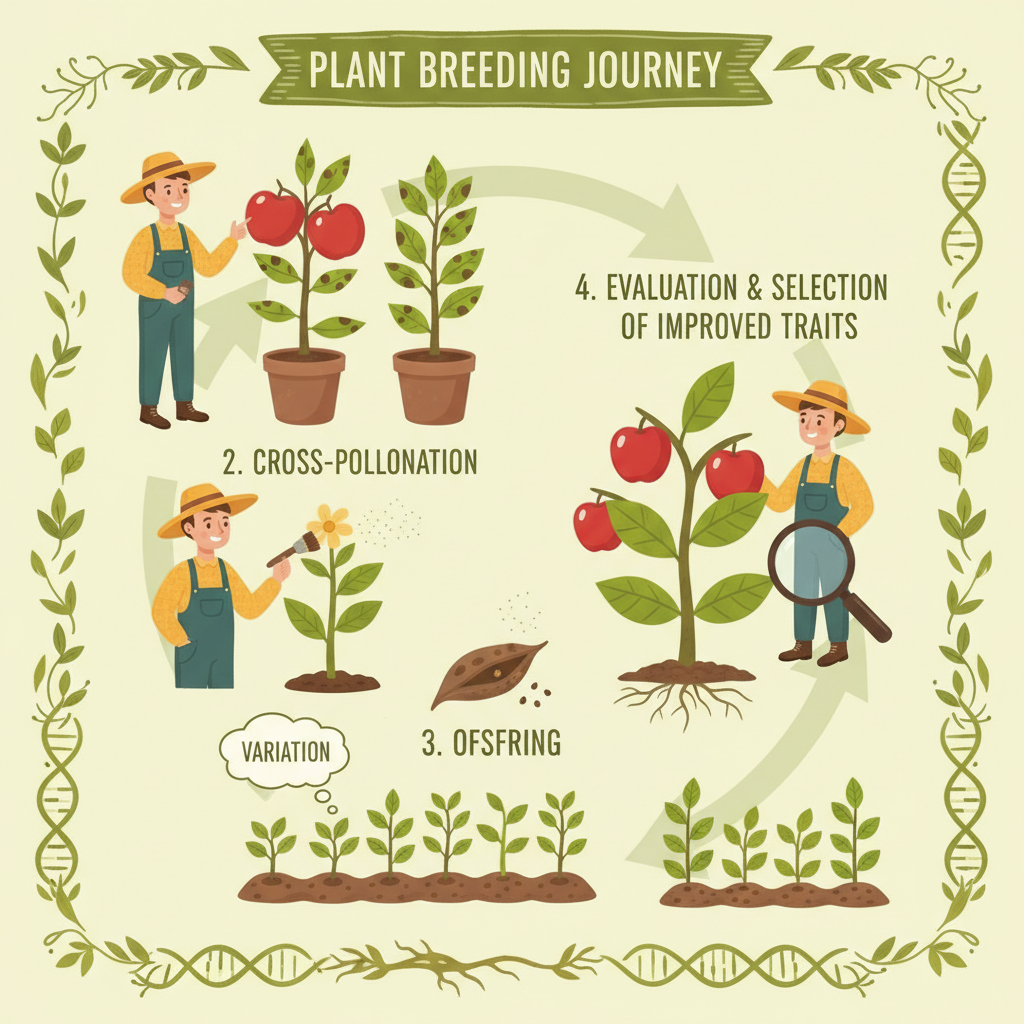 ⚠️ This picture may have spelling mistakes. Trust the words in the lesson.
The 'Blueprint' of a Plant: Genes and Traits
Every plant has a set of instructions, like a detailed blueprint or a secret recipe book, stored inside its cells. These instructions are called genes. Genes determine all the different characteristics of a plant, like how tall it will grow, the color of its flowers, how big its fruits will be, or if it can resist certain diseases.
- Genes: Think of genes as individual instructions or pages in a recipe book. Each page tells the plant how to make something specific, like 'make a red flower' or 'grow a sweet fruit.'
- Traits: Traits are the visible results of these genes. So, a red flower is a trait, and a sweet fruit is a trait. They are what you can see, measure, or observe.
Just like how your hair color or eye color is inherited from your parents, plants also pass on their genes and traits to their offspring. This passing down of characteristics is called heredity.
Why Do We Breed Plants? The Goals!
Plant breeders aren't just doing this for fun! They have very important goals, mostly focused on making our lives better and ensuring we have enough food. Here are some key goals:
- Higher Yield: Imagine a farmer's field. 'Yield' means how much crop the farmer can get from that field. A major goal is to create plants that produce more fruits, vegetables, or grains per plant or per acre. It's like finding a magical recipe that lets you bake twice as many cookies with the same amount of ingredients!
- Disease Resistance: Plants, just like people, can get sick. Diseases caused by fungi, bacteria, or viruses can wipe out entire crops. Plant breeders work to create 'super plants' that are naturally strong and can fight off these diseases, like giving plants an immune system boost.
- Pest Resistance: Pests are annoying insects or other creatures that love to munch on plants. Some plants can be bred to have natural defenses, like producing chemicals that pests don't like, or having tough leaves that are hard to chew. This is like giving the plant its own 'invisible shield' against hungry bugs.
- Improved Quality: This means making plants better in terms of taste, nutrition, size, or even how long they last. Think of a tomato: breeders might want it to be sweeter, juicier, have more vitamins, or stay fresh longer after being picked. It's about perfecting the product for consumers.
- Adaptation to Environment: Some plants struggle in certain conditions, like very dry soil (drought) or very cold weather. Breeders can develop plants that are tougher and can thrive in challenging environments, making them more resilient. This is like creating special 'superhero' plants that can withstand extreme conditions.
How is Plant Breeding Done? Simple Methods
Plant breeding involves a few fundamental techniques that have been used for centuries, along with some newer, advanced ones. For now, let's focus on the basics:
1. Artificial Selection (Choosing the Best)
This is the oldest and most basic form of plant breeding, and humans have been doing it for thousands of years, even before they knew about genes! Artificial Selection means that humans actively choose which plants with desirable traits will be allowed to reproduce and pass on their genes. Nature does a similar thing with 'natural selection,' but with artificial selection, we are doing the choosing.
Analogy: Think about dog breeds. All dogs came from wolves, but humans selected wolves with certain traits (like being friendly or good at hunting) and bred them together. Over thousands of years, this led to the incredible variety of dog breeds we see today – from tiny Chihuahuas to giant Great Danes! Each breed was 'selected' for specific traits. In the same way, if a farmer notices some corn plants in their field produce much larger cobs, they might save the seeds from only those plants to grow next year, hoping their offspring will also have large cobs.
Steps in Artificial Selection:
- Observe: Look at a group of plants and identify the ones with the best traits (e.g., biggest fruit, healthiest leaves).
- Select: Choose only those superior plants.
- Reproduce: Collect seeds or cuttings from the selected plants and use them to grow the next generation.
- Repeat: Keep doing this over many generations, and slowly, the desired traits will become more common in your plants.
2. Hybridization (Mixing and Matching)
Sometimes, a single plant doesn't have all the amazing traits you want. Maybe one type of apple tree produces super sweet apples, but it's very vulnerable to disease. Another type of apple tree might be incredibly tough and disease-resistant, but its apples are a bit bland. What if you could combine the best features of both?
This is where Hybridization, also known as cross-breeding, comes in! It's the process of crossing two genetically different parent plants to create offspring (called 'hybrids') that have a combination of traits from both parents.
Analogy: Imagine you have two different colors of paint – a vibrant blue and a sunny yellow. If you mix them together, you get a beautiful green! Hybridization is like mixing the 'genetic paint' of two parent plants to get a new plant with a blend of their characteristics. Or, think of a hybrid car that combines the fuel efficiency of an electric motor with the power of a gasoline engine – you get the best of both worlds!
How it works (simply):
- A plant breeder takes pollen (the male part) from one parent plant (let's call it Parent A) that has a desired trait (e.g., disease resistance).
- They transfer this pollen to the flower of another parent plant (Parent B) that has a different desired trait (e.g., sweet fruit).
- Parent B's flower is then pollinated, and it produces seeds.
- These seeds, when planted, grow into hybrid plants that might carry both the disease resistance from Parent A and the sweet fruit trait from Parent B!
Often, these hybrid plants can be even better than either parent, a phenomenon sometimes called 'hybrid vigor.' They might grow faster, be stronger, or produce more. It’s like when two really talented musicians combine their skills to create a song that’s even more incredible than what they could make alone.
The Importance of Plant Breeding for Our Future
Plant breeding isn't just an interesting science; it's absolutely crucial for humanity. As the world's population grows, we need to produce more food on the same amount of land, often with fewer resources and in changing climates. Plant breeding helps us achieve this by:
- Increasing food supply globally.
- Making crops more resilient to climate change, diseases, and pests.
- Improving the nutritional value of our food, making us healthier.
- Reducing the need for harmful pesticides by developing naturally resistant plants.
So, the next time you bite into a juicy apple, a crisp cucumber, or a fluffy slice of bread, take a moment to appreciate the hard work of plant breeders. They are the unsung heroes who are constantly working behind the scenes to make our food system better, healthier, and more sustainable!
Keep learning, free
Create a free Syllabax account to unlock practice questions and games for this topic.
Visual Learning Enhanced! 🚀
To help you master this topic, we use Advanced Syllabax AI to generate detailed diagrams and visual models.
Note on Visuals: The AI sometimes makes spelling errors in image labels. Please refer to the lesson text for the correct terminology.