Learning Journey
Watch this topic in 60 seconds
Free preview · Lesson 1
Understanding Finding the Least Common
Finding the Least Common Multiple (LCM): Your Guide to Shared Jumps!
Hey there, awesome 5th graders! Have you ever tried to meet a friend at a specific spot, but you both started from different places? Or maybe you have two different types of toys, and you want to find the first time they line up perfectly? That's a bit like what we do when we 'find the least common'!
What Does 'Common' Mean Anyway?
Think about the word 'common'. If you and a friend both love pizza, that's a common interest. It means you share it! In math, 'common' means something that two or more numbers share. When we talk about 'Least Common Multiple', we're looking for a number that two (or more) numbers share, and it's the smallest one they share.
Part 1: Meeting Multiples!
Before we jump into 'common', let's talk about 'multiples'. Multiples are like jump-counting! If you start at 0 and jump by 3s, you'd land on 3, 6, 9, 12, 15, and so on. These numbers are the multiples of 3.
- Multiples of 2: 2, 4, 6, 8, 10, 12, 14, 16, 18, 20... (Like counting by 2s)
- Multiples of 3: 3, 6, 9, 12, 15, 18, 21, 24, 27, 30... (Like counting by 3s)
- Multiples of 5: 5, 10, 15, 20, 25, 30, 35, 40, 45, 50... (Like counting by 5s)
Imagine you have two friends, Ana and Ben. Ana jumps every 2 steps, and Ben jumps every 3 steps. They start at the same spot. Where will they land at the same time?
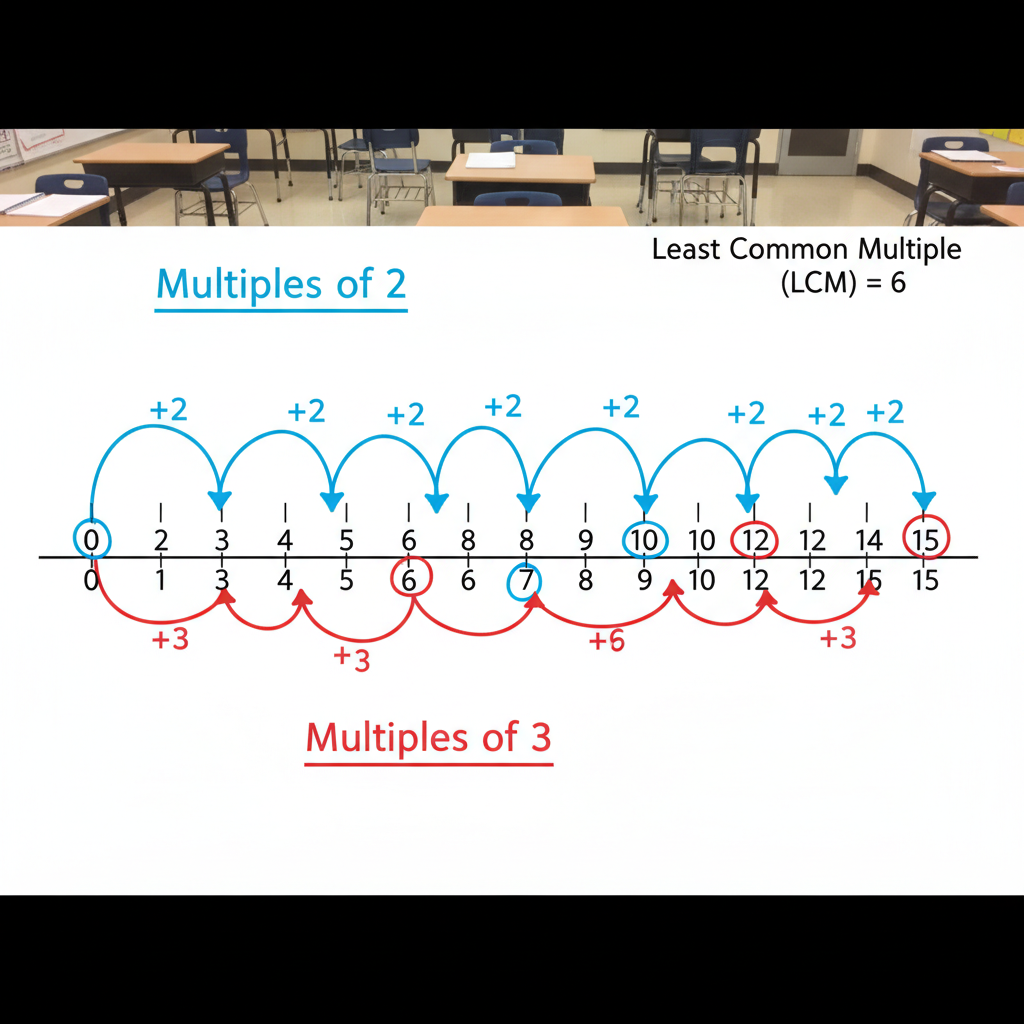 Part 2: Finding Common Multiples (Shared Jumps!)
Now, let's bring 'common' and 'multiples' together. A Common Multiple is a number that is a multiple of two or more different numbers. It's like those shared jumps for Ana and Ben!
Let's look at the multiples of 2 and 3 again:
- Multiples of 2: 2, 4, 6, 8, 10, 12, 14, 16, 18, 20...
- Multiples of 3: 3, 6, 9, 12, 15, 18, 21, 24, 27, 30...
Can you see any numbers that show up in BOTH lists? Yes! 6, 12, 18, and so on. These are the common multiples of 2 and 3.
Think of it like two different gear wheels turning. The common multiples are the points where the same 'tooth' on each gear would line up again after a full rotation, if you marked a starting point on each.
Part 3: The LEAST Common Multiple (The Very First Shared Jump!)
You found lots of common multiples for 2 and 3 (6, 12, 18...). But what's the smallest one? It's 6! This is called the Least Common Multiple (LCM).
The Least Common Multiple (LCM) is the smallest number (not zero) that is a multiple of two or more numbers. It's the first time Ana and Ben land on the same spot after starting their jumps!
Why is the LCM important? (It helps with fractions!)
The LCM is super helpful, especially when you need to add or subtract fractions with different denominators (the bottom numbers). To do that, you need to make the denominators the same, and the LCM tells you the best, smallest number to change them into!
How to Find the LCM: A Simple Recipe!
Let's find the LCM of 4 and 6.
- Step 1: List the Multiples!
- Start by listing out the first few multiples for each number. Keep going until you see a number that appears in all lists.
- Multiples of 4: 4, 8, 12, 16, 20, 24, 28...
- Multiples of 6: 6, 12, 18, 24, 30, 36...
- Step 2: Find the Common Multiples!
- Look at your lists. Which numbers show up in BOTH lists?
- For 4 and 6, we see 12, 24, and more if we kept listing!
- Step 3: Pick the LEAST (Smallest) One!
- Out of the common multiples you found, which one is the smallest?
- For 4 and 6, the common multiples are 12, 24... The smallest is 12!
- So, the LCM of 4 and 6 is 12.
Another Example: Finding the LCM of 3 and 5
- Step 1: List the Multiples!
- Multiples of 3: 3, 6, 9, 12, 15, 18, 21, 24, 27, 30...
- Multiples of 5: 5, 10, 15, 20, 25, 30, 35, 40, 45, 50...
- Step 2: Find the Common Multiples!
- We see 15, 30...
- Step 3: Pick the LEAST One!
- The smallest common multiple is 15.
- So, the LCM of 3 and 5 is 15.
Let's Recap!
Finding the Least Common Multiple (LCM) is like finding the first time two friends jumping at different rhythms will land on the same spot. You list all their jumps (multiples), find the spots they share (common multiples), and then pick the very first spot they share (the least common multiple).
Keep practicing, and you'll be a master of finding shared jumps in no time!
Keep learning, free
Create a free Syllabax account to unlock practice questions and games for this topic.
Visual Learning Enhanced! 🚀
To help you master this topic, we use Advanced Syllabax AI to generate detailed diagrams and visual models.
Note on Visuals: The AI sometimes makes spelling errors in image labels. Please refer to the lesson text for the correct terminology.